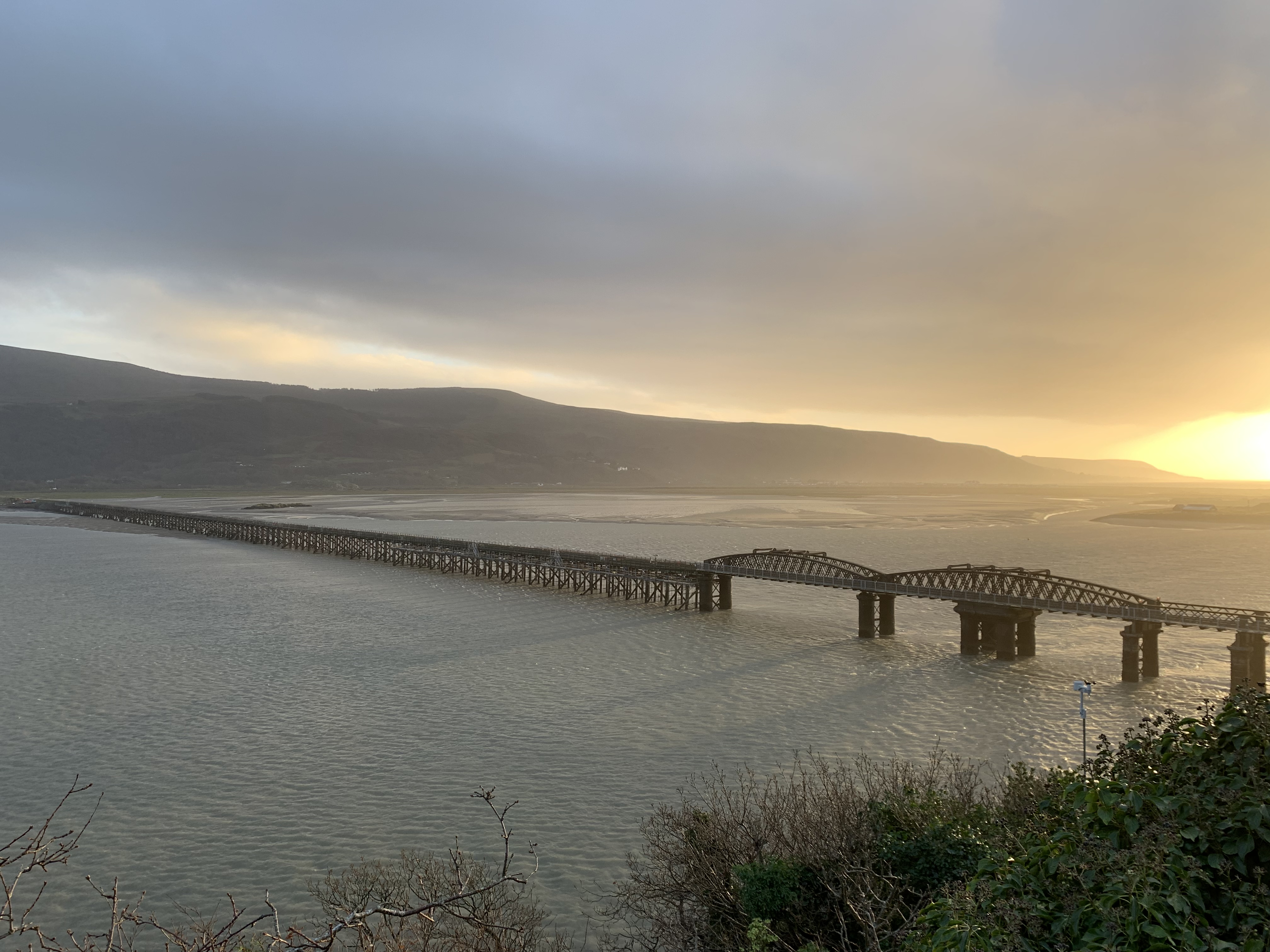
Barmouth Bridge
A train crosses the Mawddach estuary at walking pace, 900 yards of single track laid across 113 wooden trestles supported by cast iron piers. This is Barmouth Bridge, the longest timber viaduct in Wales and one of the oldest still in regular use anywhere in Britain. Since 1867 it has carried the Cambrian Coast Line across one of the most beautiful river mouths in the country, and for most of that time somebody has been trying to close it, tear it down, or let it rot. So far, the bridge has outlasted them all.
Built for a Railway That Nearly Wasn't
The Aberystwyth and Welsh Coast Railway authorized the bridge in 1861 and began construction in 1864. Spanning the broad Mawddach estuary between Barmouth to the north and Morfa Mawddach near Arthog to the south, the bridge sits within both a Site of Special Scientific Interest and Snowdonia National Park. Horse-drawn carriages began crossing on 3 June 1867, and steam services followed on 10 October. To allow tall sailing ships to pass, the original design incorporated a drawbridge section, later replaced by a swing bridge between 1899 and 1902. The timber section alone stretches 699 meters, built atop a gravel bed covered by shifting sand, with water flowing through the northern channel at up to nine knots.
A Mine, Some Worms, and a Fire
The bridge has survived threats that would have finished lesser structures. In 1946, a live naval mine washed past one of the pillars during a storm but failed to detonate. By 1980, marine woodworm -- Teredo navalis, the shipworm that has plagued timber structures since the age of sail -- had eaten into 69 of the supporting pillars at riverbed level. British Rail divers estimated repairs at 2.5 million pounds. The viaduct closed to rail traffic on 13 October 1980, and there was serious talk of permanent demolition. Gwynedd County Council fought to save it, arguing that 40 percent of local tourism was rail-dependent. The bridge reopened in April 1986 after extensive repairs, though with weight restrictions and a ban on locomotive-hauled trains. In October 2016, a fire on the structure closed it for a week, prompting fresh calls for urgent renovation.
The Troll Under the Bridge
Pedestrians and cyclists share the bridge via a footpath on its eastern side, part of National Cycle Route 8 linking Cardiff to Holyhead. Tolls were collected for foot and cycle traffic until 2013, when the collectors simply left and were not replaced. Gwynedd Council, struggling to cover the 30,800-pound annual maintenance contribution to Network Rail, considered closing the footpath entirely. A petition against closure attracted 20,000 signatures in a single week, and in February 2016 the council backed down. In late 2017, someone had the inspired idea of introducing an "honesty toll" of one pound for adults and 50 pence for children, complete with a troll mascot. The old toll house was rebranded as a "troll house," adding a touch of whimsy to a structure that has spent most of its existence fighting for survival.
Thirty Million Pounds of Faith
The bridge's most recent and most expensive restoration began in 2020, when Network Rail committed 30 million pounds to a multi-year project. The work required three separate seasonal closures, the last running from autumn through December 2023. On 2 December 2023, the track reopened, and a formal ceremony the following Friday drew the Wales Office minister, a Senedd member, the mayor of Barmouth, and representatives of Network Rail and its engineering contractors. The swing-bridge mechanisms were not restored during this refurbishment, ending the bridge's ability to open for tall ships. But the timber trestles were renewed, the ironwork strengthened, and the line secured for the foreseeable future. The viaduct had celebrated its 150th anniversary in October 2017 with fireworks and charter trains. At 156 years old and counting, it remains the most improbable piece of railway engineering in Wales.
From the Air
Located at 52.72N, 4.04W across the Mawddach estuary. The bridge is a striking visual feature from the air -- a long, thin line of timber trestles crossing open water with the mountains of Snowdonia as a backdrop. Barmouth town is to the north, with Cadair Idris visible to the south. Nearest airports: Llanbedr airfield (EGOD) approximately 10nm north. Recommended altitude: 1,500-2,500 ft for dramatic views of the estuary crossing.