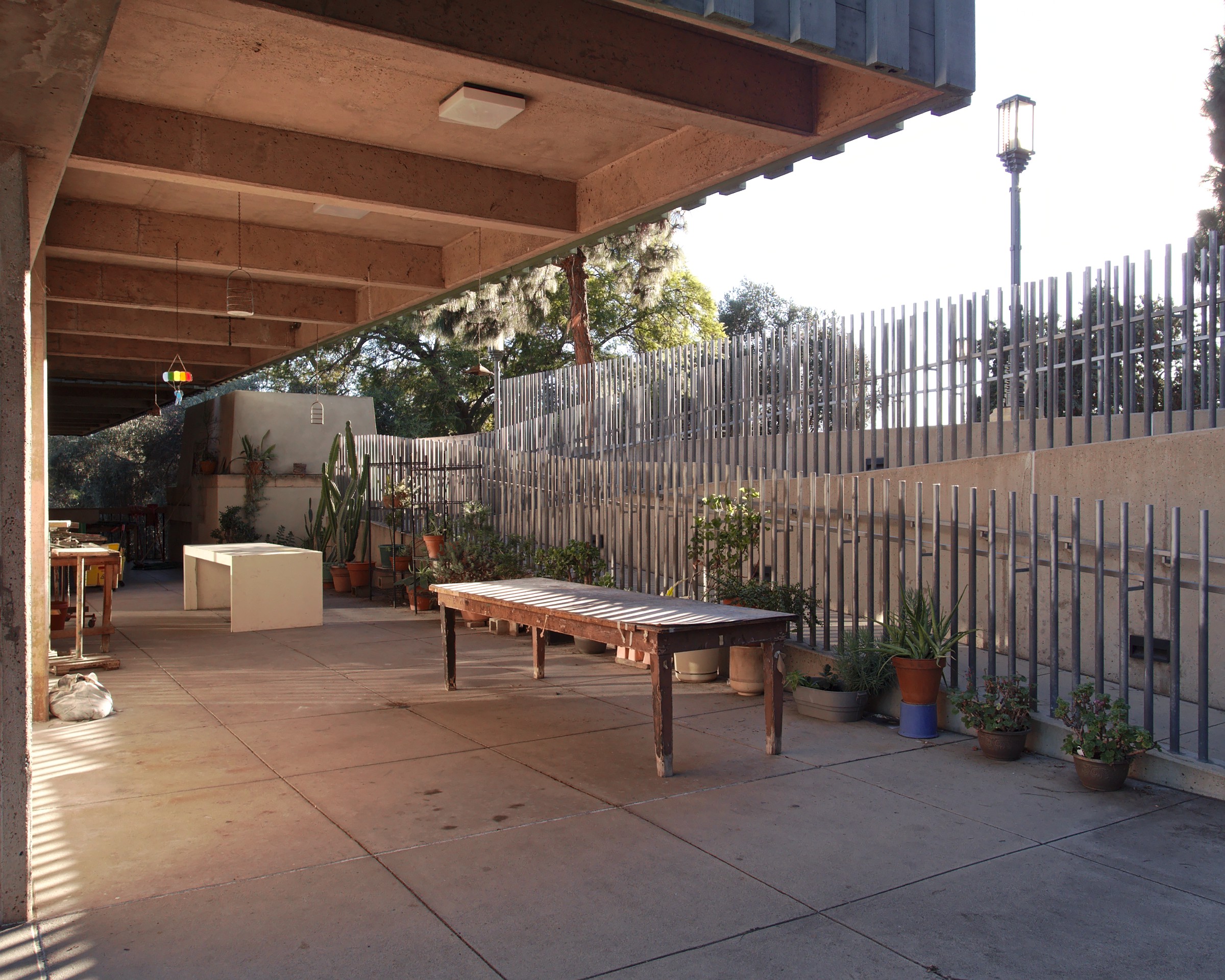
Barnsdall Art Park
Aline Barnsdall was an oil heiress and theater patron who wanted Frank Lloyd Wright to build her a house and an art colony on a hill above Hollywood. Wright designed Hollyhock House for her between 1919 and 1921—angular, organic, its roofline decorated with the abstracted hollyhock flowers that Barnsdall considered her personal symbol. Then Barnsdall decided she didn't actually want to live there. She offered the house and the surrounding land to the City of Los Angeles for arts purposes. The city wasn't sure it wanted it either. It took two decades for the gift to fully take effect.
Hollyhock House
Hollyhock House is generally considered one of Frank Lloyd Wright's masterworks in California—the only house he completed in Los Angeles proper, and a pivotal point in the development of his California style. Built from 1919 to 1921, it uses textured concrete block in a way that anticipates Wright's later California buildings, with mayan-influenced geometric forms and a plan organized around a central garden court. The hollyhock motif runs throughout: carved into the exterior concrete, pressed into the interior woodwork, woven into the decorative program of the house as a kind of personal language. In 2019, Hollyhock House was added to the UNESCO World Heritage List as part of a group of Wright-designed structures recognized for their contribution to modern architecture.
The Gift and the Delay
Barnsdall first offered to donate the property to Los Angeles in December 1923, proposing that the city use the house for library and recreation purposes, along with ten acres covering the summit of Olive Hill. The city initially accepted, then rejected, then partially accepted the offer over the following years—a bureaucratic dance that reflected genuine uncertainty about what to do with an unconventional gift. It wasn't until a second, modified donation in the 1920s and 1930s that the arrangement was finally settled. The property is now managed by the City of Los Angeles Department of Cultural Affairs in partnership with the Barnsdall Art Park Foundation, and is a designated Los Angeles Historic-Cultural Monument.
The Park on Olive Hill
Barnsdall Art Park covers 11.5 acres of what was once Aline Barnsdall's Olive Hill estate, situated at 4800 Hollywood Boulevard between Vermont Avenue and Edgemont Street. The park sits at the crest of a modest but significant hill, and from its terrace the view extends south across Hollywood and east toward Griffith Park and the San Gabriel Mountains. Several paved pathways wind through the property. The Los Angeles Municipal Art Gallery and the Junior Arts Center are housed in buildings on the grounds, hosting exhibitions and programs throughout the year. The park's hillside position gives it a quality rare in Los Angeles: genuine elevation above the street grid.
A Living Arts Institution
Hollyhock House is open for tours, and the experience of moving through it rewards attention. Wright designed the interior to compress and release space—low ceilings in some passages opening into double-height rooms, natural light controlled through screens and overhangs. The garden court at the center of the plan still functions as Wright intended: a sheltered outdoor room that links the house's wings while framing a sky that in Los Angeles is, more often than not, brilliant blue. The Barnsdall Art Park Foundation runs programs that bring children and adults to the hill for exhibitions, workshops, and events. The city that was slow to accept the gift has, over the decades, made reasonable use of it.
From the Air
Located at 34.10°N, 118.29°W at 4800 Hollywood Boulevard in East Hollywood, Los Angeles. The park occupies a clearly defined hilltop visible from the air at 2,000–3,000 feet MSL as a green oval in the urban grid. Hollyhock House's distinctive angular roofline is visible on the summit. Nearest airports: KBUR (Burbank, ~7 miles north), KLAX (LAX, ~12 miles southwest). The Hollywood Hills are visible as a long ridge to the north.