Baroda State
Kashirao and his three sons walked 600 kilometers to apply for a throne. It was 1875, and the seat of Baroda -- one of the wealthiest princely states in India -- stood vacant after its occupant had been deposed for attempting to poison the British Resident with arsenic. Maharani Jamnabai, widow of the previous legitimate ruler, summoned branches of the Gaekwad dynasty to present themselves and their sons. From the village of Kavlana, the family came on foot. The boy who would be chosen, twelve-year-old Gopalrao, would be renamed Sayajirao and placed on a gilded throne that came with solid gold cannons, a carpet made entirely of pearls, and the governance of over a thousand square miles of Gujarat.
In the Heart of the Banyan Tree
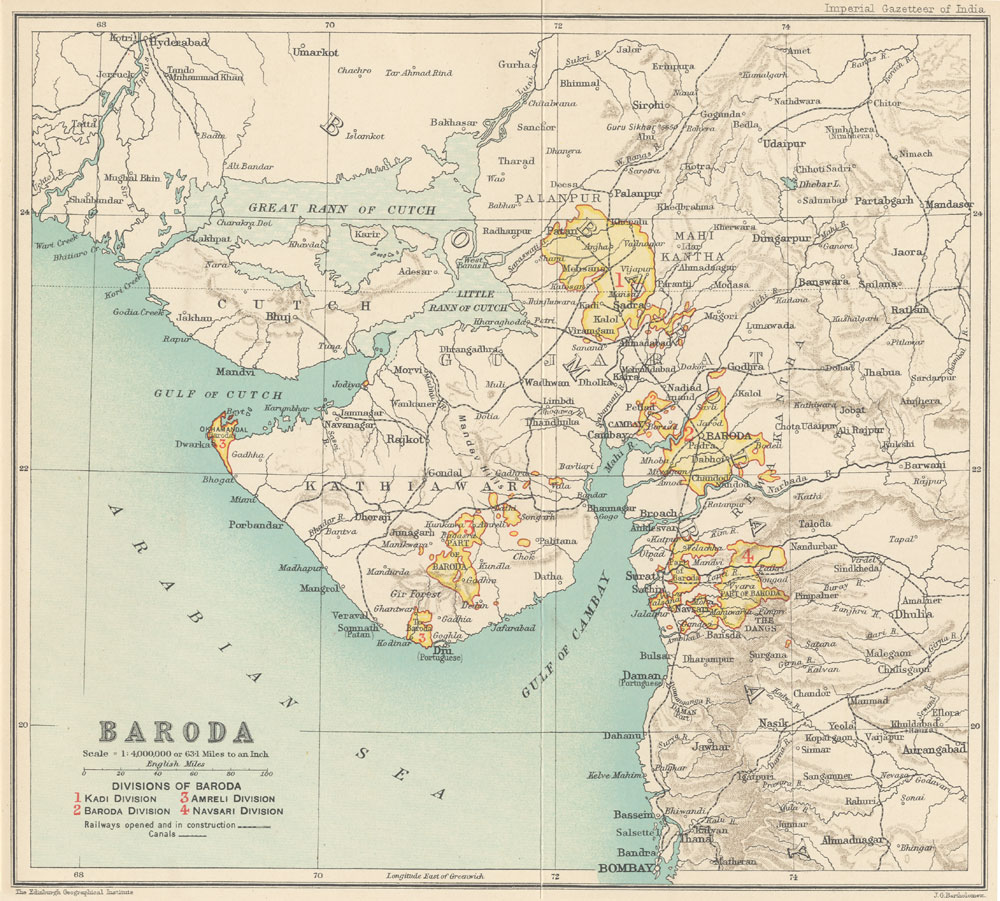
The name Vadodara, from which the anglicized Baroda derives, comes from the Sanskrit vatodara: "in the heart of the banyan tree." The 17th-century Gujarati poet Premanand Bhatt also called it Virakshetra, the land of warriors. Early English travelers knew it as Brodera. The state itself was geographically eccentric, comprising disjointed tracts of land spread across Gujarat and subdivided into four prants: Kadi, Baroda, Navsari, and Amreli, the last of which included coastal territory near Dwarka and Kodinar. The Marathas first attacked Gujarat in 1705, and by 1721 the general Pilaji Gaekwad had conquered Songadh from the Mughals, founding a dynasty that would endure for more than two centuries. Songadh remained the Gaekwad headquarters until 1866, long after the family's power and ambitions had outgrown it.
The Poisoner on the Throne
The succession crisis of the 1870s reads like a Jacobean revenge tragedy set in Gujarat. When Maharaja Khanderao Gaekwad died in 1870, his brother Malharrao was next in line but had already been imprisoned for conspiring to assassinate Khanderao. The succession was delayed because Khanderao's widow was pregnant, but the child born on 5 July 1871 proved to be a daughter, clearing the way for Malharrao. He spent money with spectacular recklessness, commissioning a pair of solid gold cannons and a carpet of pearls while emptying the state treasury. Reports of cruelty reached the British Resident, Colonel R. Phayre, and Malharrao's response was to try to poison him with arsenic. The Secretary of State for India, Lord Salisbury, ordered Malharrao deposed on 10 April 1875. He was exiled to Madras, where he died in obscurity in 1882, a footnote in a dynasty that preferred to forget him.
Reformer and Collector
Sayajirao Gaekwad III, the boy who walked from Kavlana, became one of India's most progressive rulers. Adopted by Maharani Jamnabai on 27 May 1875 and enthroned on 16 June, he ruled under a regency council until assuming full powers on 28 December 1881. He founded the Bank of Baroda in 1908 and established the Baroda Legislative Assembly the same year. His state was wealthy enough to rank among the four largest princely states managed directly by a British Resident under the Governor-General, alongside Hyderabad, Mysore, and Jammu and Kashmir. The Gaekwad collection was extraordinary: The Pittsburgh Press reported in 1927 that a diamond necklace containing the Star of the South was part of a royal collection worth $10 million. The Pearl Carpet of Baroda, a cloth embroidered with precious stones and seed pearls made to cover a tomb, now resides in Qatar's National Museum.
Resistance, Rails, and the End of a Kingdom
Baroda's history was not only royal pageantry. During the Indian Rebellion of 1857, Koli chieftains Nathaji Patel and Yamaji Patel led a revolt in Chandap, drove out Gaekwad cavalry, and retreated into the Taranga hills. They assembled 2,000 Koli and Bhil soldiers and adopted guerrilla tactics, fighting around the Sabarmati River until the end of 1858. The Kolis paid heavily: defeated, disarmed, and marginalized as outlaws by the rest of society. More peacefully, Baroda also built India's first narrow-gauge railway in 1862, eight miles of track from Dabhoi to Miyagam, eventually expanding into a network with Dabhoi as its hub. The state maintained its own navy at Billimora, a fleet of 50 vessels guarding the coast from Portuguese, Dutch, and French competitors. On 1 May 1949, Baroda formally merged into the Dominion of India, ending 228 years of Gaekwad rule. Dr. Jivraj Narayan Mehta, who oversaw the transition, would become Gujarat's first Chief Minister when the new state was formed in 1960.
From the Air
Baroda State was centered on the city of Vadodara (Baroda) at 22.18N, 73.12E in central Gujarat. From the air, the Laxmi Vilas Palace and Nazarbaug Palace complex are prominent landmarks. Best viewed at 2,000-5,000 feet AGL. The nearest airport is Vadodara Airport (VABO), located about 8 km northeast of the city center. Ahmedabad's Sardar Vallabhbhai Patel International Airport (VAAH) is approximately 110 km to the north. The Vishwamitri River winds through the city and is visible from altitude. Clear flying conditions prevail outside monsoon season.