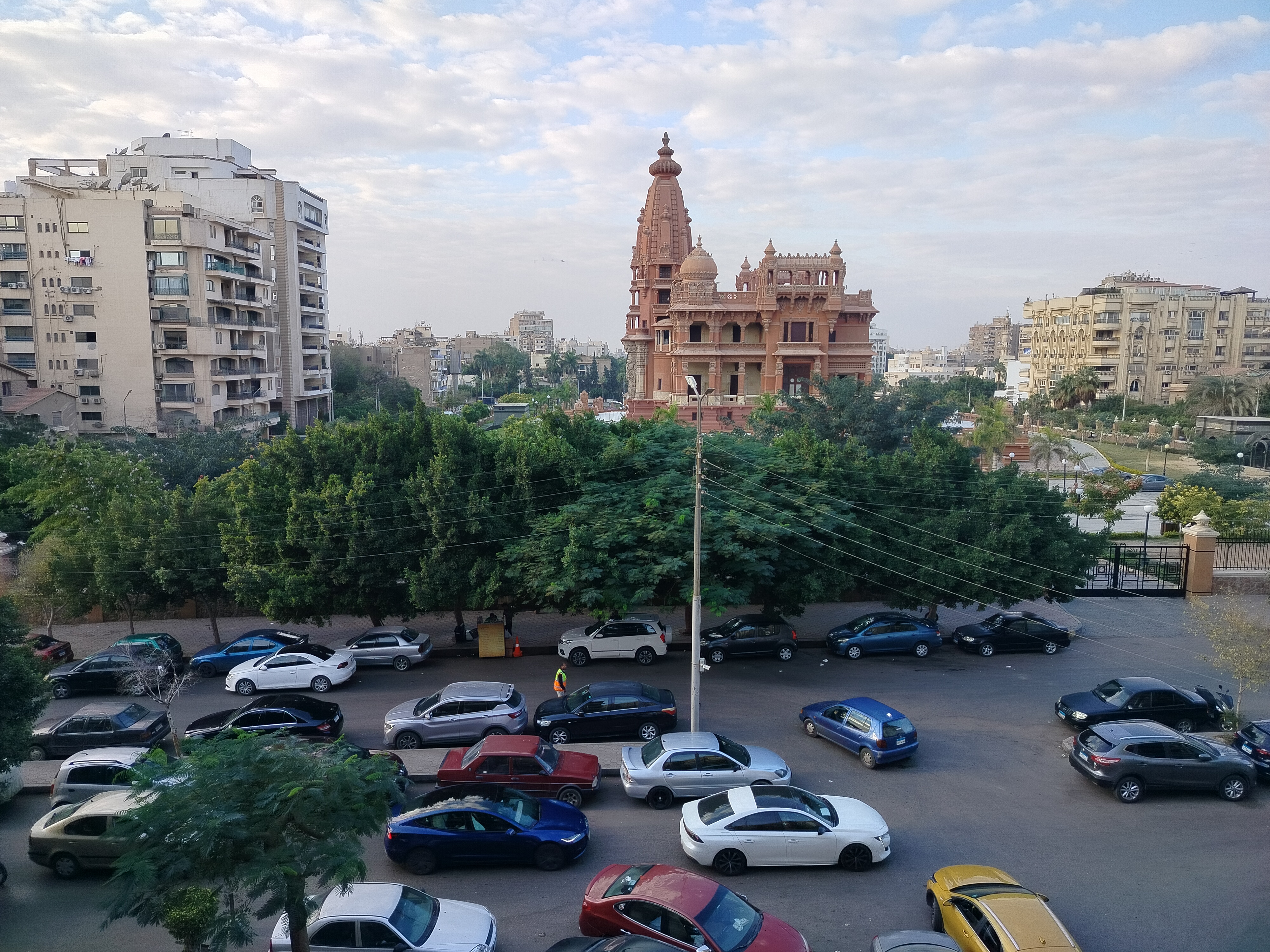
Baron Empain Palace
It is the most improbable building in Cairo -- and in a city that includes the pyramids, that is saying something. Rising from the broad avenues of Heliopolis, a suburb that did not exist before 1905, the Baron Empain Palace looks like a Cambodian temple that wandered off the map and settled down in the Egyptian desert. Its towers are crowned with Hindu deities. Elephants, monkeys, lions, and snakes adorn its facades. Statues of Buddha, Shiva, and Krishna gaze out from the balustrades. The palace was built not by an Egyptian pharaoh or an Ottoman pasha but by a Belgian tramway magnate named Edouard Empain, who arrived in Egypt in 1904, founded an entire city, and built himself a house that no one in Cairo has ever been able to forget -- or fully explain.
The Baron Who Built a City
Edouard Empain, Baron Empain, made his fortune building tramway systems across Europe. When he turned his attention to Egypt in 1904, his ambitions went far beyond railways. He envisioned an entirely new suburb northeast of Cairo -- a planned city with wide boulevards, parks, hospitals, restaurants, and a distinctive architectural identity that would draw residents from across the world. By 1906, Empain had hired architects to develop what became known as the "Heliopolis style," a deliberate fusion of Persian, neoclassical European, and Moorish elements. Heliopolis grew quickly, becoming one of Cairo's most desirable neighborhoods. At its center, the Baron built his personal residence -- a palace that owed nothing to the aesthetic of its surroundings and everything to a private obsession with South Asian temple architecture.
A Temple in Concrete
The palace was designed by Alexandre Marcel, a French architect and member of the French Institute who had already built Cambodian-inspired structures for the 1900 Paris Exposition. Marcel drew primarily on Angkor Wat and the Hindu temples of Orissa in eastern India. The interior was decorated by Georges-Louis Claude. Construction took from 1907 to 1911, and the building material was reinforced concrete -- considered a luxurious, cutting-edge choice at the time. The result is extravagant: the ornamentation is dense and intricate, covering nearly every exterior surface with carved figures, sacred animals, and deity sculptures. A spiral staircase winds through the main tower. The palace housed Empain, his wife, and their two sons. Persistent local rumors also speak of a daughter who was kept hidden from the outside world due to a medical or mental condition, though these accounts remain unverified.
Decades in the Dark
Baron Empain died in 1929. His heirs maintained the palace for a time, but the 1952 Egyptian revolution disrupted the old social order, and the building was gradually abandoned. For decades it stood empty, its ornate facades crumbling, its grounds overgrown. By the 1990s, the palace had acquired a reputation as one of Cairo's most haunted locations. Young people began breaking in to hold parties and use drugs -- acts of countercultural rebellion that conservative voices quickly reframed as Satanism and devil worship. The rumors fed on themselves: a Belgian industrialist's Hindu-inspired palace, abandoned and decaying in an Islamic neighborhood, became a screen onto which Cairo projected its anxieties about foreignness, secularism, and the supernatural. Locals shared stories of ghosts, curses, and occult rituals. The palace became more famous as a ruin than it had ever been as a residence.
Resurrection in Heliopolis
In 2017, the Egyptian government began a comprehensive restoration of the Baron Empain Palace. The work was extensive, addressing structural damage from decades of neglect and vandalism while restoring the original ornamentation to something approaching its early-20th-century appearance. The palace reopened as a museum and cultural venue, allowing visitors inside for the first time in generations. The restoration also renewed interest in Heliopolis itself -- Empain's planned city, once the height of cosmopolitan Cairo, has been absorbed into the metropolitan sprawl but retains echoes of its original vision in its wide streets and eclectic architecture. The palace stands today as the most visible monument to a peculiar moment in Egyptian history: when a Belgian baron built a Hindu temple in an Islamic country using French architects and Cambodian blueprints, and somehow created a landmark that belongs to none of those traditions and all of them at once.
From the Air
Coordinates: 30.09N, 31.33E, in the Heliopolis district of northeastern Cairo. The palace is a distinctive single structure visible from low altitude amid the residential blocks of Heliopolis, near the intersection of Al-Orouba and Salah Salem streets. Its ornate towers and unique silhouette distinguish it from surrounding buildings. Cairo International Airport (ICAO: HECA) is approximately 5 km to the east. Best viewed at 1,500-3,000 ft AGL. The broad avenues of Heliopolis provide orientation.