Barren Island (Andaman Islands)
Somewhere on the slopes of India's only active volcano, a herd of feral goats grazes on thick vegetation fed by two freshwater springs. They are the descendants of animals placed on Barren Island by British sailors from a steamer leaving Port Blair in 1891. When geologists from the Geological Survey of India discovered them during a field expedition, the mystery of their survival on an actively erupting volcanic island baffled the scientific community until the springs were found. The goats are not the strangest thing about Barren Island -- that distinction belongs to the volcano itself, which has been in a state of near-continuous eruption since 2022, sending ash plumes to 8,000 feet and higher while remaining classified at the low end of the Volcanic Explosivity Index.
A Restless Giant
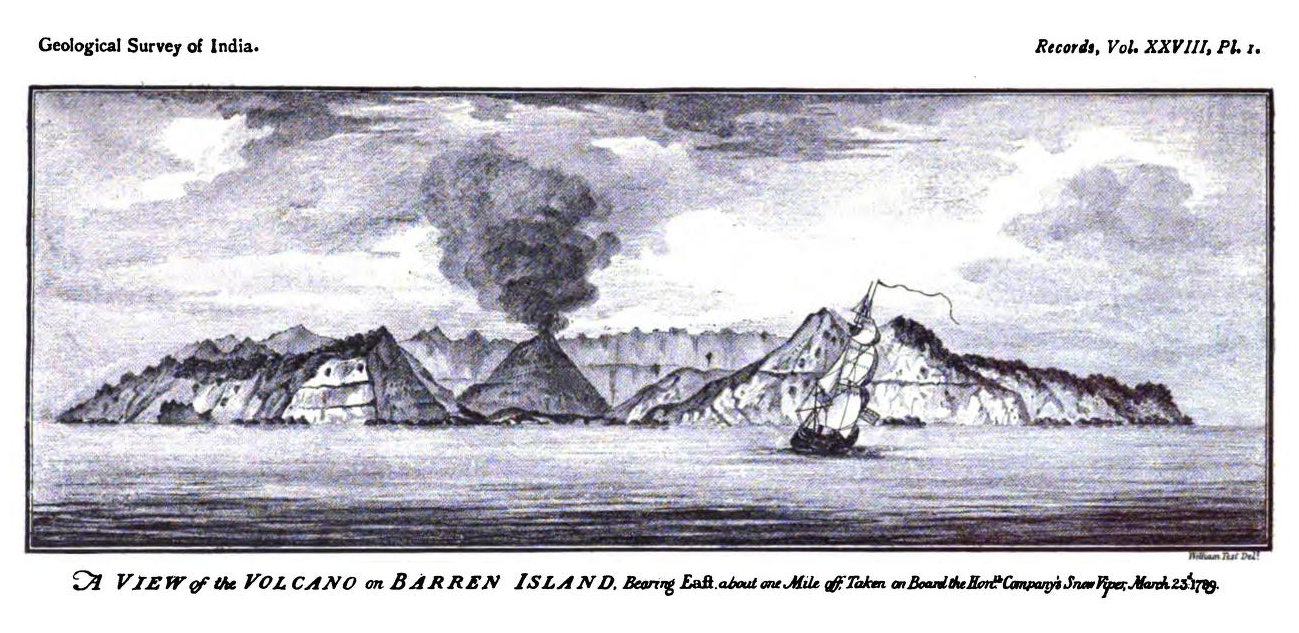
Barren Island's volcanic history reads like a clock that keeps irregular time. The first recorded eruption came in 1787, followed by further activity in 1789, 1795, 1803-04, and 1852. Then silence -- nearly a century and a half of dormancy that lulled observers into treating the volcano as extinct. The 1991 eruption shattered that assumption. Lasting six months, it caused considerable damage to the island's ecology and announced that the volcano was very much alive. Since then, eruptions have recurred with increasing frequency. A team from the National Institute of Oceanography observed the volcano erupting in January 2017, describing episodes of five to ten minutes where ash clouds rose during daylight and red lava fountains spewed from the crater after sundown, hot lava streaming down the slopes in glowing rivers. By 2024, the volcano was routinely producing ash plumes reaching 8,000 feet or more. In October 2025, the Darwin Volcanic Ash Advisory Center warned of a plume rising to an estimated 10,000 feet, moving northeast at 10 knots.
Where Plates Collide
Barren Island exists because of one of Earth's fundamental processes: the Indian Plate diving beneath the Burma Plate in a subduction zone that stretches from Sumatra to Myanmar. The volcano sits along this chain as the only confirmed active member on the Indian subcontinent, a geological distinction that makes it a site of intense scientific interest. Its eruptions produce mafic magmas -- basalt and basaltic andesite in a tholeiitic series, consistent with what geologists expect from a subduction-zone volcano fed by magma generated in the hydrated mantle wedge above the descending slab. Comparing lava from the 2005 flow with samples from the 1994-95 eruptions reveals only minor chemical variations, suggesting a stable magma source that has been feeding the volcano with broadly consistent material from prehistoric times through the present. The geology is straightforward; its implications are not. An active volcano in the middle of a busy maritime zone, erupting unpredictably, demands constant monitoring.
Life on a Volcano
True to its name, Barren Island presents vast stretches of bare landscape around the volcanic rim. But the slopes tell a different story, covered in thick vegetation that supports a small ecosystem against seemingly impossible odds. The 1991 eruption devastated the island's fauna -- a survey team visiting in April 1993 found only 6 of the 16 bird species previously documented. The pied imperial pigeon proved the most resilient, maintaining a visible population. Nighttime surveys turned up one rat species and 51 insect species across eight orders. Alongside these survivors and the improbable goats, flying foxes navigate the ash-tinged air. The island is designated a protected area as the Barren Island Wildlife Sanctuary, though the volcano itself serves as the most effective warden -- few creatures, and no humans, choose to live on ground that could erupt at any moment.
Diving into Fire
While the land above the waterline belongs to the volcano, the waters surrounding Barren Island have earned a reputation as one of the world's premier scuba diving destinations. Crystal-clear visibility reveals an underwater landscape sculpted by volcanic forces: basalt formations from past lava flows create dramatic topography, and fast-growing coral gardens colonize the cooled rock with startling speed. Manta rays patrol these waters, drawn by the nutrient upwelling that volcanic activity promotes. The dive site is remote -- accessible only by live-aboard vessels or operators based at Swaraj Island -- and that remoteness is part of the appeal. Divers descend into water warmed by geothermal activity, swimming past formations that were molten rock within living memory, watching marine life flourish in conditions that seem hostile to everything. It is a place where creation and destruction happen simultaneously, where the same forces that build the island also create the conditions for extraordinary underwater beauty.
From the Air
Located at 12.278N, 93.858E in the Andaman Sea, approximately 135 km northeast of Port Blair. Barren Island is an uninhabited volcanic island clearly visible from cruising altitude -- look for the distinctive conical profile and, during active eruptions, ash plumes that can reach 10,000 ft or higher. CAUTION: Active volcanic ash plumes present a hazard to aircraft; check NOTAMs and VAAC Darwin advisories before routing near the island. Nearest airport is Veer Savarkar International Airport (VOPB) at Port Blair. Best observed from a safe lateral distance at 10,000-15,000 ft AGL. No landing facilities on the island.