Barriles
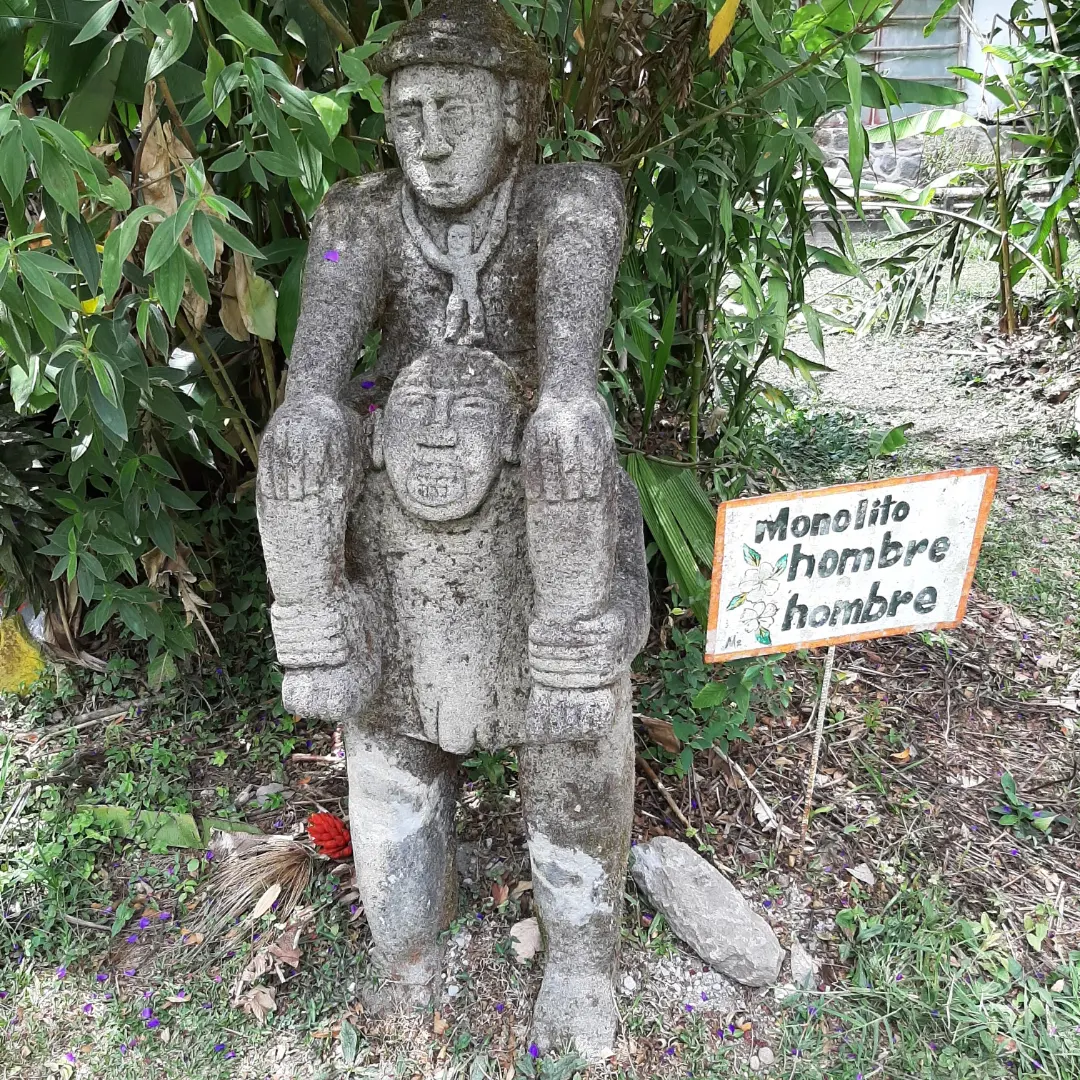
Fourteen stone statues once stood in a row at Barriles, a pre-Columbian site on the western flanks of Volcan Baru in Panama's Chiriqui Province. Four of those statues depict something unusual: a larger figure, often wearing a conical hat and ornaments, perched atop the shoulders of a naked man. Whatever relationship those two carved figures represented -- ruler and subject, priest and acolyte, victor and captive -- the arrangement is one of the most striking pieces of evidence for social hierarchy in ancient lower Central America. The statues are long gone from the site itself, most of them now displayed at the Museo Antropologico Reina Torres de Arauz in Panama City, but the ground they stood on still has stories to tell.
Named for Barrels, Built on Ceremony
The site takes its name from small stone barrels found in the area, though similar objects have turned up elsewhere in the Rio Chiriqui Viejo valley and across the border in Costa Rica. Sitting at 1,200 meters above sea level, a few kilometers west of the modern town of Volcan, Barriles occupies a cool highland zone with a pronounced rainy season from May to November and dry, windy weather the rest of the year. Archaeologists believe this was a socioceremonial center -- a place where people gathered not just to live but to feast, bury their dead, and reinforce the social bonds that held a regional network of settlements together. Population estimates range from 500 to 1,000 residents, making it far denser than other known sites in the region during the same period.
Layers Beneath the Volcanic Soil
Most of the activity at Barriles dates to the Aguas Buenas period, roughly A.D. 300 to 900, known locally as the Bugaba period. Nine radiocarbon dates from the site cluster between A.D. 500 and 800. The pottery was generally unpainted, sometimes decorated with engraving or applique, and the stone tools -- blades, axes, grinding stones -- were fashioned from andesite, basalt, rhyolite, and chert. Before this era, human presence in the highlands was sparse, limited to small populations during the preceding Concepcion Phase. After Barriles' heyday, something changed. During the Chiriqui Phases (A.D. 900-1500), the large village pattern dissolved and populations scattered into smaller, more transient settlements. The rise and fall of Barriles tracks what appears to have been a cycle of political consolidation and dispersal that played out over centuries.
The Volcano Question
For decades, a hypothetical eruption of Volcan Baru around A.D. 600 was thought to have devastated settlements upstream from Barriles and driven populations into the Caribbean watershed. The idea was tidy: volcanic catastrophe scatters people, some of them end up at Barriles, the site grows. But recent geological and archaeological work has undermined this narrative. Evidence now points toward a much later eruption, possibly around A.D. 1400 -- centuries after Barriles had already declined. Meanwhile, excavations in the Caribbean lowlands suggest that populations there were earlier and denser than previously assumed. The old story of highland refugees colonizing empty lowlands has given way to a more complex picture of interconnected communities adapting to their landscape on both sides of the continental divide.
Digging Through Decades
The first outsider to excavate Barriles was Matthew Stirling in the late 1940s, the same National Geographic archaeologist famous for discovering the Olmec colossal heads in Mexico. Stirling recovered fragments of the statues and the large metate -- a grinding stone ringed with tiny carved heads that has been interpreted as evidence of ritual violence. In the 1970s, Panamanian archaeologist Olga Linares led the multi-year Adaptive Radiations project, which surveyed the valley and concluded it had once supported substantial populations fed by maize agriculture. More recently, Scott Palumbo of the College of Lake County conducted the most extensive fieldwork at the site, using hundreds of small excavations to show that Barriles held a far denser residential population than its neighbors. His findings suggest the village's draw was ceremonial feasting, perhaps tied to funerary rituals -- gatherings that cemented social ties even as they advertised subtle differences in status.
Visiting What Remains
Today Barriles is one of the few archaeological sites in Panama open to the public, though access is through private property. The Landau family, who own the finca covering the northwestern portion of the site, display artifacts in their yard and a small museum, and offer guided tours in both Spanish and English. Not all the objects on display were found on-site, and visitors should keep that in mind. The main excavation block, opened by a German-Panamanian team in 2001, sits exposed for tourists to peer into -- the cut earth itself a kind of exhibit. Because Barriles has received far less attention than flashier sites in Mesoamerica or Peru, it has attracted its share of fringe theories, including claims of African or Asian colonists and Maya conquest. Professional archaeologists find no evidence for any of these. The site's real significance lies in what it reveals about indigenous Chibchan-speaking peoples who built their own complex societies without outside help.
From the Air
Barriles is at approximately 8.80N, 82.70W, on the western slopes of Volcan Baru at 1,200 m elevation in Chiriqui Province, Panama. The nearest airport is Enrique Malek International (MPDA) in David, roughly 50 km to the southeast. The modern town of Volcan is the closest landmark. From altitude, the site is indistinguishable from surrounding farmland, but Volcan Baru's distinctive cone serves as a reliable reference point.