Barton Academy: Alabama's First Public School and Its Long Second Act
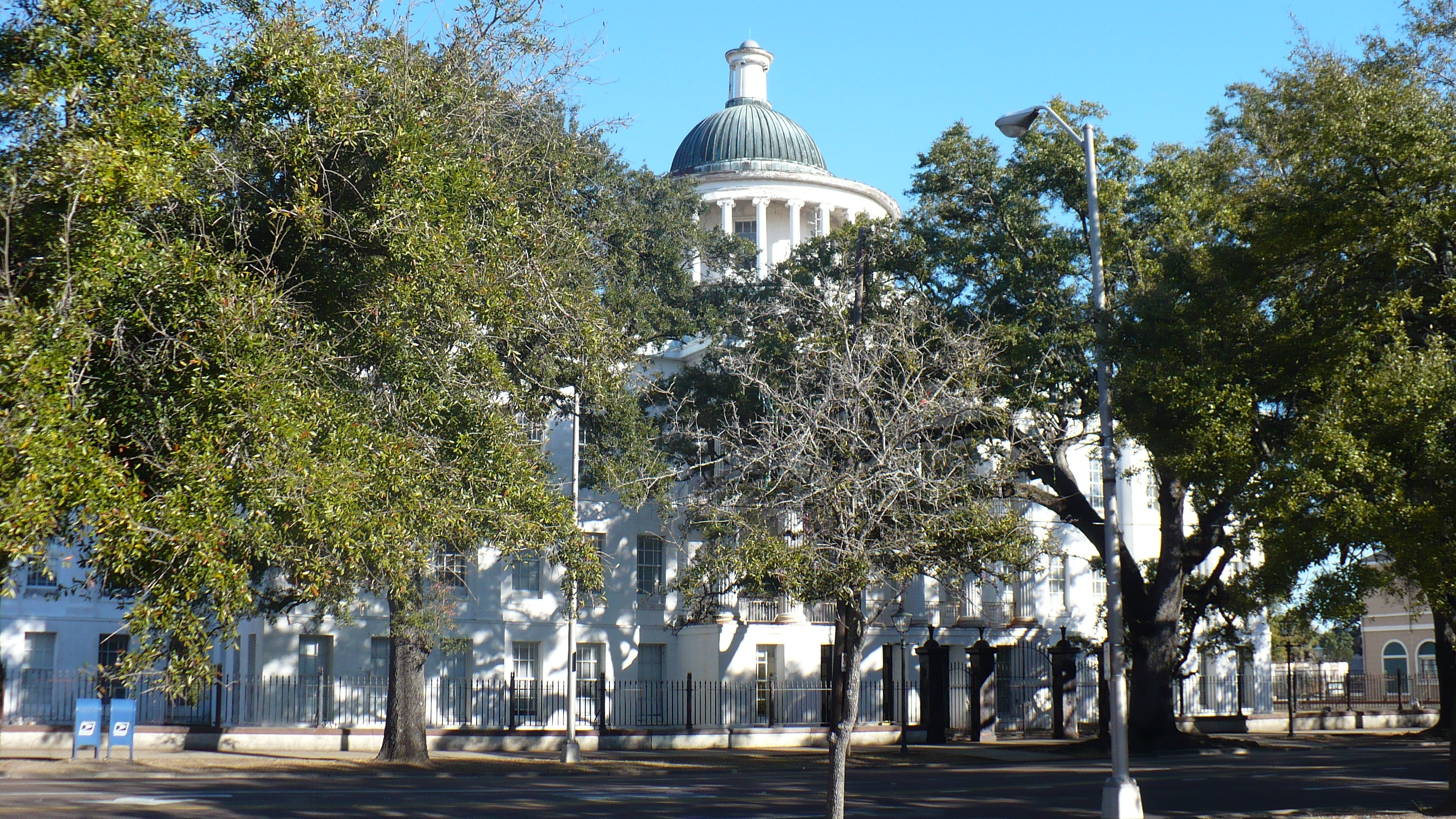
Twenty-eight Ionic columns ring the cupola, and from the right angle on Government Street, the dome's lantern catches the Alabama sun in a way that makes the whole building look like it belongs in Athens rather than Mobile. Barton Academy was the first public school in the state of Alabama, and for nearly two centuries its fortunes have mirrored the city's own: grand ambitions, slow construction, wartime survival, postwar decay, a near-demolition, and finally a $14 million resurrection. The architects who designed it, James H. Dakin, Charles B. Dakin, and James Gallier Sr., were among the most prominent practitioners of the Greek Revival style in the antebellum South. Their work still commands the streetscape.
Before the First Brick
Barton Academy owes its existence to Willoughby Barton, a state legislator from Mobile who pushed through an act on January 10, 1826, creating the Board of School Commissioners of Mobile County, the first education board in Alabama. The school that would bear his name took another decade to begin. Construction started in 1836, and the architects Dakin and Gallier, who had already made their reputations with buildings in New York and New Orleans, brought a level of ambition unusual for a frontier schoolhouse. They also designed the nearby Government Street Presbyterian Church. The Barton project proved far more complicated. Progress was slow, and on March 9, 1837, inspectors found the roof incomplete and faulty, with water seeping in and damaging the interior plaster. Workers applied interior paint in September 1837, but the last finish work was not completed until January 1839.
Columns, Cupola, and a Monument from Athens
The building itself is a study in Greek Revival ambition. Three stories of brick, stuccoed and scored to resemble ashlar stone, rise from a heavy ground floor. The central block features a two-story, pedimented, hexastyle Ionic portico, five bays wide, with wrought-iron balustrades that nod to the New Orleans ironwork the architects knew well. But the real showpiece is the cupola: a dome ringed by 28 Ionic columns, topped by a lantern modeled after the Choragic Monument of Lysicrates in Athens. That ancient Greek monument, built in 335 BC to commemorate a choral victory, became one of the most copied architectural forms in America. Finding its likeness crowning a public school in Mobile says everything about how seriously the young state took this building.
A School, an Office, a Ruin, a Cause
Barton Academy served as an elementary and middle school from its opening until the 1960s, when the Mobile County school board converted it into central administrative offices. The board moved out in 2007, and the building began its long slide. Preservationists pushed for restoration, but in January 2009, the school board stalled, declining to set aside an additional $700,000 beyond the $2.3 million already committed. Two board members argued the money was needed elsewhere. Alabama's Historical Commission placed Barton on the state's "Places in Peril" list that same year. The building sat vacant, a Greek Revival monument gathering dust on one of Mobile's grandest streets.
The $14 Million Return
The turning point came when advocates raised $14 million for a full restoration. Construction began in June 2020, and Barton Academy officially reopened in August 2021, not as an office building but as a school again: Barton Academy for Advanced World Studies, serving sixth through ninth graders. The building was added to the National Register of Historic Places in 1970, and the restoration honored that status, preserving the architectural details while updating the structure for modern educational use. Walk past it on Government Street today and you see what the Dakin brothers and Gallier intended: a building that declares public education worthy of the same grandeur as a courthouse or a cathedral.
From the Air
Located at 30.689°N, 88.048°W on Government Street in downtown Mobile, Alabama. The building's white cupola and dome are distinctive from the air, standing out among the low-rise downtown blocks. Mobile Regional Airport (KMOB) is approximately 13 miles west. Mobile Downtown Airport (KBFM) is about 3 miles south. From 2,000-3,000 feet AGL, the Greek Revival portico and dome are identifiable along the Government Street corridor. The nearby Government Street Presbyterian Church, designed by the same architects, is visible one block east. Mobile Bay stretches to the east and south.