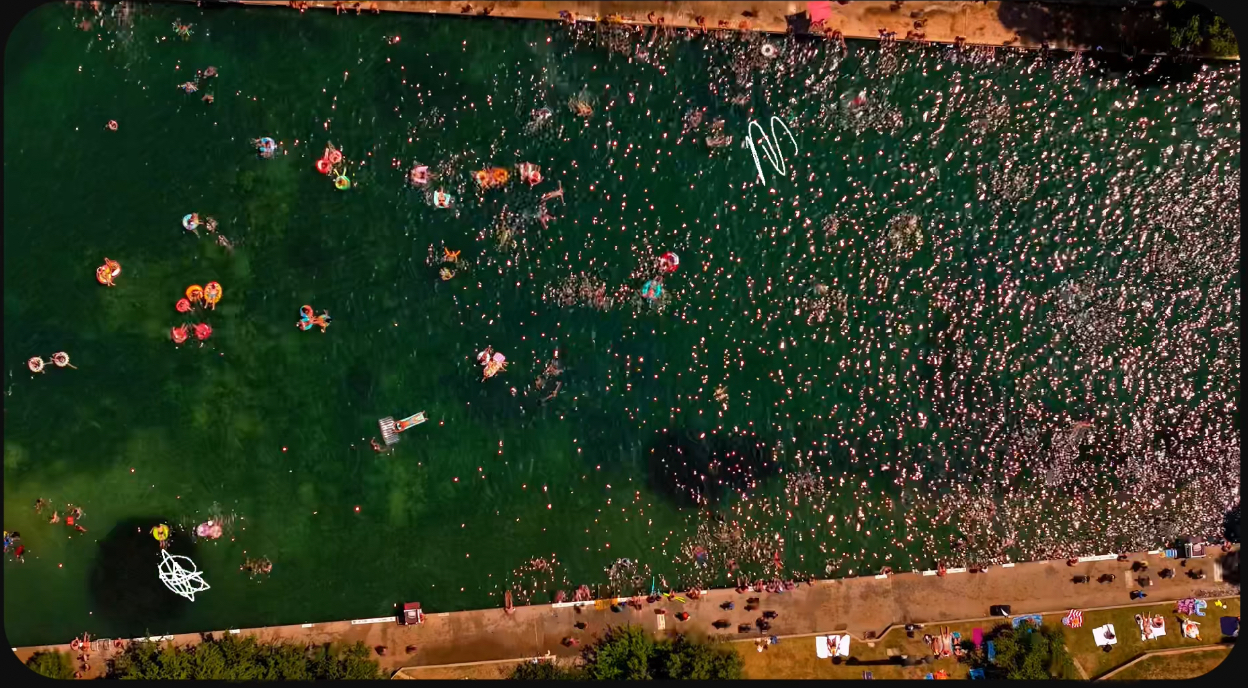
Barton Springs Pool
In 1837, a settler named William Barton claimed a stretch of creek bed in the Texas hill country and named three springs after his daughters: Parthenia, Eliza, and Zenobia. Nearly two centuries later, those springs still flow -- cold, clear, and constant -- filling a swimming pool in Austin's Zilker Park where the water holds steady at around 68 to 70 degrees year-round, regardless of whether it is a hundred degrees outside or a rare Texas freeze. Barton Springs Pool is not just a swimming hole. It is a geological artifact, a political battleground, a sacred site, and the emotional center of a city that has grown up around it.
Waters Before Memory
Long before William Barton arrived, the Coahuiltecan people counted these springs among the four sacred waters of their creation story, alongside Comal Springs, San Marcos Springs, and San Antonio Springs. Spanish explorers encountered the site in the 17th century and erected temporary missions around 1730 before eventually relocating them to San Antonio. The springs draw from the Edwards Aquifer, one of the most prolific artesian aquifer systems in the world, and Main Barton Spring -- the primary source for the pool -- ranks as the fourth-largest spring in Texas. Water pushes up through limestone that was laid down as seafloor sediment millions of years ago, filtered through miles of subterranean rock before emerging cool and mineral-clear into the Austin sunlight.
From Daughters' Names to Public Treasure
William "Uncle Billy" Barton and the property owners who followed him recognized early that these springs had commercial appeal, promoting the site vigorously as a tourist attraction. The swimming hole's popularity grew steadily through the 19th century. In 1918, the last private owner, Andrew Jackson Zilker, deeded the property to the city of Austin. During the 1920s, the city dammed the springs and built sidewalks to create a larger, more formal swimming area within the channel of Barton Creek. The bathhouse was designed in 1947 by Dan Driscoll, who also designed the bathhouse at Deep Eddy Pool, another beloved Austin swimming spot. Today the pool stretches roughly a thousand feet long, reaching a maximum depth of about 18 feet when the dam's floodgates are closed and Main Barton Spring fills the basin to capacity.
The Salamander and the Swimmers
Beneath the surface of Barton Springs Pool lives a creature found nowhere else on the planet: the Barton Springs salamander, a federally listed endangered species that shares its habitat with the thousands of swimmers who visit each year. The discovery of this tiny amphibian triggered years of debate among the city of Austin, Texas state agencies, and the U.S. Fish and Wildlife Service over whether human recreation and species survival could coexist. Studies eventually determined they could -- and likely had been doing so for a very long time. The salamander was not the only environmental crisis the pool has weathered. In 2003, the pool closed for 90 days after a local newspaper reported toxic contamination. Investigators from the CDC, EPA, and state agencies traced the source to coal tar pavement sealer used on a nearby parking lot. That discovery led to the nation's first ban on coal tar pavement sealers in 2005, making Barton Springs Pool an unlikely catalyst for environmental policy nationwide.
Save Our Springs
The fight to protect Barton Springs spawned one of Austin's most influential political movements. The Save Our Springs Alliance, known simply as SOS, emerged from concerns about upstream development flushing contamination into the Edwards Aquifer recharge zone that feeds the springs. SOS became a significant force in Austin municipal politics, driving "green" initiatives that shaped the city's approach to development and environmental regulation for decades. Robert Redford, who first learned to swim in the pool as a child, became one of its most prominent defenders. In 2007, he and filmmaker Terrence Malick co-produced The Unforeseen, a documentary examining how real estate development around the Edwards Aquifer threatened the springs that Austin holds sacred. The pool's vulnerability to what happens upstream -- heavy rains can flush contaminants into the recharge zone, and flash floods can turn the peaceful swimming hole into a raging creek -- makes it a living barometer of the city's relationship with its own growth.
A Constant in a Changing City
From the air, Barton Springs Pool appears as a narrow ribbon of green-blue water tucked into the tree canopy of Zilker Park, with the grassy hillsides that frame it visible as lighter patches against the surrounding urban development. On any given day, swimmers share the water with the invisible flow of ancient springs, floating in the same current that the Coahuiltecan people considered sacred. The pool opens at five in the morning and stays open until ten at night, every day except Thursdays, when crews scrub algae from the limestone bottom and trim overgrown vegetation. Austin has changed almost beyond recognition since Uncle Billy Barton named those three springs for his daughters. The population has exploded, the skyline has risen, the tech industry has arrived. But the water keeps coming up through the rock at the same temperature it always has -- cool, clear, and indifferent to whatever happens on the surface above.
From the Air
Barton Springs Pool is located at 30.2639N, 97.77W within Zilker Park in south-central Austin, Texas. The pool is a narrow, elongated body of water visible within the tree canopy of the park, adjacent to Barton Creek. Zilker Park's open fields to the north and Lady Bird Lake provide primary visual references. Austin-Bergstrom International Airport (KAUS) is approximately 6 nm to the southeast. Best viewed at 2,000-4,000 feet AGL. The Barton Creek greenbelt corridor running west from the pool is a useful navigation feature.