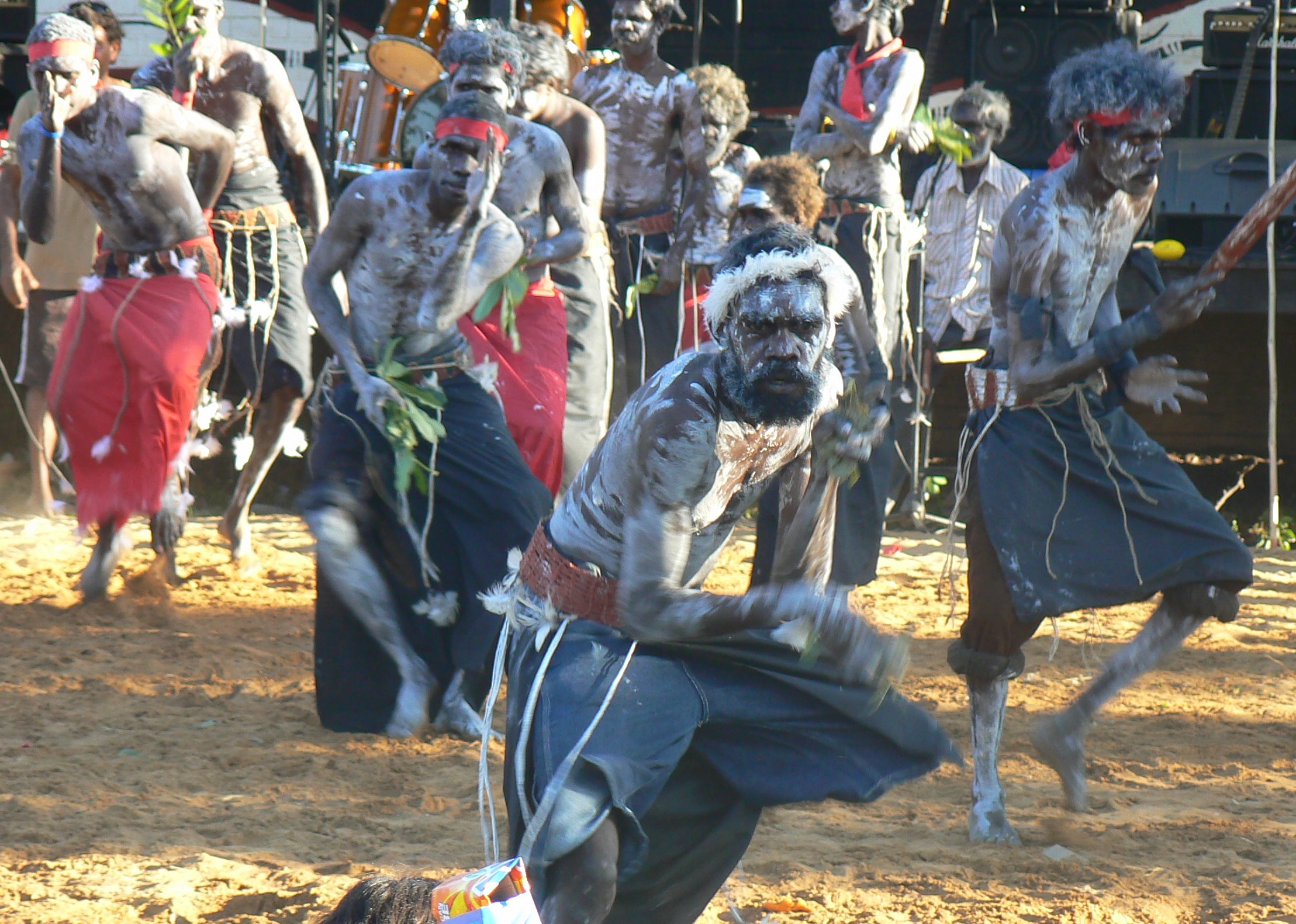
Barunga, Northern Territory
In June 1988, as Australia was celebrating its bicentennial, Prime Minister Bob Hawke drove into the bush to attend a festival at Barunga. He was presented with a painting — 1.2 metres square, on composite wood — by Galarrwuy Yunupingu and Wenten Rubuntja. The Barunga Statement, as it became known, called for a treaty between the Australian federal government and Indigenous Australians. Hawke said he wanted one concluded by 1990. It didn't happen. Three years later, in December 1991, his last act as prime minister was to hang the painting in Parliament House in Canberra, one minute before Paul Keating was sworn in. The statement is still there. The treaty is still unfinished. And every June, Barunga holds its festival.
Country That Carries Its Age
The Jawoyn people — and before the community took this name, the Mangarrayi, Ngalakan, and others whose country overlaps here — have lived in this region for thousands of years. The name Barunga is relatively recent: the community was known as Beswick Creek, then Tandangal, then Bamyili before elders renamed it Barunga in 1984. Each renaming reflects a different chapter of a story that includes forced removals, influenza epidemics, colonial settlement patterns, and the gradual, contested recovery of self-determination. The Maranboy tin mine, 8 kilometres from where Barunga is today, drew European, Chinese, and Aboriginal workers from 1913 until its closure in 1949. Many of the Aboriginal workers who had serviced the mine returned to Beswick Creek when it shut.
Tandangal and Resettlement
In 1947, the Tandangal Native Settlement was established about 13 kilometres from Beswick Station — the Jawoyn word dangdangdal giving it its name. The local people were not consulted about the location, nor about how they would be moved there. The following year, the community shifted again to avoid flooding. An influenza epidemic spread through the settlement in May 1951. In June 1951 they moved to a new site, initially called Beswick Creek Native Settlement. The Compound — a camp that had formed on the other side of the river — was renamed Bamyili by elders in 1965. The school opened in 1954, with 42 children. These are the years of managed community life, of government-imposed structures and limited economic opportunity, of a people navigating their own continuity inside an imposed framework. The Bagala Community Store, opened in September 2017, is the only store in the Northern Territory entirely owned and operated by Indigenous people.
The Festival
Bangardi Robert Lee, a leader of the Bagala clan of the Jawoyn people, initiated the Barunga Sport and Cultural Festival in 1985. He died in 2005, having created something that outlasted him. The festival is held on the Queen's Birthday long weekend each June and draws over 4,000 people to a community of around 313. It showcases music, dance, sport, and cultural practice from Aboriginal and Torres Strait Islander peoples across the country. In 2018, popular Tiwi band B2M performed. The festival also carries the political weight of the 1988 statement: it is where the conversation about a treaty is kept alive year after year, in performance and gathering and presence.
Treaty, Statement, Song
Yothu Yindi released "Treaty" in February 1991, written by Mandawuy Yunupingu and his older brother Galarrwuy — along with collaborators including Peter Garrett and Paul Kelly — to mark the years of inaction since Hawke's promise. The song became one of the most significant pieces of Australian popular music of the twentieth century. In 2018, just before the festival, the Northern Territory Government and all four of the Territory's Aboriginal land councils signed the Barunga Agreement — a Memorandum of Understanding to begin treaty talks, drafted after a week of discussions involving about 200 elected land council members. The two surviving senior men from among the nine who painted the 1988 statement — Galarrwuy Yunupingu and Djambawa Marawili — were present as it was signed. The conversation started in this small community 80 kilometres from Katherine is not over.
From the Air
Barunga sits at -14.5208°S, 132.865°E, approximately 80km southeast of Katherine via the Barunga Track. The community is small and surrounded by savanna woodland; it is not served by a commercial airport. Katherine/Tindal (YPTN) is the nearest major airfield, approximately 45nm west-northwest. The region southeast of Katherine is lower Top End country — flat, seasonally flooded in the wet, dry and clear from April through October. Barunga is accessible by road from Katherine.