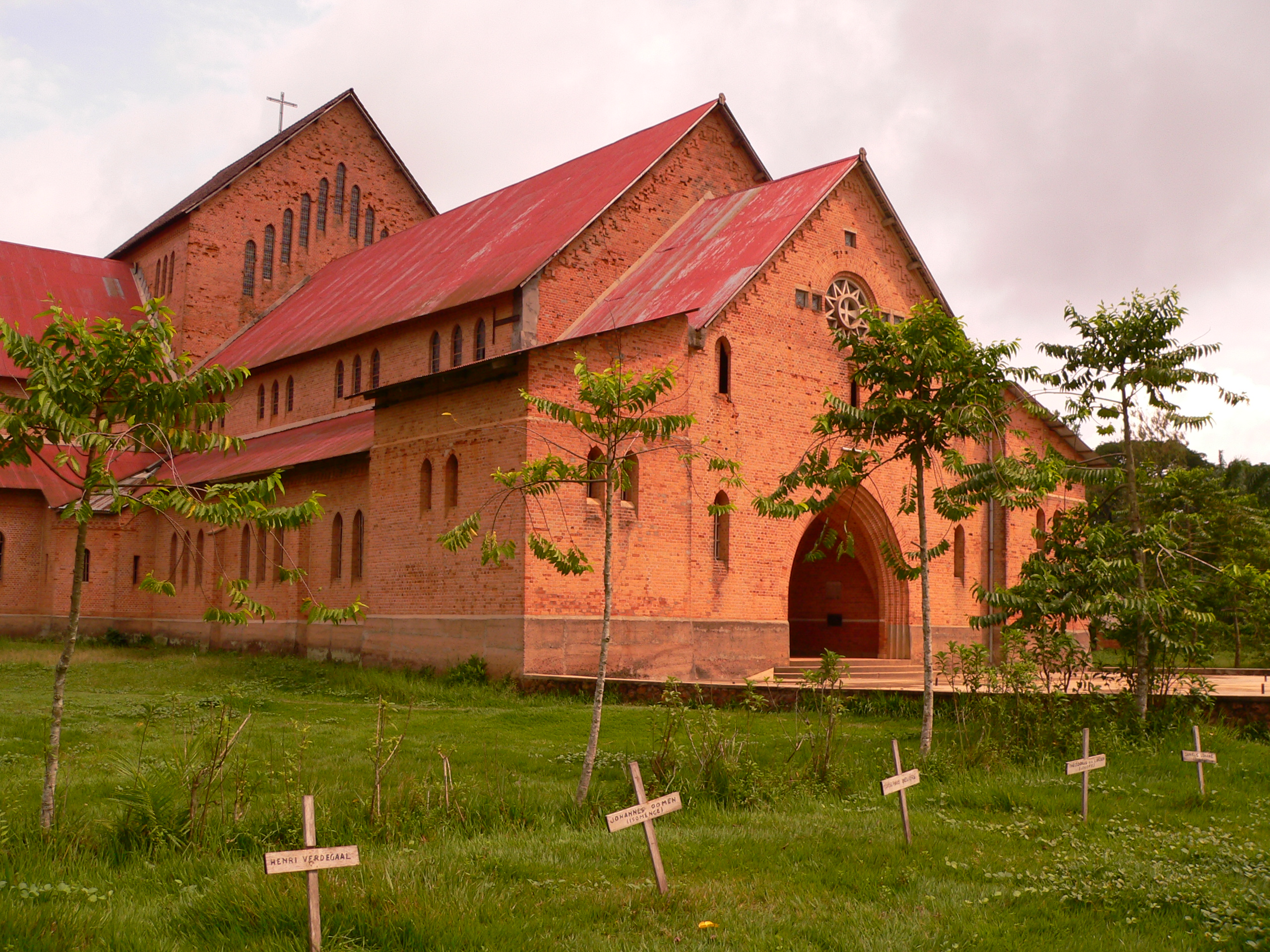
Basankusu
The boat journey from Kinshasa takes several weeks. Seven hundred kilometers of river, passengers crammed onto barges, sometimes riding on top of the logs being pushed downstream. If a barge breaks down -- and breakdowns are frequent -- travelers may have to sell everything they own just to buy food while they wait. This is how you reach Basankusu, a town at the confluence of the Maringa and Lopori rivers in the Equateur Province of the Democratic Republic of the Congo. There are no paved roads. The metal Bailey bridges that span the ravines around town are rusting and collapsing. Motor vehicles are rare. And yet Basankusu matters -- to primatologists tracking bonobos, to dog breeders seeking purebred Basenjis, and to epidemiologists who traced the first human case of monkeypox to this remote stretch of forest.
Life at the Confluence
The Mongo people are the dominant group in Basankusu, and their Bantu language, Lomongo, carries the community's proverbs and customs. Lingala serves as the lingua franca across tribal lines, while French -- a legacy of Belgian colonialism -- is spoken in schools and government offices. Daily life revolves around subsistence. People farm cassava, peanuts, maize, and pineapples in slash-and-burn plots cut from the forest, where house-sized termite mounds and the trunks of felled trees remain to supply a year's firewood. In the marketplace, seasonal specialties appear alongside the staples: the savory African plum known as safu, and caterpillars called mbinzo. Maize is grown primarily for distilling into lotoko, a potent spirit made in improvised stills fashioned from cut oil drums. The woody corn cobs produce dangerously high levels of methanol. Palm wine, fermented from the sap of wild palms, offers a gentler alternative at five to seven percent alcohol.
The Barkless Dogs of the Congo
Walk through Basankusu and you will likely encounter a Basenji -- a small, elegant hunting dog with erect ears, a tightly curled tail, and a sound unlike any other breed. Instead of barking, Basenjis produce yodels, howls, and undulating vocalizations sometimes called a barroo, the result of an unusually shaped larynx. Over centuries, the breed adapted to net hunting in extremely dense old-growth forest. In Basankusu, they are often crossbred with European dogs, but pure Basenjis still live in villages farther upriver. In 2010, the town served as a base camp for an expedition to collect breeding stock for the American market -- a reminder that even the world's most isolated places can produce something the world wants.
Bonobos and the Vanishing Forest
Basankusu sits at the western edge of the Maringa-Lopori-Wamba Landscape, a 74,000-square-kilometer conservation area that is home to the bonobo, humanity's closest living relative alongside the chimpanzee. The landscape harbors at least eleven species of diurnal primates, including the Dryas monkey -- so rare that only two specimens are known -- along with Thollon's red colobus, the golden-bellied mangabey, and the Congo peafowl, a bird with feathers of deep blue tinged with metallic green. The African Wildlife Foundation, the Max Planck Institute, and the Milwaukee Zoological Society all use Basankusu as a staging post. Primatologist Jef Dupain spent more than a decade working in the area and confronted the central tension of conservation here: you cannot tell people who depend on bushmeat for protein to simply stop hunting. An AWF-funded cargo barge, the Ferbo I, now travels the Congo and Maringa rivers collecting agricultural products, offering farmers an alternative to the bushmeat trade.
Scars of War and Neglect
During the military conflict of 1998 to 2003, the Movement for the Liberation of Congo captured Basankusu, cutting it off from trade and aid. The takeover on November 29, 1999 was quick and bloodless, but food was seized from household gardens. The broader consequences have been catastrophic: 80 percent of people in the DRC survive on less than a dollar a day, 75 percent face food insecurity, and one child in five dies before age five. Basankusu was also the first place on Earth where monkeypox was recorded in a human being. Meningitis, cholera, dysentery, and sleeping sickness remain prevalent. In 2015, a British national named Francis Hannaway opened a therapeutic feeding center with twelve local volunteers. By 2020, it had treated over 4,000 malnourished children -- a small intervention in a vast landscape of need, but one that keeps working in a place the rest of the world finds almost impossible to reach.
From the Air
Located at 1.22N, 19.80E at the confluence of the Maringa and Lopori rivers in Equateur Province, DRC. From altitude, the river confluence is the key landmark -- the Maringa and Lopori join before flowing into the Lulonga and eventually the Congo River. The town has a small airstrip visible from the air. The surrounding terrain is dense equatorial rainforest with few clearings. Bangui M'Poko International Airport (FEFF) is the nearest major airport, roughly 300 km to the north. Kinshasa N'Djili Airport (FZAA) is approximately 700 km to the south by river. The area lies just north of the equator with hot, wet conditions year-round.