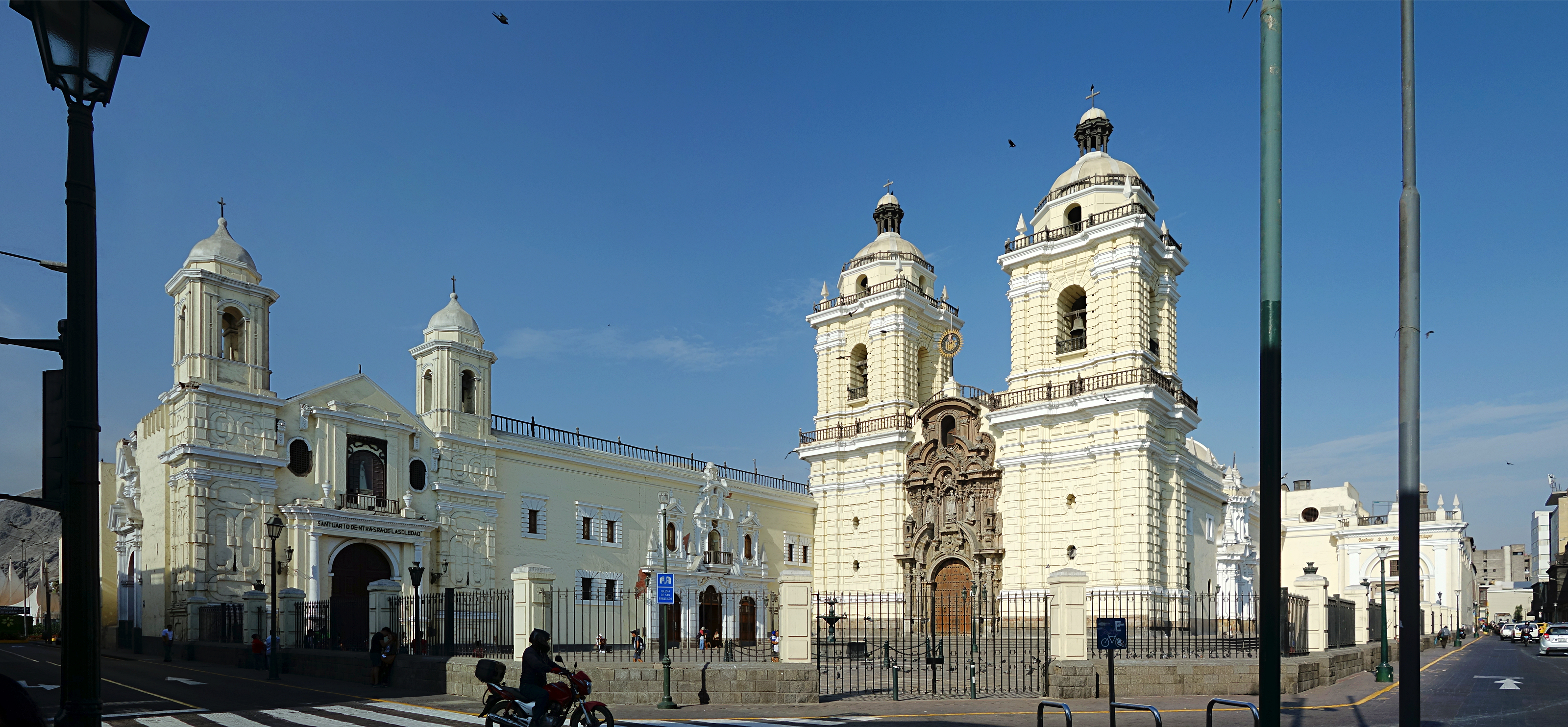
Basilica and Convent of San Francisco, Lima
Beneath one of Lima's most beautiful churches, the dead are arranged with a curator's eye. In the catacombs of the Basilica of San Francisco, bones are sorted by type and placed in geometric patterns -- femurs radiating outward in circles, skulls stacked in tidy rows. An estimated 70,000 people were buried here during the colonial era, and when the catacombs were rediscovered in 1951, the sheer scale of what lay beneath the sanctuary floor stunned archaeologists. But the bones are only part of the story. Above ground, the basilica and its surrounding convent form one of Lima's most important architectural complexes, a place where Baroque grandeur, Mudejar craftsmanship, and Franciscan humility have coexisted since the sixteenth century.
From Pizarro's Blueprint
The complex traces its origins to the founding of Lima itself. When Francisco Pizarro laid out the city on January 18, 1535, lots were distributed to the religious orders. The Franciscans received a parcel near Santo Domingo, where Friar Francisco de la Cruz built a simple ramada for use as a chapel. But de la Cruz departed and no other Franciscan remained in the valley, so Pizarro reassigned the land to the Dominicans and gave the Franciscans a new plot -- the site where the Chapel del Milagro stands today. In 1546, Francisco de Santa Ana arrived and built a modest church, later expanded with the patronage of Viceroy Andres Hurtado de Mendoza. Over the following century, successive repairs and embellishments transformed the complex into what Spanish scholar Ramon Menendez Pidal called 'the largest and noblest monument that the conquest erected in these prodigious lands.'
A Dome Without Equal
The basilica's interior unfolds as a succession of architectural treasures. In the vestibule, Sevillian azulejo tiles frame a carved wooden ceiling, while an eighteenth-century Rococo pavilion decorated in gold leaf dominates the room's center. The refectory houses fifteen paintings attributed to the Spanish master Francisco de Zurbaran, depicting the Twelve Apostles, Christ the Redeemer, the Virgin Mary, and Saint Paul. But the building's most extraordinary feature is its Mudejar dome, initially constructed in 1546 and rebuilt in 1655 with timber imported from Costa Rica by Friar Miguel de Huerta after an earthquake damaged the original. By its finish and dimensions, this dome has no comparison on the entire American continent -- a claim that has held for more than three and a half centuries.
The City Beneath
Lima's dead needed somewhere to go, and for nearly three centuries, they went to San Francisco. The catacombs functioned as the city's primary cemetery from the colonial period until 1810. The rooms were rediscovered in 1951, and today visitors walk through chambers where bones are organized with an almost artistic sensibility. Some passageways, according to longstanding local tradition, once connected to tunnels leading to other churches and even to the Government Palace -- though these hypothetical corridors have never been fully explored. The catacombs give the complex a dimension that most churches lack: a tangible, physical connection to the tens of thousands of ordinary people who lived and died in colonial Lima, their remains still resting beneath the stones where Franciscan friars continue to walk.
Layers of Faith and Conflict
The monumental complex is not one building but three. The Sanctuary of Nuestra Senora de la Soledad presents a Neoclassical facade, the main convent church displays Liman Baroque with its distinctive rhythmic bossage, and the Chapel del Milagro offers another Neoclassical front. Together they form a religious compound that is part of the Historic Centre of Lima, added to the UNESCO World Heritage List in 1991. In the main cloister, a balcony with Mudejar-style latticework is known as the 'balcony of Pizarro,' reportedly brought from the Government Palace. An ivory crucifix shipped from Manila, Philippines, hangs at the back of one room. The complex's history remains active: during restoration work beginning in 2022, the crypt of the former Church of Our Lady of Solitude, demolished in 1669, was discovered -- proof that even after nearly five centuries, San Francisco has not finished revealing its secrets.
From the Air
Located at 12.05S, 77.03W in Lima's Historic Centre, approximately one block northeast of the Plaza Mayor. The basilica's distinctive yellow Baroque facade and twin towers are visible from low altitude among the dense colonial-era buildings of central Lima. Jorge Chavez International Airport (SPJC) is roughly 6 nm to the northwest. The Historic Centre sits along the south bank of the Rimac River. The complex is part of the UNESCO-listed Historic Centre of Lima, which includes the nearby Plaza Mayor, Government Palace, and Lima Cathedral.