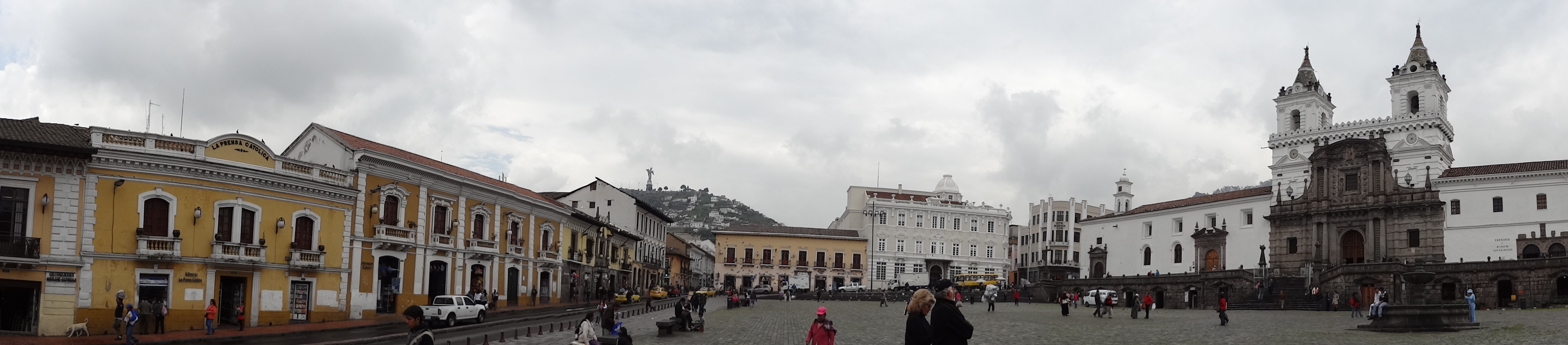
Basilica and Convent of San Francisco, Quito
The Franciscans arrived in Quito two years after the Spanish foundation of the city and chose their ground carefully. They asked the Cabildo for land that had once held the royal palace of Huayna Capac, the Inca emperor, and before that had been the ceremonial heart of the Quitu and Caranqui cultures. The site had been burned to rubble by the Inca general Ruminahui when he realized he could not defend the city. The Spanish would rebuild here, and above the buried foundations of empires they would raise the largest architectural complex in the historic centers of all South America.
Three and a Half Hectares of God
Construction began in 1537. It would continue for more than 150 years. The complex that eventually emerged - the Basilica and Convent of San Francisco, known to Quitenos simply as el San Francisco - covers three and a half hectares and holds thirteen cloisters, three temples, a vast atrium, and roughly 40,000 square meters of built space. The Spanish called it El Escorial of the New World, comparing it to Philip II's monumental palace-monastery outside Madrid. That comparison alone suggests the scale. The current building was largely completed by 1680, though the formal inauguration did not come until 1705. The entire atrium is cut from andesite stone quarried from the Pichincha volcano that looms to the west of the old city.
The Men from Ghent
The story of this place is inseparable from two Flemish clerics named Jodoco Ricke and Pedro Gosseal, who arrived from Ghent bearing European Franciscan authority and, conveniently, blood relation to Emperor Charles V. They managed to secure plots on the southwest side of what would become Plaza Mayor. The cabildo first assigned them two city blocks. By 1538, through successive adjudications, the Franciscan footprint had grown to more than three hectares. The hill on which the complex stands had to be engineered, with water drainage for the natural ravines built into the foundation. The mannerist-baroque facade, fronted by a concave-convex staircase considered one of the great architectural achievements of the colonial Americas, still faces the Plaza de San Francisco where for generations a central fountain supplied the city's water.
The Quito School
Inside the church and its convents are more than 3,500 works of colonial art. This is not a vague estimate - it is a cataloged inventory. Most of what hangs on these walls, stands in these altarpieces, or peers from these niches belongs to the Colonial Quito School of Art, a style born precisely in these courtyards and spread from here across the Spanish Americas. The workshops trained indigenous, mestizo, and criollo artists in European techniques, and what emerged was something distinct: a fusion of Andean sensibility with Spanish baroque sensibility, visible in the saints with high cheekbones and dark eyes, in the polychromed wood, in the obsessive gold leaf. The Franciscan library inside the complex was, in the 17th century, described as the finest in the entire Viceroyalty of Peru.
The Virgin and the Sculptors
Among the treasures, a handful stand out by name. Bernardo de Legarda carved the Virgin of Quito in the 18th century - a winged Virgin crushing a serpent, supposedly modeled on the sculptor's restless young niece. The sculpture's mobility, its sense of being caught mid-motion, gives it a visual appeal that has made its replicas the standard diplomatic gift from the Quito city council to visiting dignitaries. Manuel Chili, the indigenous master known as Caspicara, carved Saint Peter of Alcantara, the Transit of the Virgin, and a San Jose whose tenderness has moved viewers for two centuries. Jose Olmos, called Pampite, produced a Judas Betrayal in the 17th century. Every Good Friday, the Jesus del Gran Poder - Jesus of the Great Power - is carried through the streets in one of Ecuador's two largest religious processions, surrounded by curucuhos and penitents in the purest medieval style, evoking the Seville of an earlier age.
What the Earth Shook
The 1868 earthquake brought down the tops of the spires. The complex has been rebuilt, renovated, and restored many times, most recently between 1983 and 1990, when archaeological excavations beneath the nave, cloisters, atrium, and plaza turned up pre-Columbian ceramics from the Inca, Caranqui, and Panzaleo cultures. The evidence buried beneath the convent confirmed what colonial chroniclers had reported: that this ground had held religious significance for centuries before the Franciscans arrived. On its surface today, San Francisco continues to function. Masses are still said. Cloisters still shelter friars. Hundreds of the faithful kneel daily before altarpieces coated in gold leaf, asking for intercessions. The building is active in a way many colonial monuments no longer are. Its continuous use may be what has preserved it best.
From the Air
Coordinates 0.22 S, 78.52 W. Located in the Historic Center of Quito at approximately 2,850 meters elevation. Part of the UNESCO World Heritage Site 'City of Quito.' The Pichincha volcano rises to the west of the city at 4,784 meters. Best viewing altitude 12,000-15,000 feet. Nearest major airport: Mariscal Sucre International (SEQM), about 18 km northeast of central Quito.