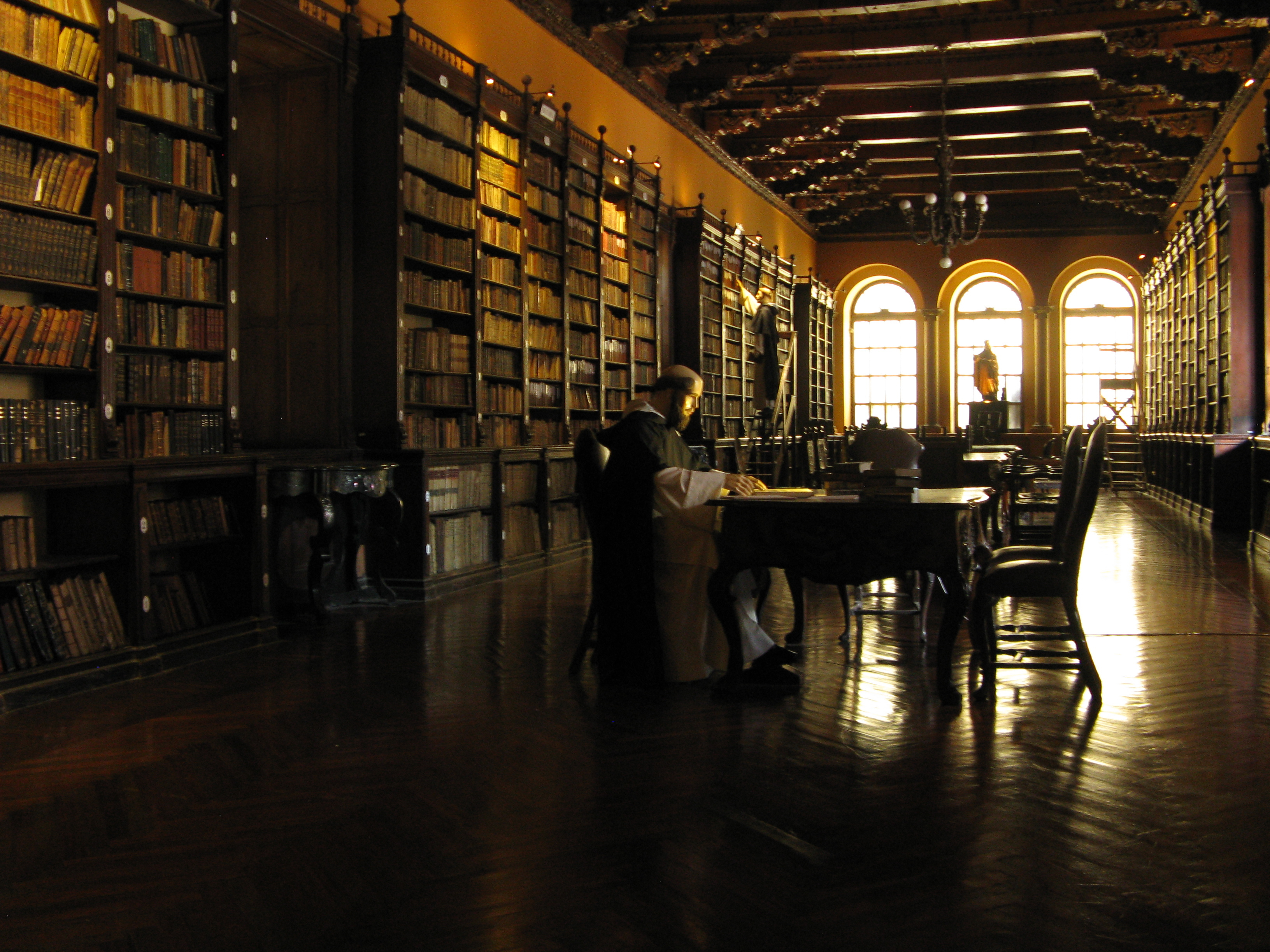
Basilica and Convent of Santo Domingo, Lima
Three thousand pieces of carved wood fit together by pressure alone, not a single nail among them. The artesonado ceiling in the guest room of Lima's Convent of Santo Domingo has held since 1580, surviving the earthquakes that flattened most of the city around it. Beneath that ceiling, composer José Bernardo Alcedo wrote the notes of Peru's national anthem. The building has a talent for sheltering things that endure.
Born with the City
Construction began in the 1530s, at the same moment Francisco Pizarro was laying out the grid of Lima itself. The Dominican order broke ground on its convent almost simultaneously with the city's founding, and the project took fifty years to complete. Friar Tomás de San Martín launched the work; Friar Sebastián de Ayllón finished it in 1578, with financial help from the Spanish Crown. But what the friars built, the earth destroyed. The earthquake of 1678 leveled the original structure entirely. Dominican architect Diego Maroto, born in Camarena in Spain's Toledo province, designed the replacement — a church with six cloisters and several courtyards. Then the earthquakes of 1687 and 1746 struck again, forcing yet more rebuilding. The materials evolved with each iteration: adobe and brick reinforced with quincha, a flexible lattice of wood and cane that absorbs seismic shock rather than resisting it. The convent learned to bend rather than break.
A Tower Designed by a Viceroy
The bell tower that rises 46 meters above the complex is its most recognizable feature, painted in its original white and pink. The first tower, a three-bodied Baroque design by Diego Maroto, fell in the earthquake of October 28, 1746. Its replacement came from an unlikely architect: Viceroy Manuel d'Amat i de Junyent, who conceived and designed it himself in 1766 in the Rococo style. The octagonal base supports two tall bodies with small balconies on corbels, and at the summit stands a figure holding a trumpet — the angel announcing the Final Judgment. The tower's base still preserves the rough bossage stonework that once covered the facade of Maroto's original church, a geological layer of architectural memory visible to anyone who looks closely enough.
Saints and Scholars
The convent's most significant residents never left. The remains of Saint Rose of Lima, the first person born in the Americas to be canonized, rest in a reliquary beneath the altarpiece of the Peruvian Saints. Beside her lie Saint Martin de Porres, the son of a Spanish nobleman and a freed enslaved woman of African descent, and Saint John Macias, who was born in Spain but is claimed as Peruvian because he lived his religious life in Lima. A sculpture of Saint Rose, carved by Maltese artist Melchor Caffá in 1669 on behalf of Pope Clement IX for her beatification, rests at the altar's base. Beyond saints, the convent housed the University of San Marcos, officially the oldest university in the Americas, inaugurated in 1551 in the Chapter House. The baroque tribune from which professors lectured, with its Solomonic columns and a painting of Saint Thomas Aquinas, still stands.
Seville on the Pacific
Walking the main cloister is like stepping into a corner of Andalusia transplanted across an ocean. Sevillian azulejos — glazed ceramic tiles — dating from 1604 and 1606 line the four galleries. Paintings depicting the life of Saint Dominic, contracted in 1608 from the Sevillian artists Miguel Güelles and Domingo Carro, hang above them. The cloister's artesonado ceilings are carved from oak imported from Panama. In the choir, cedar brought from Nicaragua was worked into what is considered the oldest choir stall in Peru, a Renaissance piece with Mannerist elements carved in part by Juan Martínez de Arrona between the late 16th and early 17th centuries. Every surface in the convent speaks of trade routes and colonial ambition: materials from Central America, artisans from Spain, and a devotional effigy of Our Lady of the Rosary that tradition says was gifted to Lima by Emperor Charles V himself.
Still Standing
The church was elevated to the rank of Minor Basilica in 1930, and damaged again by the earthquake of 1940 — which left cement patches on the walls where centuries of adobe had cracked. The Rímac River, whose changing course swallowed the convent's apple orchard, continues to press against the complex from the north. Yet the convent endures. The turquoise-and-gold neoclassical altar still catches the light. The bronze holy water font where, according to writer Ricardo Palma, Saint Martin de Porres washed bread of brown sugar until it turned white still sits in the cloister. Nearly five hundred years after the Dominicans broke ground alongside Pizarro's new city, their complex remains one of Lima's most concentrated repositories of colonial art, sacred relics, and architectural resilience.
From the Air
Located at 12.044°S, 77.032°W in the Historic Centre of Lima, on the north bank of the Rímac River. The 46-meter bell tower is visible from low altitude as a white-and-pink vertical element amid the colonial roofscape. From 3,000–5,000 feet AGL, the convent occupies a large footprint northwest of the Plaza Mayor. Nearest airport is Jorge Chávez International (SPJC/LIM), approximately 10 km west. Lima's coastal fog and marine layer are common, particularly June through November.