Basilica Cistern
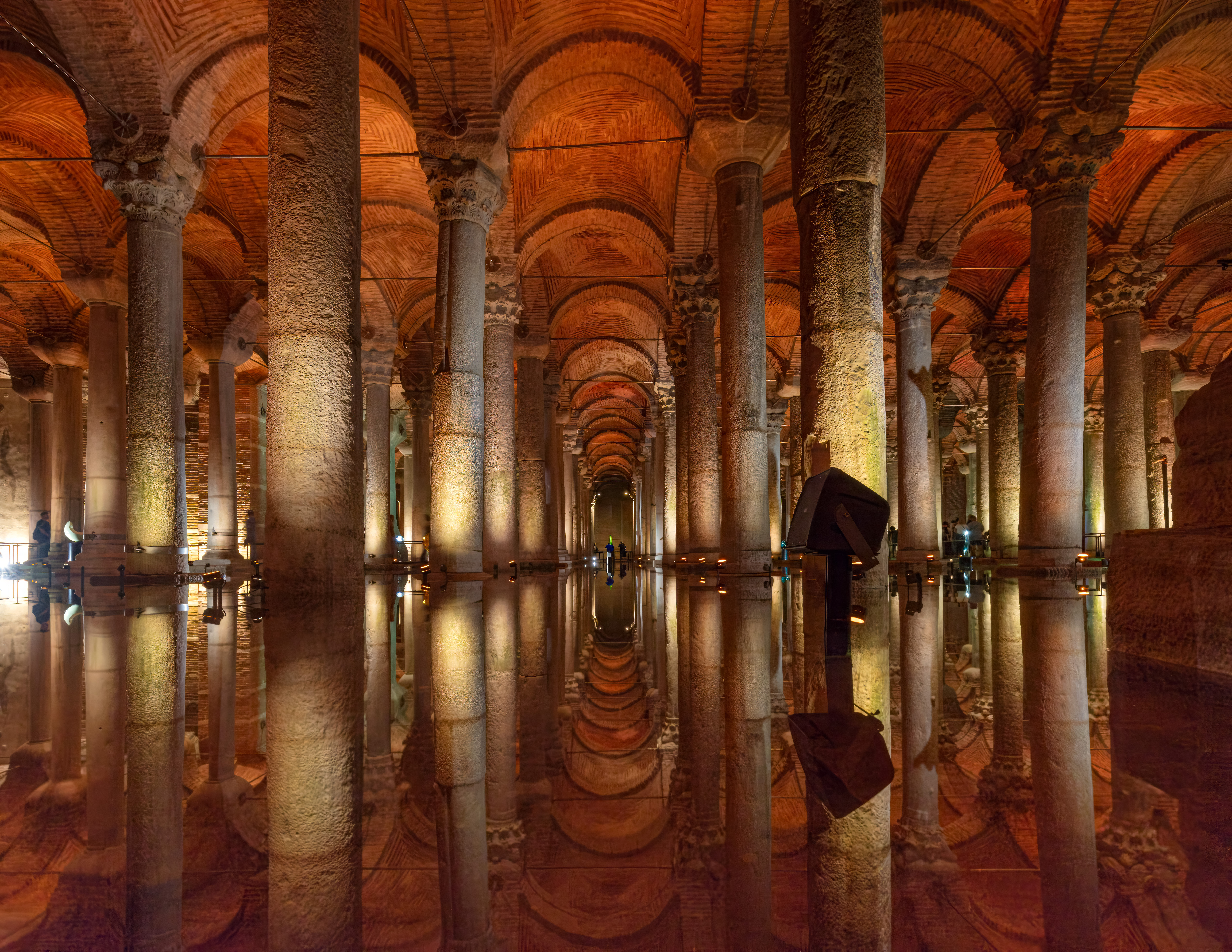
Walk down the steps off Yerebatan Street and the air changes before the eyes do. It gets cool. It gets damp. There is the small shock of stepping below the noise of Sultanahmet into a forest of marble columns standing in shallow water, lit now by careful LED arrangements that throw long shadows across vaulted brick ceilings. The Basilica Cistern is the largest of several hundred ancient cisterns under Istanbul, and it was built in the sixth century during the reign of the Byzantine emperor Justinian I to supply water to the Great Palace just up the hill. It was called the Basilica Cistern because there had once been a basilica on the public square above it, the Stoa Basilica on the First Hill of Constantinople. The basilica is gone. The cistern, fifteen hundred years later, is still here.
Justinian's Water Engine
The numbers help. The chamber is roughly 138 by 65 meters, an interior of about 9,800 square meters, capable of holding 80,000 cubic meters of water. Three hundred and thirty-six marble columns, each nine meters tall, rise in twelve rows of twenty-eight, spaced five meters apart. Most of the capitals are Ionic and Corinthian, with a few plain Doric ones thrown in. The columns are not original to the cistern. They are spolia, recycled from older Roman buildings around the empire and shipped to Constantinople, the same imperial recycling program that filled the Hagia Sophia 150 meters to the northeast. Look closely and you can see the mismatch: column shafts of different marbles, capitals of different orders, one famous shaft carved with a peacock-eye pattern that resembles a fragment of the fourth-century Triumphal Arch of Theodosius I. Justinian's engineers did not waste a usable column.
The Two Medusas
In the northwest corner, two columns rest on blocks carved with the face of Medusa. One head lies on its side. The other is upside down. No one knows where the carved blocks came from. They were probably scavenged from a late Roman building like everything else, but they were placed here deliberately. Tradition says the orientation was meant to negate the Gorgon's gaze: a Medusa whose eyes do not meet yours cannot turn you to stone. Whether the sixth-century masons believed that or simply needed the right size of supporting block remains an open question. What is certain is that the placement turned the cistern into one of the most quietly atmospheric sites in Istanbul, two pre-Christian goddesses pressed into Christian service, holding up the foundations of an emperor's water supply.
From Disuse to Discovery
After the Ottoman conquest in 1453, the cistern's existence faded from public memory. Locals still drew water from it, and there are stories of householders in the neighborhood lowering buckets through their basement floors and occasionally pulling up fish. The Dutch traveler Petrus Gyllius rediscovered it for European scholarship in the sixteenth century by following those rumors. Modern restoration began with the Istanbul Metropolitan Municipality between 1985 and 1987, when elevated wooden walkways were installed and the cistern opened to the public. A more comprehensive restoration ran from 2020 to 2022 by the IBB Miras team. They removed roughly 1,440 cubic meters of mid-twentieth-century concrete and 1,600 cubic meters of accumulated sediment, exposing the original sixth-century Byzantine brick floor for the first time in decades. New LED lighting and sensors went in. The site is protected under Turkey's Law No. 2863 as a first-degree archaeological site, which mandates that any future intervention be reversible.
The Cistern in the Imagination
There is a reason this place keeps showing up in films and novels. James Bond met a contact here in From Russia with Love in 1963, although the script invented a ridiculous geography that placed the cistern under the Soviet consulate, which is across the Golden Horn in Beyoglu. Dorothy Dunnett used it in Pawn in Frankincense in 1969. The reservoir under the palace in Garth Nix's Old Kingdom series was inspired by it. Dan Brown wrote it into Inferno in 2013, with the inverted Medusa pillar at the center of the plot, and the 2016 film adaptation followed. Ezio Auditore explores it in Assassin's Creed: Revelations. It is even one of the two Castle Age landmarks for the Byzantines in Age of Empires IV, named the Cistern of the First Hill. The reason is obvious once you have stood in it: this is what an underground city looks like when it is real, when the columns are old, when the water is shallow but persistent, when the ceiling drips. You cannot fake the patience of stone.
From the Air
Located at 41.008N, 28.978E in the Sultanahmet district of Istanbul on the historical peninsula of Sarayburnu. The cistern lies about 150 meters southwest of the Hagia Sophia and is reached by stairs from the surface; from above, it is invisible. Recommended viewing altitude 3,000 to 5,000 feet for a clear sense of the First Hill, with the Hagia Sophia, Sultan Ahmed Mosque, Topkapi Palace, and Bosphorus all in one frame. Nearest airport is Istanbul Airport (LTFM) about 35 kilometers northwest, with Sabiha Gokcen (LTFJ) on the Asian side. The Sea of Marmara opens to the south, the Golden Horn cuts in from the west, and the Bosphorus runs north toward the Black Sea. Best in late afternoon when the low sun lights the domes.