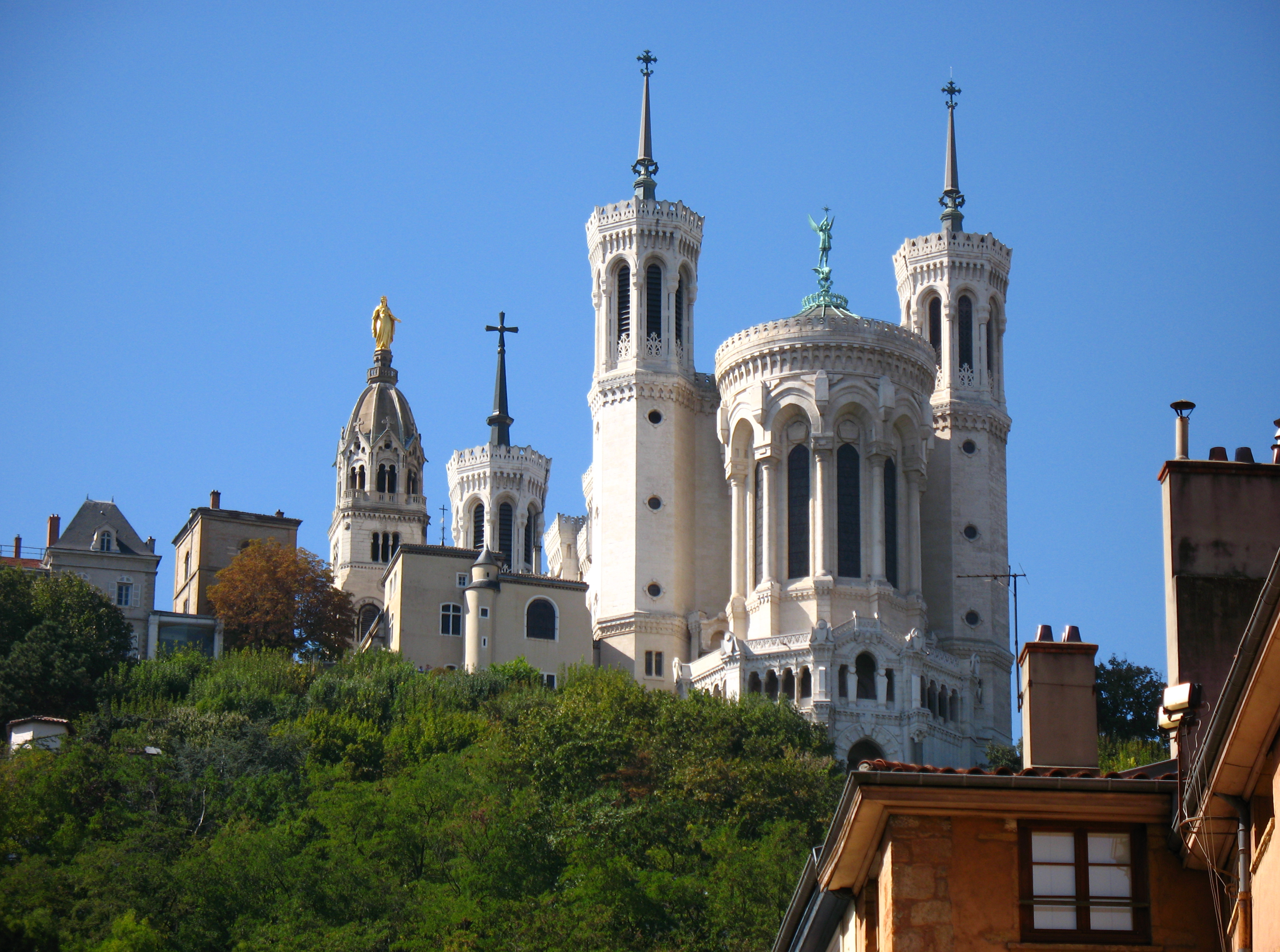
Basilica of Notre-Dame de Fourviere
Lyonnais locals call it "the upside-down elephant" -- the four octagonal towers look like legs, the main nave like a body suspended above the city. The Basilica of Notre-Dame de Fourviere is not subtle. Perched on the hill that dominates Lyon's skyline, it was designed to be seen from everywhere below, a statement of faith so emphatic that it borders on defiance. The site itself carries layers of meaning that reach far deeper than the 19th-century walls. Before the basilica, before the medieval chapel, this hilltop held the Roman forum of Trajan -- the forum vetus, or old forum -- from which the name Fourviere descends through centuries of French corruption.
A City's Bargain with the Virgin
Fourviere's story is inseparable from Lyon's recurring conviction that the Virgin Mary has personally intervened to save the city. The tradition dates to 1643, when bubonic plague was ravaging Europe and Lyon's civic leaders made a formal vow to the Virgin, pledging devotion in exchange for deliverance. The plague receded, and Lyon credited Mary. When cholera struck in 1832, the city turned to Fourviere again. When Prussian armies threatened during the Franco-Prussian War of 1870, Lyonnais prayed at the hilltop shrine -- and when the city was spared, they committed to building the present basilica alongside the older chapel. Every December 8, the Feast of the Immaculate Conception, Lyon repays the debt: candles appear in windows across the city in the Festival of Lights, or Fete des Lumieres, one of France's most spectacular annual celebrations.
Two Churches, One Ambition
Fourviere is actually two churches stacked vertically. The lower church is restrained and simple. The upper sanctuary is anything but -- a riot of gold, mosaic, and ornamentation that took decades to complete. Construction began in 1872, funded entirely by private donations, and the structural work was finished by 1884. But the interior decoration continued for another 80 years; finishing touches were not completed until 1964. The architect Pierre Bossan drew his first sketches as early as 1846, while living in Palermo, where he absorbed the Byzantine-influenced gold-leaf mosaics of the Monreale Cathedral and the Palatine Chapel. That Sicilian influence saturates Fourviere's interior -- walls gleaming with gold mosaic in a style more commonly associated with Constantinople than with central France. The basilica receives 2 million visitors annually and contains a Museum of Sacred Art and a crypt dedicated to Saint Joseph.
Birthplace of Religious Orders
The hilltop shrine predates the basilica by centuries, and its significance to French Catholicism extends beyond Lyon. On July 23, 1816, twelve Marist aspirants -- priests and seminarians -- climbed the hill and placed their promise to found the Society of Mary under the corporal on the altar during Mass celebrated by Jean-Claude Courveille. Five years later, on September 30, 1821, Andre Coindre and ten others made private vows in the chapel, founding the Brothers of the Sacred Heart, a teaching order devoted to educating youth. In 1851, Peter Julian Eymard prayed at the shrine and was inspired to establish the Congregation of the Blessed Sacrament. Three distinct religious communities trace their origins to this single hilltop -- a concentration of founding moments that makes Fourviere one of the most consequential sites in 19th-century Catholic history.
The Forum Beneath the Faith
The name gives it away. Fourviere derives from forum vetus -- the old forum -- marking this as the administrative heart of Roman Lugdunum, one of the most important cities in Roman Gaul. Trajan's forum occupied this hilltop nearly two thousand years ago, and the layers have been accumulating ever since. Roman foundations, a medieval chapel, the vow of 1643, the 19th-century basilica -- each era built literally and figuratively on the one before it. From the esplanade beside the basilica, the view sweeps across Lyon's two rivers, the Rhone and the Saone, across the red-roofed old town below, and out to the Alps on clear days. It is a view that Roman administrators, medieval pilgrims, and 21st-century tourists have all shared, each seeing a different city from the same commanding height.
From the Air
Located at 45.76°N, 4.82°E atop Fourviere hill in Lyon. The basilica's distinctive white facade and four towers are prominently visible from the air, dominating the western skyline of the city. Lyon sits at the confluence of the Rhone and Saone rivers. Nearest airports: Lyon-Saint Exupery (LFLL) approximately 25 km east, and Lyon-Bron (LFLY) approximately 8 km east. The basilica's relationship to the old town below and the river confluence is best appreciated from moderate altitude.