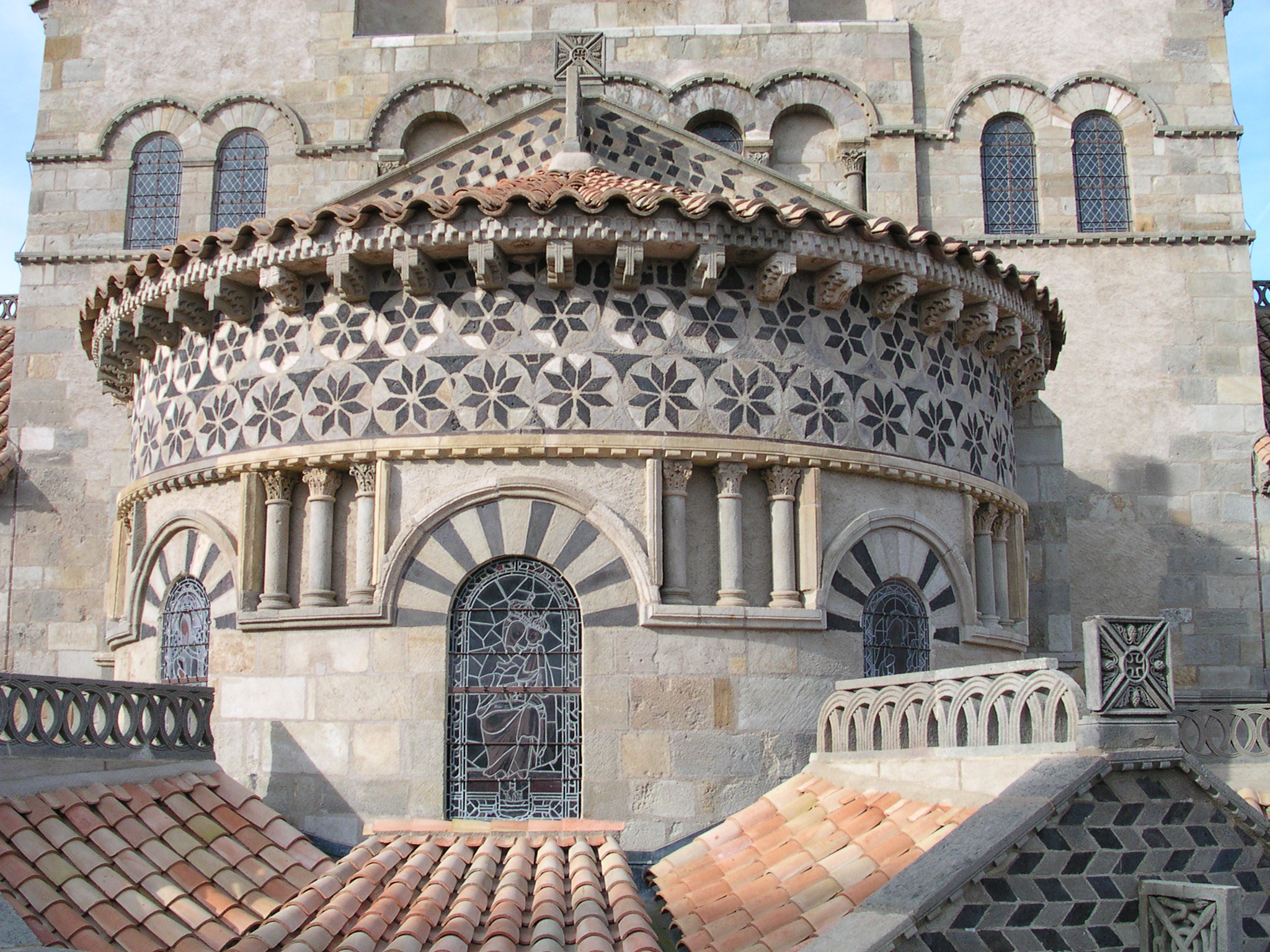
Basilica of Notre-Dame du Port
The name is misleading. Notre-Dame du Port sits nowhere near a harbor. The word 'port' derives from the Latin portus, meaning 'market' rather than 'seaport,' though even this explanation is disputed — the Port district was not especially commercial in the Middle Ages. What is beyond dispute is the building itself: a Romanesque basilica in the heart of Clermont-Ferrand whose proportions have been analyzed, measured, and celebrated for their near-perfect harmony, supposedly derived from the ratio of the Golden Number.
Five Sisters in Stone
The basilica belongs to an exclusive group. It is one of five Romanesque churches in Auvergne designated as the 'greater' churches, or majeures, alongside Saint-Austremoine in Issoire, Notre-Dame of Orcival, the church of Saint-Nectaire, and the church of Saint-Saturnin. Together, these five define the Auvergnat Romanesque style: restrained exteriors, powerful massing, and interiors that achieve grandeur through proportion rather than ornament. Notre-Dame du Port is built of arkose, a form of sandstone that gives its walls a warm, golden tone quite distinct from the black volcanic stone of Clermont-Ferrand's nearby Gothic cathedral. The contrast between the two churches, visible within a short walk, encapsulates centuries of architectural evolution.
Capitals That Tell Stories
The sculpted capitals of Notre-Dame du Port are considered among the finest in all of Auvergne. Perched atop columns in the choir and ambulatory, they depict scenes drawn primarily from the Bible but also from the Psychomachia of the Roman poet Prudentius — an allegorical battle between virtues and vices that medieval worshippers would have read as a moral instruction manual carved in stone. The chevet, with its radiating chapels and fine mosaics, exemplifies the Romanesque art of the region. Four chapels open from the ambulatory, none placed on the main axis, creating an asymmetry that somehow enhances the building's visual balance.
Burned, Rebuilt, and Consecrated Again
Tradition holds that the church was founded in the 6th century by Avitus, Bishop of Clermont, then burned by Norman raiders and rebuilt in the 11th or 12th century. A community of canons served the church from at least the mid-10th century under Bishop Étienne II of Clermont, first as regular canons and later as secular ones. The church was formally declared a basilica minor on 3 May 1886. In the 19th century, a bell tower was added and the Romanesque roof tiles were replaced with lava slabs — a misguided modernization later reversed when restorers worked to return the roof to its original state. A major interior restoration between 2007 and 2008 cleaned every stone surface, removed 19th-century cement pointing, and restored the paintings.
Pilgrims' Way
In 1998, the basilica was inscribed on the UNESCO World Heritage list as part of the Routes of Santiago de Compostela in France. The designation connected this quiet church in a Clermont-Ferrand neighborhood to a continental network of pilgrimage roads stretching to the cathedral of Santiago in northwestern Spain. On 7 December 2008, the statue of Notre-Dame du Port — Our Lady of the Port — was reinstalled in the church after being kept safe in Clermont Cathedral during restoration works, marking the building's reopening to the public. The church sits on a Latin cross plan with a six-bay nave flanked by low side aisles with simple vaults, a transept with a semicircular chapel on each arm, and that celebrated chevet that draws architecture students from across Europe.
From the Air
Located at 45.78°N, 3.09°E in Clermont-Ferrand, between Place Delille and the Gothic cathedral. Clermont-Ferrand Auvergne Airport (LFLC) is the nearest field. The basilica is less visually prominent from the air than the black Gothic cathedral nearby, but sits in the historic Port quarter of the city. Recommend viewing the wider Clermont-Ferrand historic center at 3,000-5,000 ft AGL.