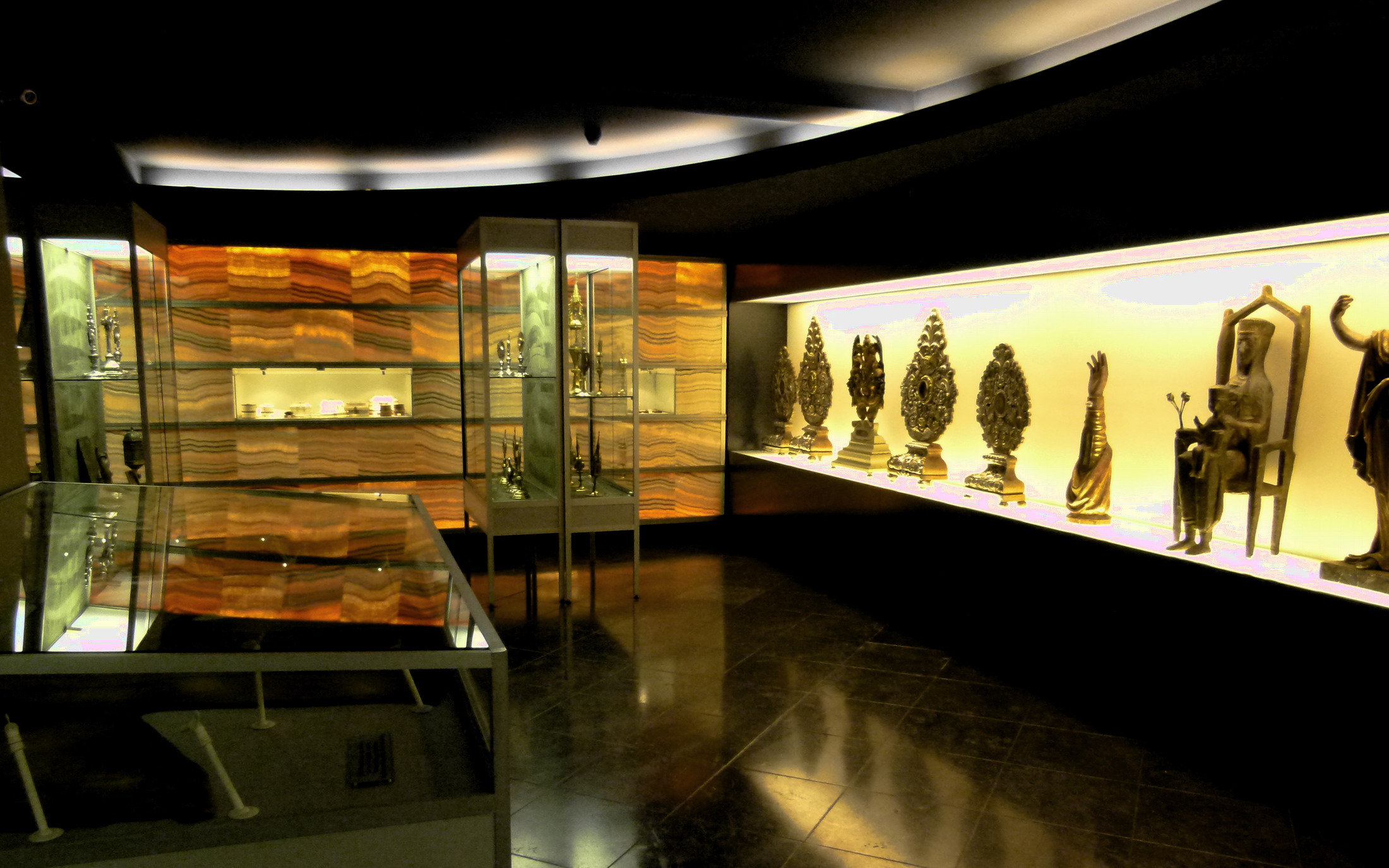
Basilica of Our Lady, Maastricht: The Star of the Sea
Step through the medieval Gothic portal off the Onze Lieve Vrouweplein and your eyes need a moment to adjust. The architect Pierre Cuypers wanted it this way. When he restored the church between 1887 and 1917, he replaced the wide Gothic windows of an earlier renovation with narrow Romanesque ones, deliberately darkening the interior to recover what he believed an eleventh-century church should feel like: heavy, mystical, candle-lit. Cross to the Star of the Sea chapel and the room concentrates around a single object - a fifteenth-century wooden statue of the Virgin Mary, blackened by centuries of candle smoke, draped in a stiff embroidered mantle, surrounded by hundreds of small flames left by pilgrims. People kneel here every day, all year, in numbers that have not stopped for centuries.
On Top of a Roman Town
Nobody has done a proper archaeological dig under this floor, so much remains speculation. What is clear is the geography: the church sits inside the perimeter of the Roman castrum that became Maastricht, next door to a shrine that was once dedicated to Jupiter. The hypothesis - reasonable but unproven - is that the city's first Christian church was raised here in the fourth or fifth century, and that this building became the cathedral of the diocese of Tongeren-Maastricht when the bishop's seat moved south. Whatever stood here then, the surviving structure is what canons started building in the eleventh century. The massive westwork - the fortress-like tower complex at the western entrance - was begun shortly after the year 1000 from carbonic sandstone, with small Roman spolia visible in the lower courses, stones the builders salvaged from the old Roman walls and quietly reused.
The Rivalry Across Town
For most of the Middle Ages, Maastricht had two religious chapters in open competition. Saint Servatius', dating from the sixth century, was the politically powerful one - bound to the Holy Roman Emperors, governed by provosts drawn from Germany's noble houses. Our Lady's was a smaller chapter of around twenty canons, appointed by the prince-bishop of Liege, who picked his provosts from the chapter of Saint Lambert's Cathedral. Parishioners here were even classified in old documents as the Familia Sancti Lamberti - the Liege family. The two chapters squabbled regularly. At one famous flashpoint, the canons of Saint Servatius complained that Our Lady's was displaying its relics outdoors, a privilege Servatius claimed for itself alone. Both churches profited handsomely from the pilgrims those relic displays drew.
Carved Stories in Stone
The architectural sculpture inside Our Lady's is some of the finest of the entire Mosan school. In the choir ambulatory, twenty deeply carved Romanesque capitals depict scenes from the Old Testament along with monsters, birds, naked human figures tangled in foliage, and people wrestling with animals - the medieval imagination at full volume. One capital is famously signed Heimo, probably the carver, possibly the small kneeling figure on the stone itself, handing a finished capital to the Virgin Mary. The capitals in the nave and the choir gallery are slightly later and tamer. Art historians have linked this stonework directly to its rival across town at Saint Servatius, to Saint Peter's in Utrecht, and to the Schwarzrheindorf double chapel in Bonn - a network of master carvers moving along the Meuse and Rhine in the second half of the twelfth century.
Stables and Survivors
Then came the French. After Maastricht was absorbed into the French First Republic in 1794, the religious chapter was dissolved in 1798, and the church and cloisters were handed over to the military garrison. For nearly forty years, this Romanesque masterpiece served as a blacksmith's shop and stables. The 1380 inventory had recorded thirty-three altars; almost all of them disappeared. Treasures were melted down to pay war taxes or carried off privately. A beautiful baptismal font cast around 1500 by the Maastricht metalworker Aert van Tricht survived, but stripped of its ornaments. Even after the church returned to worship in 1837, blunders continued. A tenth-century reliquary said to contain the largest known particle of the True Cross, and the so-called pectoral cross of Constantine - both probably brought back from Constantinople by crusaders - were simply given away by a former canon. They sit today in the treasury of Saint Peter's in Vatican City.
The Star of the Sea
The wooden Madonna that draws the pilgrims was not originally Our Lady's. She was carved in the fifteenth century for a nearby Franciscan monastery, moved to the parish church of Saint Nicholas in 1801, and finally brought here in 1837 when Saint Nicholas was demolished. In 1903 she was installed in the Gothic chapel near the main entrance, where she remains. Pope Pius X granted her a formal coronation on 15 August 1912, performed by the Bishop of Roermond. Twice a year she is carried through the streets of Maastricht in religious procession. The chapel is small and the air smells of wax and old wood. People come with petitions, light a candle, kneel, and sit for a while. Whatever else this building has been - cathedral, collegiate church, stable, museum of Mosan art - this small dim room is what the city actually uses it for.
From the Air
The Basilica of Our Lady stands at 50.848N, 5.693E, in the historic centre of Maastricht just west of the Maas (Meuse) river. From the air the church is identifiable by its tall, massive westwork - two narrow towers with stone Rhenish-helm roofs - close to the second main church silhouette of Maastricht, the Basilica of Saint Servatius half a kilometre northwest. The river bend through the medieval centre is the clearest orientation cue. Nearest airport: Maastricht-Aachen (EHBK) 10km northeast; Liege (EBLG) 30km south; Brussels (EBBR) 95km west.