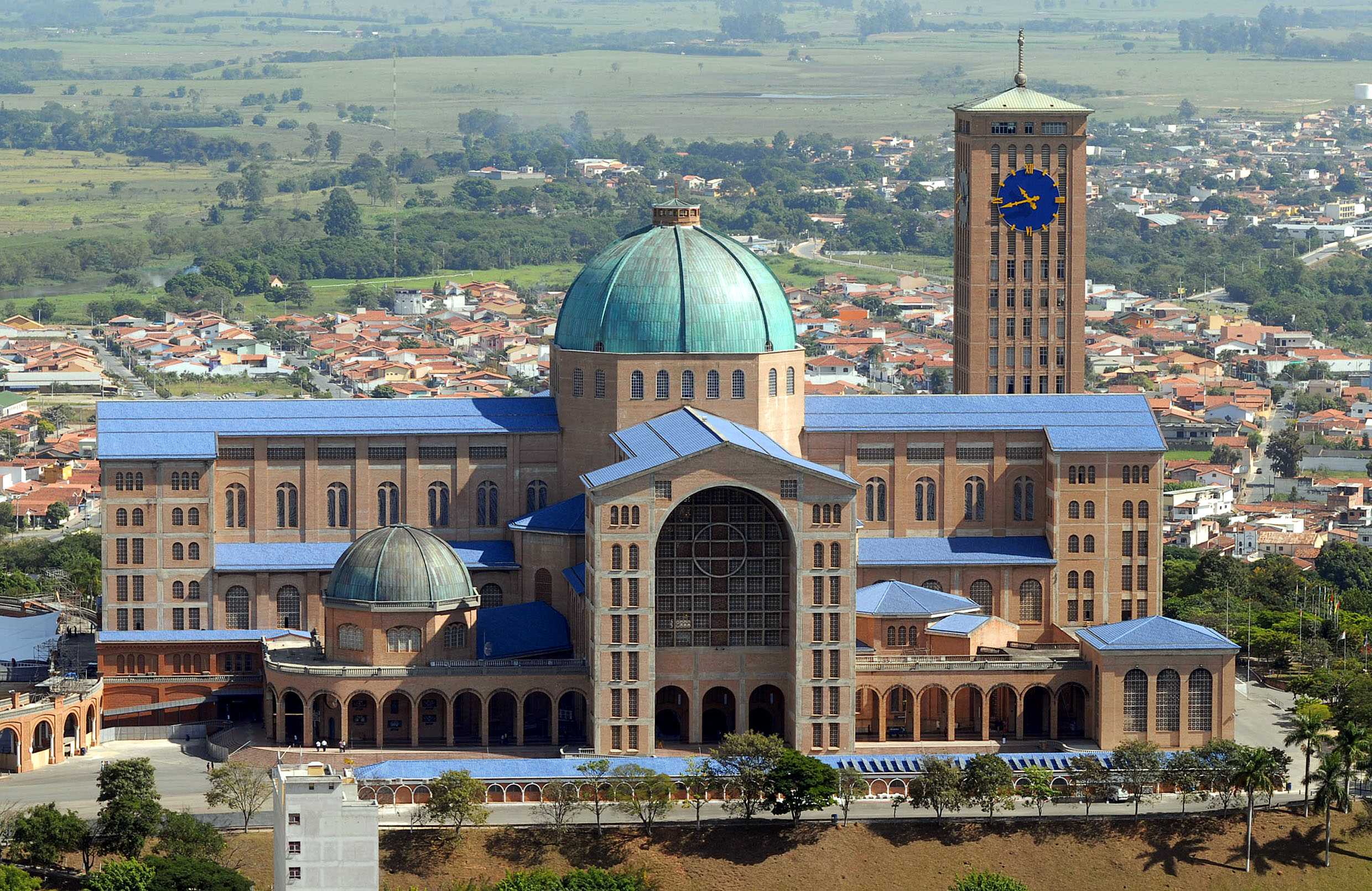
Basilica of Our Lady of Aparecida
In 1717, three fishermen cast their nets into the Paraiba do Sul River, hoping to fill them for a banquet honoring the visiting governor of Sao Paulo. The fish were not biting. Late in the day, one fisherman pulled up his net to find something unexpected: a small, headless clay statue of the Virgin Mary, darkened by the river mud. On his next cast, he found the head. That broken figure, reassembled and housed first in a fisherman's home and then in a series of increasingly grand chapels, would become Nossa Senhora da Conceicao Aparecida -- Our Lady of Aparecida, the patroness of Brazil. The basilica built in her honor is now the second largest Catholic church in the world.
From a Fisherman's Shelf to a National Shrine
Filipe Pedroso, one of the three fishermen, took the statue home. Word spread, and visitors began arriving to pray before the small dark figure. The Pedroso family built a chapel to accommodate them. Over the centuries, the devotion grew from a local curiosity into a national phenomenon. Pope Pius X granted a canonical coronation to the image in 1904. In 1930, Pope Pius XI declared Our Lady of Aparecida the official patroness of Brazil, a papal bull signed in the presence of Cardinal Eugenio Pacelli, the future Pope Pius XII. By the mid-20th century, the old chapel could no longer hold the pilgrims, and plans for something far larger began to take shape on the Pitas hill overlooking the town.
Building a Colossus
Architect Benedito Calixto Neto designed the new basilica in the Romanesque Revival style, shaped as a Greek cross with arms stretching 188 meters in length and 183 meters in width. Construction began on November 11, 1955, starting from the north side. The Brasilia Tower came next, its metallic structure donated by President Juscelino Kubitschek. Then the central dome, rising 70 meters above the floor. The tower reaches 109 meters. The interior encompasses 25,000 square meters, and open-air celebrations on the grounds can accommodate 300,000 people. Pope John Paul II consecrated the sanctuary on July 4, 1980, while construction was still ongoing -- a measure of how urgently the faithful needed the space. The building was not yet finished, but the pilgrims had already arrived.
Three Golden Roses
The Vatican reserves its Golden Rose -- one of the oldest papal honors -- for places and people of exceptional significance. The Basilica of Aparecida has received it three times. Pope Paul VI bestowed the first in 1967, marking the 250th anniversary of the statue's discovery. Pope Benedict XVI delivered the second during his 2007 visit to Brazil, when he blessed the rose on Laetare Sunday and presented it at the shrine. Pope Francis gave the third in 2017, on the occasion of the 300th anniversary. No other church in Brazil has received even one. In 2016, the Vatican recognized the basilica as the cathedral of the Archdiocese of Aparecida, making it the seat of the local archbishop and cementing its status as the spiritual heart of Brazilian Catholicism.
A City Built for Pilgrims
The basilica is not just a church -- it is a small city designed to receive millions. A 392-meter walkway called the Passarela da Fe connects the old chapel to the new basilica; some pilgrims traverse it on their knees. Underground, the Sala das Promessas holds offerings left by the faithful. The support center, known locally as the Shoppinho, contains 380 stores across 36,000 square meters, along with a food court, an aquarium, and an amusement park. There are two baby care stations that serve roughly 300 children daily. The parking lot holds 2,000 buses and 3,000 cars. Two hundred security agents patrol the grounds year-round, supplemented by 400 military police during peak seasons. Every February, the Men's Rosary pilgrimage draws tens of thousands of men from across the country, a movement that now claims two million worshippers nationwide. The scale is staggering, but it follows logically from that first moment in 1717 when a fisherman's net came up heavy with something other than fish.
From the Air
Located at 22.85S, 45.23W in the Paraiba do Sul river valley between Sao Paulo and Rio de Janeiro. The basilica's massive Greek cross footprint and 109-meter tower are visible from considerable altitude. The nearest airport is Guaratingueta (SBGW), approximately 20 km to the northeast. Sao Jose dos Campos (SBSJ) lies about 80 km to the southwest. Guarulhos International Airport (SBGR) is roughly 170 km to the west. The Presidente Dutra Highway (BR-116) passes nearby, connecting Sao Paulo and Rio. The basilica grounds, with their enormous parking facilities, create a distinctive footprint visible from the air.