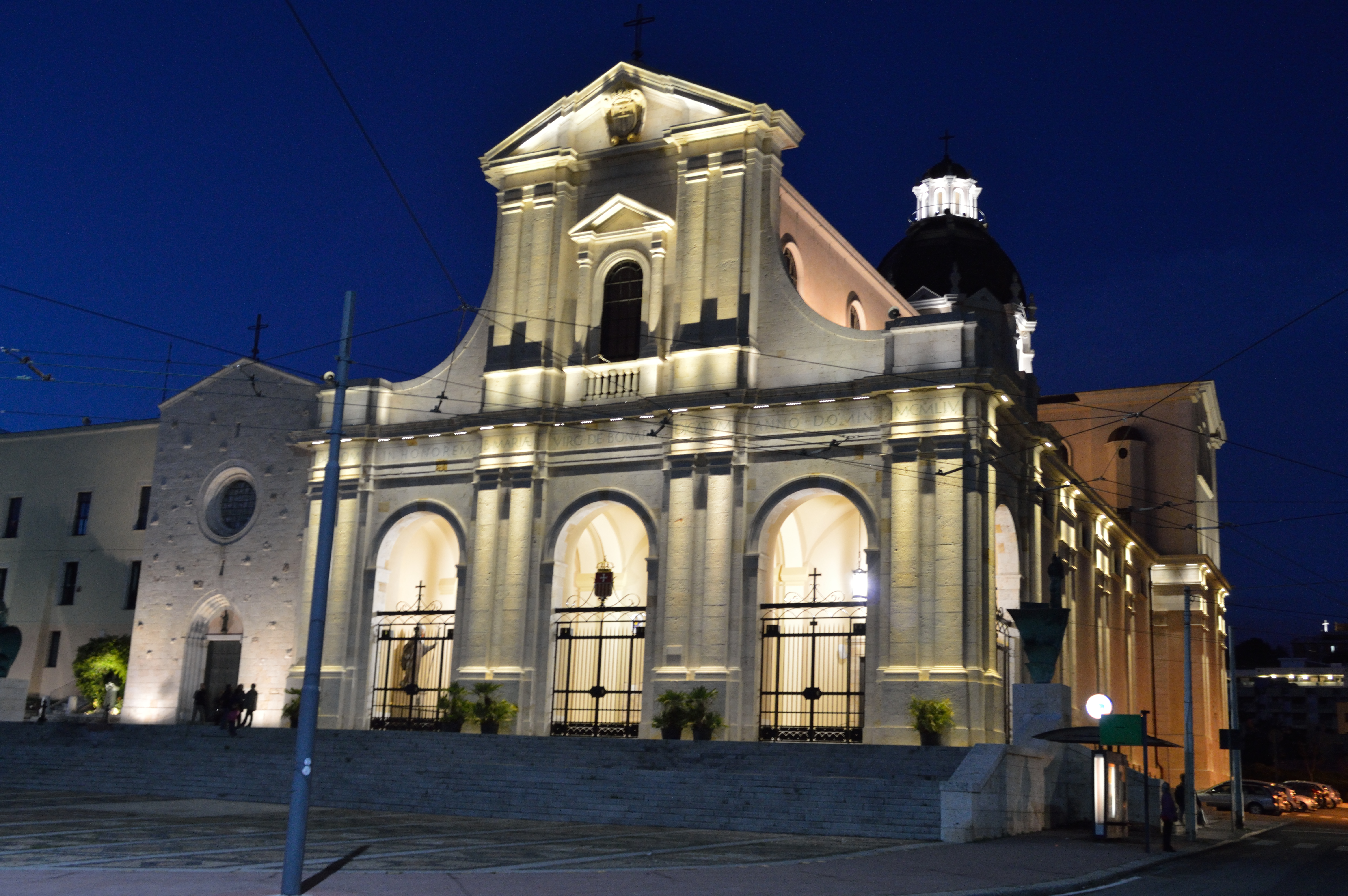
Basilica of Our Lady of Bonaria
Two hundred and fifty-six years. That is how long it took to build the Basilica of Our Lady of Bonaria, from the first stone laid in 1704 to the final completion in 1960. In between came changes of architect, changes of style, chronic shortages of money, and a world war that nearly destroyed it all. The basilica stands on a hill overlooking Cagliari's harbor, part of a complex of buildings that includes the original 13th-century sanctuary it was meant to absorb but never did. The two structures stand side by side now, the older sanctuary a modest companion to the grander church -- a pairing that says everything about the gap between ambition and history.
A Baroque Dream, Abandoned
When the Mercedarian friars -- the Order of the Blessed Virgin Mary of Mercy -- conceived the basilica in the early 18th century, they envisioned something magnificent. Antonio Felice De Vincenti, a military engineer, designed a grand Piedmontese baroque church that would enclose the original 13th-century sanctuary within it as a chapel. He even built a wooden model to show what the finished basilica would look like. But money ran out, and construction stalled. When work resumed decades later under De Vincenti's pupil Giuseppe Viana, the new architect rejected his master's elaborate vision. The baroque dream was set aside in favor of a more restrained classical design. What visitors see today is Viana's sober interpretation, not De Vincenti's exuberant original.
Bombs Over Bonaria
The basilica was still unfinished when the war arrived. In 1943, Allied bombers struck Cagliari repeatedly, targeting the port and airfields but devastating the city in the process. The Basilica of Our Lady of Bonaria suffered serious damage. Its frescoes were completely destroyed -- irreplaceable works of art reduced to dust and rubble in minutes. Other treasures were lost alongside them. The post-war reconstruction effort was painstaking and slow, stretching across decades. Cagliari's city council played a critical role in funding the restoration, which did not reach completion until Easter 1998. Inside the basilica today, near the entrance, a series of photographs documents the destruction and rebuilding -- before and after images that testify to both the violence of the bombing and the determination of those who pieced the church back together.
Seven Centuries of Mercedarian Care
The Mercedarian friars have overseen this site continuously since 1335 -- nearly seven centuries of unbroken stewardship. The Order of the Blessed Virgin Mary of Mercy was founded in 1218 in Barcelona to ransom Christians captured by Moors, and its presence in Sardinia reflects the island's deep connections to the Crown of Aragon and the broader Catalan-speaking world. The original sanctuary that predates the basilica remains standing beside it, a compact medieval structure that the grand church was once intended to swallow whole. Instead, both buildings survive, creating a shrine complex where centuries of Marian devotion are layered in stone. The basilica is dedicated to Our Lady of Bonaria, a title that connects to the Sardinian word for the hill on which it stands.
A Papal Blessing
On September 8, 2008, Pope Benedict XVI visited the basilica and bestowed upon it the honor of the Golden Rose, one of the oldest and most prestigious papal distinctions. The Golden Rose has been awarded since at least the 11th century, and receiving one marks a church as a site of particular significance to the Catholic faith. For a basilica that spent more than two and a half centuries under construction, endured wartime destruction, and required another half-century of restoration, the papal honor carried a particular resonance. The building that stands today is neither De Vincenti's baroque fantasy nor a pristine original -- it is something harder won, a church rebuilt from its own ruins by a community that refused to let it disappear.
From the Air
Located at 39.21N, 9.13E on the Bonaria hill in eastern Cagliari, overlooking the harbor. Best viewed at 2,000-3,000 feet; the basilica and adjacent older sanctuary are visible as a prominent hilltop complex. Nearest airport: Cagliari-Elmas (LIEE), approximately 7 km west. The Port of Cagliari is directly below to the south, providing a clear landmark.