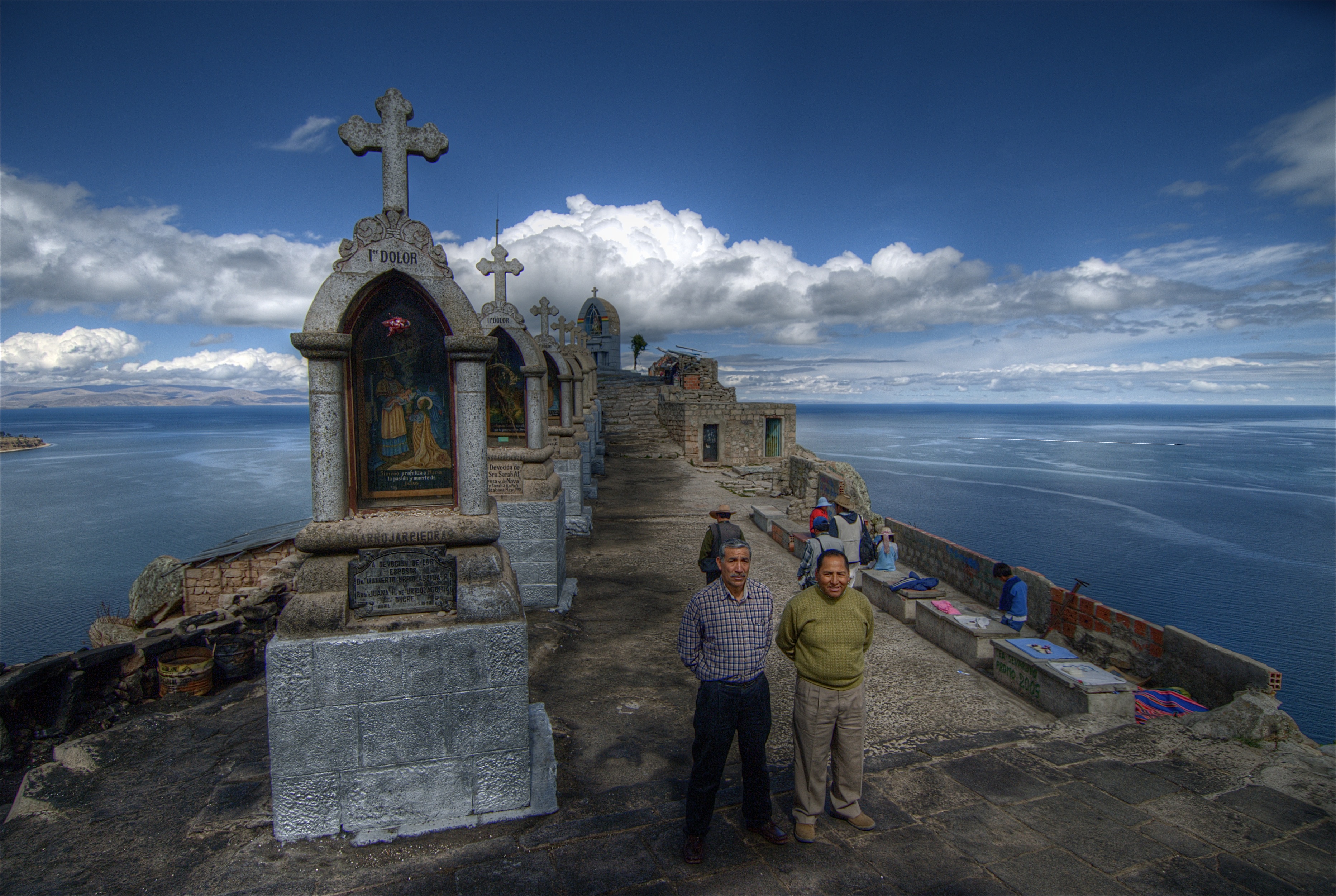
Basilica of Our Lady of Copacabana
Around 1576, an indigenous sculptor named Francisco Tito Yupanqui carved a wooden image of the Virgin of the Candelaria. The statue was not immediately accepted -- its creator faced skepticism about whether an indigenous artist could produce sacred art worthy of veneration. But the image was brought to Copacabana on the shores of Lake Titicaca, and miracles were soon attributed to its intercession. Within a few years, an adobe shrine rose at the foot of a steep hill on a site formerly known as the Temple of the Sun. Catholic faith did not replace Inca reverence here. It was built directly on top of it.
From Temple of the Sun to House of the Virgin
The site's sacred history stretches back long before Christianity reached the Andes. The Inca considered the area around Copacabana and Lake Titicaca to be a place of cosmic origin, and the hill where the basilica now stands held a Temple of the Sun. When the Spanish colonial administration and Augustinian friars established their presence, they chose this location deliberately, layering Catholic worship over indigenous sacred ground. The first adobe shrine was constructed around 1583. In 1589, the Order of Saint Augustine was entrusted with managing the site, and the friars established a monastery alongside the shrine. They kept meticulous records of miracles attributed to the Virgin -- a documentation practice that served both devotional and institutional purposes, building the case for the shrine's importance within the colonial church hierarchy.
Stone Over Adobe
The Augustinians built their first proper chapel between 1614 and 1618, replacing the original adobe structure. But the current building -- the one that stands today -- was constructed between 1669 and 1679 by Spanish architect Francisco Jimenez de Siguenza. Its whitewashed colonial facade and Moorish-influenced tilework face the lake, combining the architectural vocabulary of the Spanish Empire with the stark landscape of the altiplano. The building was elevated to the rank of Minor Basilica by Pope Pius XII on July 2, 1940, through the Pontifical decree Bolivianae Ditionis Intra, signed by Cardinal Luigi Maglione. That designation -- Minor Basilica -- places it among the most significant Catholic churches in the Americas, a status that reflects both the shrine's centuries of continuous pilgrimage and Bolivia's deep Catholic identity.
The Patroness of a Nation
Our Lady of Copacabana holds the title of patroness saint of Bolivia, one of only two principal sacred sites shared by both indigenous and Catholic communities in the country. The other is the Virgin of Urkupina near Cochabamba. The distinction is significant: Bolivia's religious landscape is not simply Catholic. It is a syncretic fabric where Andean cosmology and Christian devotion have been woven together over four centuries, sometimes in tension, often in quiet coexistence. Pilgrims travel from across Bolivia to Copacabana, and the Virgin's feast days draw crowds that transform the small lakeside town. The original statue carved by Yupanqui remains inside the basilica, dressed in elaborate garments and surrounded by offerings -- a work of indigenous artistry that became the spiritual center of a nation's faith.
What Thieves Took and What Remains
The basilica has not been immune to the vulnerabilities that affect sacred sites worldwide. At some point, thieves entered the building using a ladder stolen from a nearby telecommunications station and removed twenty-eight items, including a sculpture of the baby Jesus, from the Virgin's shrine. The theft was a violation that resonated beyond the material value of the objects -- these were devotional items that carried centuries of accumulated meaning for Bolivian Catholics. Yet the basilica endures, as it has since the 17th century. The whitewashed walls still face the cold blue waters of Titicaca. The hill behind still rises steeply, as it did when it held the Temple of the Sun. And Francisco Tito Yupanqui's carved Virgin still stands at the center of it all, an indigenous creation that became the most venerated image in Bolivia, proof that sacred power does not always flow from the conqueror downward.
From the Air
Located at 16.17S, 69.09W in the town of Copacabana on the southeastern shore of Lake Titicaca, Bolivia, at approximately 3,841 meters elevation. The basilica's white colonial facade is the most prominent structure in the small town, visible from the air as a distinctive building near the waterfront. Isla del Sol lies to the northwest across open water. Nearest major airport is El Alto International Airport (SLLP) near La Paz, approximately 150 km to the southeast. The building sits at the foot of a steep hill, with the broad expanse of Lake Titicaca stretching to the horizon.