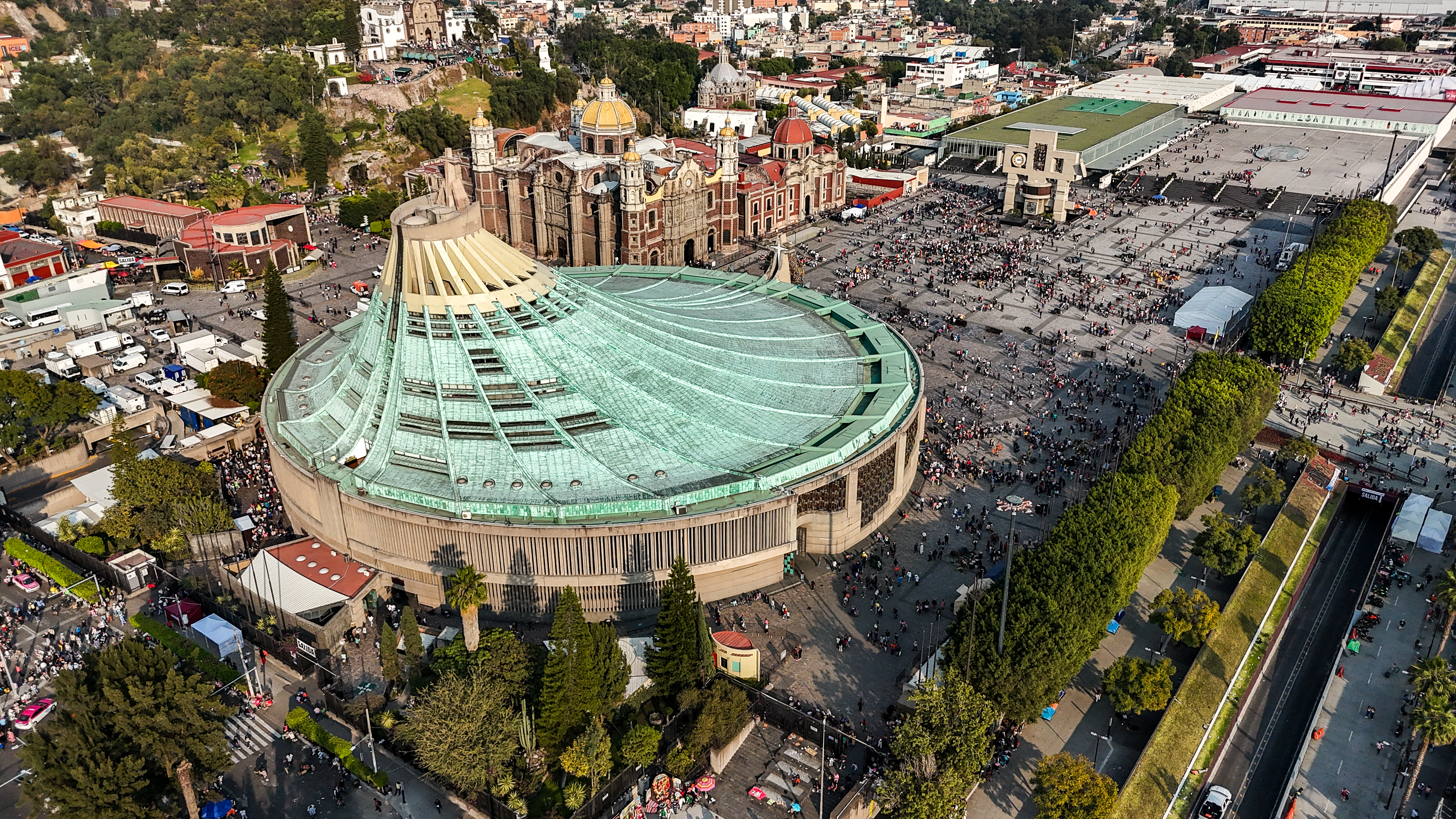
Basilica of Our Lady of Guadalupe
Twenty million pilgrims a year walk through the doors of the Basilica of Our Lady of Guadalupe, making it the most visited Marian shrine on Earth. That number doubles the attendance of any comparable Catholic pilgrimage site worldwide. On the days around December 12 alone, nine million people converge on this complex at the foot of Tepeyac Hill in northern Mexico City, filling the atrium, lining the streets, and pressing forward to glimpse the image that has defined Mexican Catholic identity since 1531. The story begins with a peasant named Juan Diego, a hill covered in roses that should not have been blooming, and a tilma - a cloak made of cactus fiber - that somehow bears an image no one claims to have painted.
A Hill That Became a Threshold
Tepeyac Hill had been sacred long before Christianity arrived. The Mexica venerated Tonantzin, a mother goddess, at this site. When the Spanish conquest imposed Catholicism, the hill's spiritual significance did not vanish - it transformed. According to tradition, Juan Diego encountered the Virgin Mary here in December 1531, just a decade after the fall of Tenochtitlan. She instructed him to gather roses from the hilltop in winter and carry them to Bishop Juan de Zumarraga. When Juan Diego opened his tilma before the bishop, the flowers fell and the image of the Virgin appeared on the cloth. From 1531 until his death in 1548, Juan Diego lived at the foot of the hill, tending the first small place of worship. His relics remain at the site today. The Capilla de Indios, built in 1649, was originally constructed for indigenous worship of the Virgin - an acknowledgment that the Guadalupe devotion bridged two spiritual worlds.
Three Centuries of Construction
The Old Basilica, designed by architect Pedro de Arrieta, took fourteen years to build. The first stone was laid on March 25, 1695; the doors opened with a solemn novena on May 1, 1709. Its four octagonal towers, crowned with yellow and blue Talavera tile, were designed to evoke the New Jerusalem from the Book of Revelation. But the building's ambitions exceeded its geology. Construction of a neighboring Capuchin convent in the early 19th century damaged the walls and vaults, forcing a full interior renovation that replaced the original Baroque decoration with Neoclassical design by Agustin Paz and Manuel Tolsa. Work stalled from 1810 to 1822 during the Mexican War of Independence. In 1904, the church was elevated to basilica rank - the same year an explosion damaged the altar steps and stained glass, though the image of the Virgin survived behind a crucifix that bent from the blast. The image was removed for safekeeping and not returned until 1929.
The Modern Basilica
By the 1970s, the Old Basilica was sinking and unstable, its foundation compromised by Mexico City's notoriously soft lakebed soil. A team of six architects, led by Pedro Ramirez Vazquez, designed the replacement. Construction began in 1974, and on October 12, 1976, the image of the Virgin was carried in procession to its new home. The circular building, meant to evoke the tent that housed the Ark of the Covenant, seats 10,000 worshippers. Its reinforced concrete roof is sheathed in green oxidized copper, and 344 control piles anchor the structure against the subsidence that doomed its predecessor. Inside, the circular plan eliminates columns, so every seat has an unobstructed view of the Virgin's image behind the altar. Beneath the altar, conveyor belts carry visitors past the tilma for a closer look - a concession to the sheer volume of pilgrims who would otherwise create dangerous crowds. Pope John Paul II visited five times between 1979 and 2002, including for Juan Diego's canonization. Pope Francis celebrated mass at the main altar in February 2016.
A Complex of Sacred Spaces
The basilica is not a single building but an entire religious precinct. The Capilla del Cerrito, first built in 1666, marks the hilltop where the apparition reportedly occurred. The Capilla del Pocito, designed by Francisco Guerrero y Torres and built between 1777 and 1791, sits near the hill's eastern slope. The Guadalupe Basilica Museum, housed in the north wing of the former Capuchinas Convent since 1941, holds nearly 4,000 cultural assets - paintings by Cristobal de Villalpando, Miguel Cabrera, and other masters of New Spanish art, plus more than 2,000 ex-votos left by grateful pilgrims over the centuries. These small devotional paintings, each recording a personal miracle or answered prayer, form one of the largest collections of folk religious art in Mexico. Together, the buildings span five centuries of Mexican sacred architecture, from the foundations of Juan de Zumarraga's original 1530s chapel buried beneath the Capilla de Indios to the modernist concrete curves of the 1976 basilica.
From the Air
Located at 19.484°N, 99.117°W in the Gustavo A. Madero borough of northern Mexico City, at the foot of Tepeyac Hill. The modern basilica's circular green copper roof is distinctive from altitude. The complex sits north of the historic center, separated from the Zocalo by about 5 km. Nearest major airport is Mexico City International (MMMX/MEX). The Tepeyac hill rising behind the basilica complex provides a useful visual reference point amid the dense urban landscape.