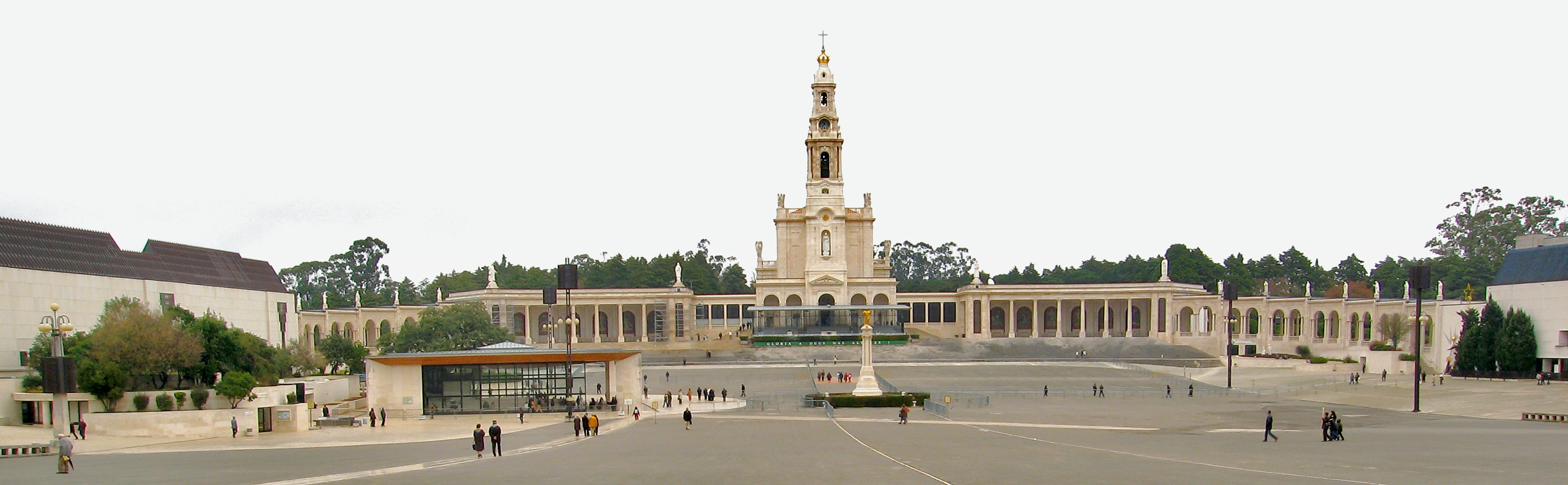
Basilica of Our Lady of the Rosary, Fatima
On October 13, 1917, an estimated 70,000 people gathered in the muddy fields of Cova da Iria, a hollow in the Portuguese countryside near the village of Fatima. They had come because three shepherd children -- Lucia dos Santos, age 10, and her cousins Francisco and Jacinta Marto, ages 8 and 7 -- had been reporting monthly visions of a luminous woman since May. What those thousands witnessed that October afternoon became known as the Miracle of the Sun: the crowd reported the sun spinning, changing colors, and appearing to plunge toward the earth. Believers and skeptics alike documented the event. A decade later, construction began on the basilica that would anchor one of Catholicism's most important shrines.
From Sheep Pasture to Sacred Ground
The story of Fatima begins not with architecture but with children. Lucia, Francisco, and Jacinta were tending their families' sheep when they reported the first apparition on May 13, 1917. The figure they described identified herself as the Lady of the Rosary and appeared five more times through October. Portugal was in turmoil -- the country had overthrown its monarchy in 1910, and the new republic was actively secularist. Church authorities were cautious, investigating the claims for over a decade before officially recognizing them as 'worthy of belief' in 1930. By then, the site had already become a place of spontaneous pilgrimage. The first stone of the basilica was blessed on May 13, 1928, exactly eleven years after the first reported apparition.
Stone, Bronze, and 12,000 Pipes
The basilica was designed by Dutch architect Gerardus van Krieken and later continued by Joao Antunes. The neo-Baroque structure measures 70.5 meters long and 37 meters wide, built entirely of local limestone from the Moimento area. Its bell tower rises 65 meters and is crowned by a bronze crown weighing 7,000 kilograms, forged at the Bolhao foundry in Porto, topped with an illuminated cross visible at night. Inside, fourteen lateral altars are dedicated to the mysteries of the Rosary. The stained glass windows and paintings, created by Joao de Sousa Araujo in 1967, depict scenes from the life of the Virgin Mary and the apparitions. An Italian-made organ dated 1952, with 152 stops and approximately 12,000 pipes, fills the nave with sound. The church was dedicated on October 7, 1953, and elevated to a minor basilica by Pope Pius XII the following year.
The Children Who Changed Everything
Francisco Marto died in 1919 at age 10, and Jacinta followed in 1920 at age 9 -- both victims of the influenza pandemic sweeping Europe. Their short lives became central to the shrine's spiritual identity. Lucia dos Santos lived until 2005, becoming a Carmelite nun and spending decades recording her memories of the apparitions and the three secrets the children said they had received. The first secret described a vision of hell. The second pointed toward the end of World War I, the beginning of World War II, and a request to consecrate Russia. The third, kept sealed until 2000, has been interpreted as foretelling the 1981 assassination attempt on Pope John Paul II. All three children are now interred within the basilica -- Francisco and Jacinta were canonized as saints by Pope Francis on May 13, 2017, the centennial of the first apparition.
A City of Pilgrims
The Basilica of Our Lady of the Rosary is only one element of the larger Sanctuary of Fatima, which now includes the modern Basilica of the Most Holy Trinity, completed in 2007 and seating 8,633 people. Between them stretches a vast esplanade -- one of the largest religious gathering spaces in the world -- capable of holding hundreds of thousands of pilgrims. The sanctuary draws an estimated four to five million visitors annually, with the largest gatherings on the 13th of each month from May through October, commemorating the original apparition dates. Many pilgrims approach the Chapel of the Apparitions on their knees, crossing the esplanade in an act of devotion that can take over an hour. The chapel marks the exact spot where the children said they saw the apparition -- a small, open-air structure at the heart of an enormous complex that grew around a moment in a sheep pasture over a century ago.
From the Air
Located at 39.63N, 8.67W in central Portugal, roughly 130 km north of Lisbon. The sanctuary complex is clearly visible from altitude as a large white esplanade flanked by two basilicas. Nearest airports include LPPT (Lisbon Portela, ~130 km south) and LPCO (Coimbra, ~80 km north). On pilgrimage dates (13th of each month, May-October), massive crowds are visible on the esplanade. The older basilica with its 65-meter bell tower is at the west end of the complex.