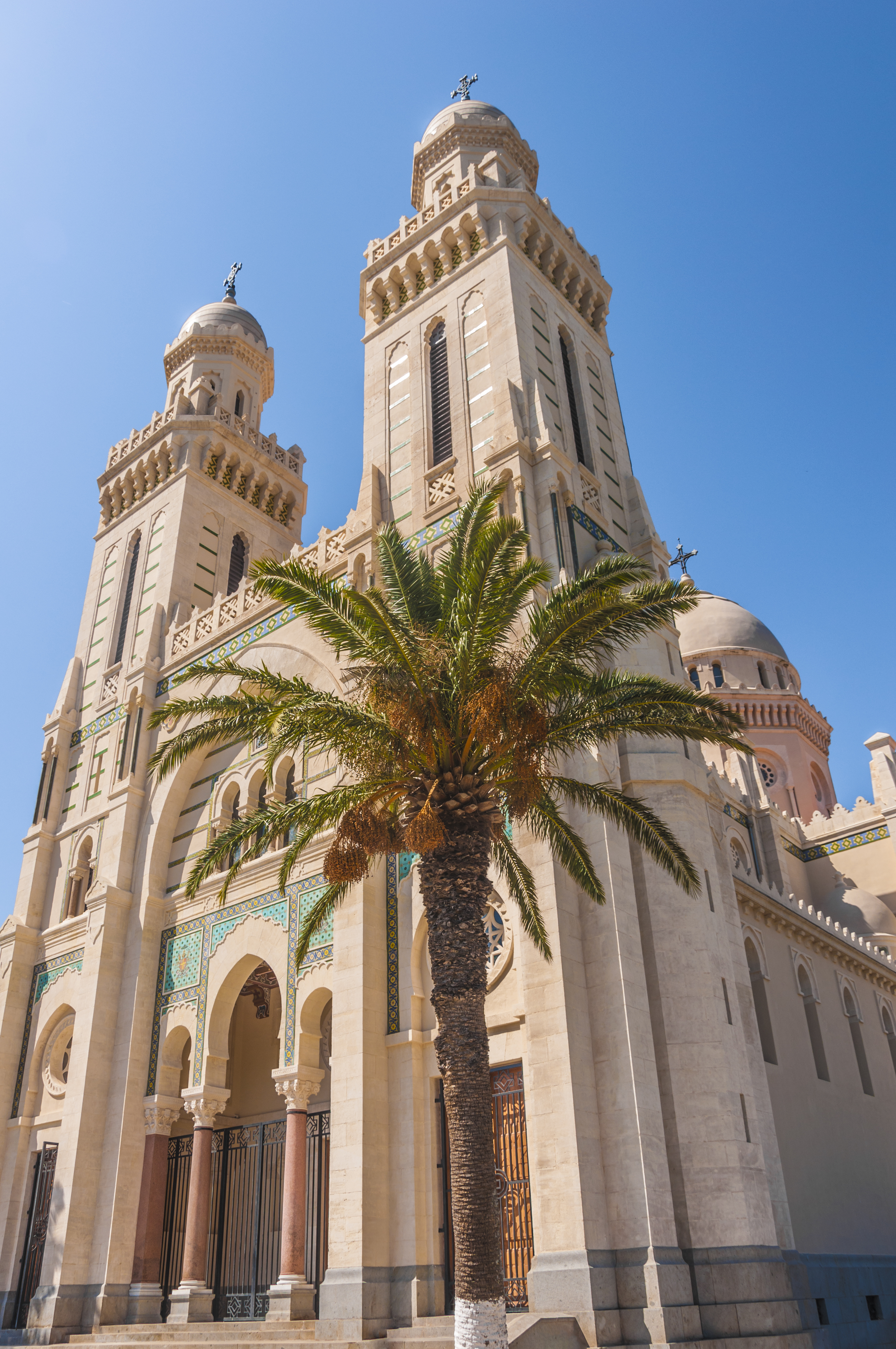
Basilica of Saint Augustine (Annaba)
Inside the Basilica of Saint Augustine in Annaba, behind glass and reliquary, rests one of the arm bones of the man who shaped Western Christianity more than perhaps any other thinker. Augustine of Hippo spent his final years in this city -- then called Hippo Regius -- and died here in 430 AD as Vandal armies besieged the walls. Fifteen centuries later, the French built a basilica on the hill above his ancient church, and his relic was brought back to the place where he breathed his last.
The Hill Above Hippo
Construction began in 1881, during the height of French colonial rule in Algeria, and finished on 29 March 1900. The basilica was dedicated on 24 April 1914, under the direction of Abbe Pougnet. It rises from a hilltop overlooking the modern city of Annaba and the Mediterranean beyond -- not far from the ruins of the Basilica Pacis, the church that Augustine himself built and where he preached, wrote, and presided as bishop for more than three decades. The choice of location was deliberate: this was not merely a new church, but a statement of continuity, linking nineteenth-century French Catholicism to the roots of the faith in North Africa.
Three Architectures in One
The basilica is a striking hybrid. Its stones were imported from France, and its interior gleams with Carrara marble from the quarries of Tuscany. Stained glass windows filter the North African light into jeweled color. Massive arches draw from three distinct architectural traditions -- Roman, Byzantine, and Moorish -- reflecting the layered history of the land on which the building stands. The effect is neither purely European nor purely North African, but something in between: a French colonial church that absorbed the visual vocabulary of the civilizations that preceded it. The blending feels both intentional and inevitable. This is a place where Phoenicians, Romans, Vandals, Byzantines, Arabs, and the French have all left their mark. The architecture, consciously or not, acknowledges all of them.
Augustine's Last Days
Augustine arrived in Hippo Regius in 391 AD and was ordained bishop in 396. Over the next thirty-four years, he produced works that would define Christian theology for millennia -- the Confessions, The City of God, treatises on grace, free will, and original sin. He also presided over church councils held in the city that helped establish the biblical canon still used by Catholic and Protestant churches today. In 430, the Vandals advanced along the North African coast. Augustine, seventy-five years old, prayed for relief as the siege tightened. The wheat fields outside the walls went unharvested. Three months into the siege, on 28 August 430, he died -- perhaps from starvation, perhaps from the stress of watching his world collapse. The Vandals lifted the siege after fourteen months but took the city through a peace treaty in 435, making Hippo Regius the first capital of the Vandal Kingdom.
A Relic Returns
Augustine's remains had been moved from Hippo Regius centuries before the basilica was built -- first to Sardinia when the Vandals took the city, then to Pavia in Italy, where they remain in the Basilica of San Pietro in Ciel d'Oro. But when the new basilica in Annaba was completed, one of Augustine's arm bones was sent from Italy to Algeria, returning a fragment of the man to the city where he had lived and died. The basilica sits today under the jurisdiction of the Diocese of Constantine, one of the few active Catholic parishes in a predominantly Muslim country. It receives visitors -- Christians, Muslims, tourists, and scholars -- who climb the hill for the view, for the architecture, or for the chance to stand near the bones of a man whose ideas about memory, desire, and the human condition remain as unsettling now as they were in the fifth century.
From the Air
Located at 36.88N, 7.74E on a prominent hilltop in Annaba, Algeria, overlooking the city and the Mediterranean coast. The basilica is clearly visible from the air as a large church structure on the highest ground above the city. Nearest airport: Rabah Bitat Airport, Annaba (DABB), approximately 10 km south. The ruins of ancient Hippo Regius are at the base of the hill, closer to the modern city center.