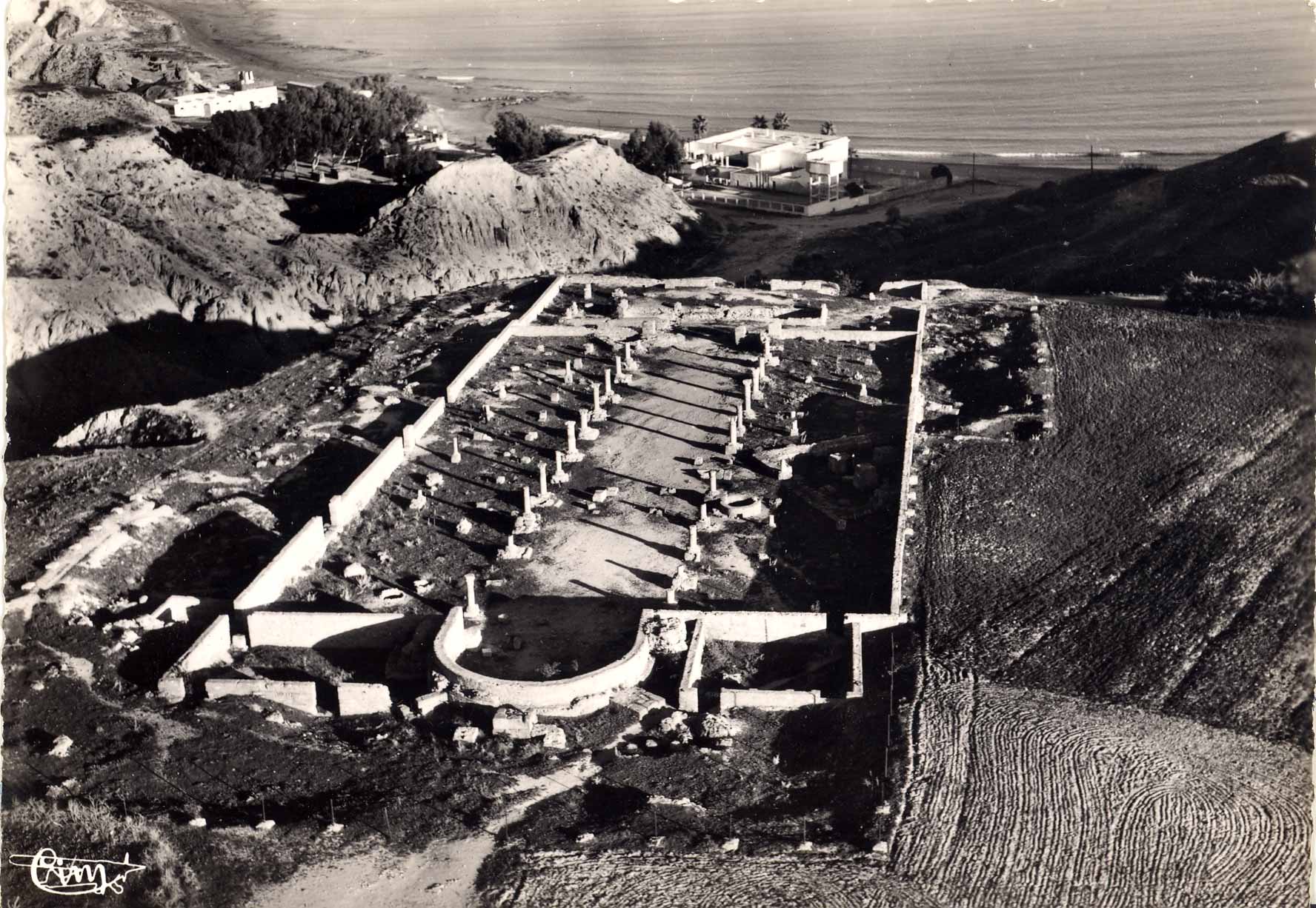
Basilica of Saint-Cyprien
Augustine of Hippo had a problem with dancing. In August 401 AD, he preached at the Basilica of Saint-Cyprien in Carthage and discovered that worshippers were dancing at the martyr's tomb -- a persistence of pagan custom that scandalized the bishop. By September, he had established vigils to keep the zithers away. The episode reveals something essential about this place: long before Christians built their basilica here, the clifftop site overlooking the Gulf of Tunis had been sacred ground, a place where sailors sought divine protection from the sea below.
Death of a Bishop
On September 13, 258 AD, two Roman officers accompanied by soldiers arrested Cyprian, the bishop of Carthage, during the persecution ordered by Emperor Valerian. The next day, September 14, Cyprian was executed by decapitation. His followers retrieved his body under cover of darkness and buried it in a place called Area Macrobi Candidati, near pools and a palace not far from the shore. For over a century, only a modest chapel marked the site. The cult of Cyprian grew steadily through the fourth century, particularly in Africa, where the veneration of martyrs was central to Christian identity. By the end of the 4th century, a proper basilica was constructed over his tomb -- a building that would remain in use through the Vandal occupation and into the 6th century.
Where Land Meets Sea
The basilica occupied a dramatic position on the Bordj Djedid plateau, perched near a thirty-meter gully that dropped to the Mediterranean. The site lay on the outskirts of the ancient city, aligned with neither the urban grid nor the rural land divisions -- evidence that it belonged to an older, pre-urban sacred geography. Excavations uncovered a fragment of an inscription mentioning the pagan divinity Securitas, suggesting that a temple to the goddess of safe passage had stood here before Christians claimed the ground. The connection makes intuitive sense: a clifftop shrine where seafarers once prayed for protection became the burial place of a bishop whose cult was, among other things, popular with sailors.
Seven Naves and Ten Thousand Names
Father Alfred Louis Delattre, the tireless White Father who spent decades excavating Carthage's Christian sites, uncovered the basilica in 1915 during his final excavation campaign. What he found was enormous: the main hall, the quadratum populi, consisted of seven large naves and fourteen bays stretching 61.60 meters in length. The columns and capitals were "quite disparate," according to later scholars Lapeyre and Pellegrin -- reused from older buildings in the eclectic fashion typical of late antique construction. An atrium with porticoes on three sides contained numerous tombs, as worshippers sought burial near the saint's remains. The site yielded some 10,000 inscriptions of varying interest, revealing Vandal, Punic, and Latin names that mapped the cosmopolitan population of late-antique Carthage.
Layers of Loss
The basilica's remains are meager today and difficult to interpret. During the Turkish occupation, a fort was built directly on the site. The 1930 Carthage Eucharistic Congress brought well-intentioned but destructive interventions that further confused the archaeological record. Underground, Delattre discovered what he believed was a decorated room with paintings and a door; the later archaeologist Noel Duval argued it was actually a cistern, measuring 18 by 4.25 meters and five meters deep, that had been repurposed as a dwelling. A second, smaller cistern was built when the main one was converted to housing -- a practical adaptation that speaks to the site's continuous habitation long after its sacred function ended. A silver coin of the Vandal king Gunthamund, found by Delattre in one of the tombs, confirmed that the site remained active even during the Vandal period of the 5th century.
The Martyr's Persistence
Historians have long debated how many basilicas were dedicated to Saint Cyprian in Carthage. Victor de Vite, writing in the late 5th century, located two outside the city walls: one at the place of martyrdom and another at the burial site in Les Mappales. Paul Monceaux argued for three buildings; Serge Lancel and most modern scholars favor two. What is not debated is the persistence of the cult. From the modest chapel of the late 3rd century through Augustine's sermons in the early 5th century to the basilica's use well into the period of the Arab-Muslim conquest of 698, the memory of Cyprian kept the site alive for over four centuries. Even now, with the basilica reduced to meager foundations on a Tunisian clifftop, the view across the Gulf of Tunis to Djebel Boukornine is the same one that Cyprian's mourners would have seen as they carried his body through the darkness in 258.
From the Air
Located at 36.86°N, 10.34°E on the Bordj Djedid plateau along the Carthage seafront, overlooking the Gulf of Tunis. The site is near the northeastern edge of the Carthage archaeological zone. Djebel Boukornine, the twin-peaked mountain visible across the gulf, serves as a navigation reference. Tunis-Carthage International Airport (DTTA) is approximately 5 km to the southwest. Best viewed at 1,500-3,000 feet to appreciate the clifftop position above the sea.