Basilica of Saint-Denis: Where Gothic Architecture and French Kings Were Born
The legend says that Saint Denis, the first Bishop of Paris, was beheaded on Montmartre around 250 AD, then picked up his own head and walked two leagues (roughly six kilometres) north to the spot where he wished to be buried. A church rose over his grave. A thousand years later, Abbot Suger transformed that church into something the world had never seen: a building where walls dissolved into light, where pointed arches and rib vaults and flying buttresses combined for the first time in a single structure. The Basilica of Saint-Denis, completed in its revolutionary choir in 1144, is widely considered the first truly Gothic building -- the prototype for Chartres, Notre-Dame, Reims, and every soaring cathedral that followed.
Suger's Vision of Light
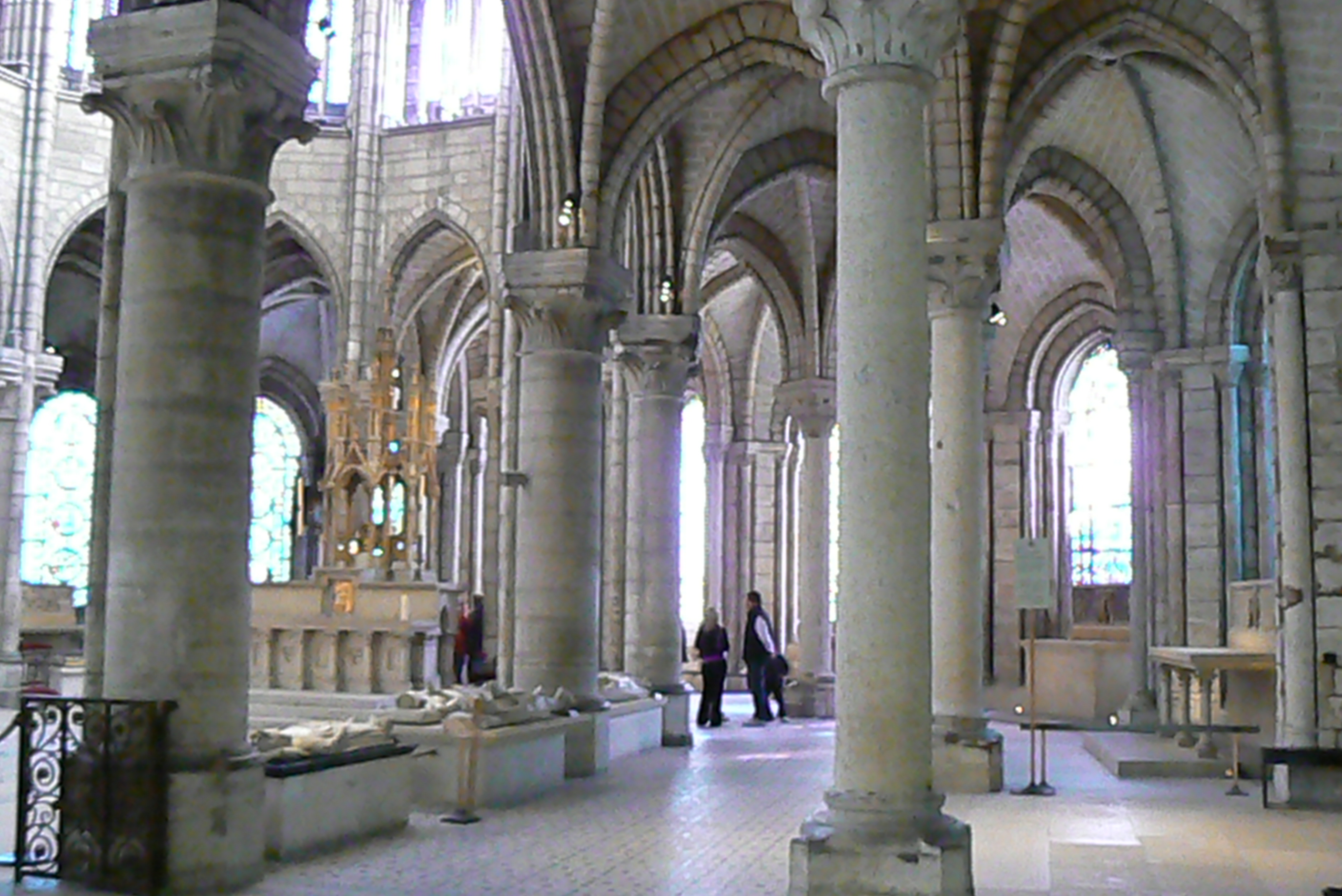
Abbot Suger began his career in the church at the age of ten and became abbot in 1122. He was a school companion and confidant of two French kings, and a regent during Louis VII's absence on Crusade. He was also a devotee of Pseudo-Dionysius the Areopagite, a sixth-century mystic who equated every glint of light with the divine. This theology shaped his architecture. When Suger rebuilt the abbey's choir between 1140 and 1144, he replaced the heavy dividing walls with slender columns, allowing light to flood the interior. He described his vision: "A circular string of chapels, by virtue of which the whole church would shine with the wonderful and uninterrupted light of most luminous windows." The twelve columns in the choir represented the twelve Apostles. His own words were carved in the nave: "For bright is that which is brightly coupled with the bright, and bright is the noble edifice which is pervaded by the new light."
The Royal Necropolis
Nearly every French king from the 10th century through Louis XVIII in 1824 was buried at Saint-Denis. The queens of France were crowned here. The royal regalia -- the coronation sword, the sceptre -- were stored between ceremonies. The kings' tombs were not mere markers but sculptural monuments featuring carved recumbent effigies, or gisants, that grew increasingly lifelike over the centuries. In 1264, under Abbot Matthew of Vendome, sixteen former monarchs were exhumed and relocated to new tombs arranged around the crossing: eight Carolingian kings to the south, eight Capetians to the north. Henry IV came to Saint-Denis specifically to renounce his Protestant faith and become Catholic -- the price of the French crown. Before every major military campaign from 1124 until the mid-fifteenth century, the kings carried the oriflamme, the battle flag of Saint Denis, to invoke the saint's protection.
The Revolutionaries Dig
On September 14, 1792, the monks celebrated their last services. The monastery was dissolved the next day. The following year, the National Convention ordered the royal tombs opened and the remains destroyed. In August and October 1793, revolutionaries exhumed the bodies of kings, queens, and princes, stripped them of funerary objects, and dumped the remains into mass graves covered with lime. The church itself was profaned: its treasury confiscated, its reliquaries melted down, its facade sculpture -- mistaken for images of French kings rather than Old Testament figures -- hacked away. The lead roof tiles were stripped and melted for bullets, leaving the interior exposed to the weather. Alexandre Lenoir saved many of the tomb sculptures by claiming them as artworks for his Museum of French Monuments. When the Bourbons ordered the mass graves opened in 1817, only portions of three bodies remained intact. The bones of 158 individuals were collected into an ossuary behind marble plaques in the crypt.
Architects Who Got It Wrong and Right
Napoleon reconsecrated the church in 1806 and designated it as the future tomb for his own dynasty -- a plan his exile rendered moot. In 1813, architect Francois Debret began repairs, but he improperly rebuilt the spire, which was battered by hurricanes in 1842 and 1843 and a tornado in 1845. Debret was forced to dismantle it entirely. His successor, Eugene Viollet-le-Duc, brought deeper knowledge of Gothic principles and worked on the basilica until his death in 1879, rearranging the interior into a museum of French funerary sculpture. Napoleon III asked Viollet-le-Duc to build an imperial section in the crypt, but was deposed before work could begin. The 86-meter spire, dismantled in the nineteenth century, is now being rebuilt -- a project decided in 2018 with construction commencing in 2025, planned for completion by 2029 at a cost of 37 million euros.
The Architecture That Changed Everything
Walk into the nave today and you see the Rayonnant Gothic style that succeeded Suger's innovations: walls reduced to skeletal frameworks of stone between vast expanses of glass, the triforium level given windows for the first time, twelve-meter rose windows filling the transept facades. The double ambulatory behind the high altar preserves elements of Suger's original 1140s construction -- the first place where pointed arches, rib vaults, and exterior buttresses were combined in a single coherent design. Beneath the choir, the archaeological crypt retains Carolingian capitals from around 775 AD and fragments of painted decoration from the original martyr's chapel. The site spans seventeen centuries, from a Gallo-Roman cemetery through the birth of Gothic architecture to an ongoing reconstruction. Hundreds of anonymous graves from the 5th to the 14th centuries were discovered as recently as 2023. Saint-Denis keeps yielding its dead.
From the Air
The Basilica of Saint-Denis (48.936N, 2.360E) is in the commune of Saint-Denis, a northern suburb of Paris about 9km from the city center. The basilica's single surviving tower is visible from the air, and the missing north tower (currently under reconstruction) will eventually restore the original two-tower silhouette. Paris Charles de Gaulle (LFPG) is 15km northeast; Paris Le Bourget (LFPB) is 5km east. The Stade de France, built for the 1998 World Cup, is visible just south of the basilica.