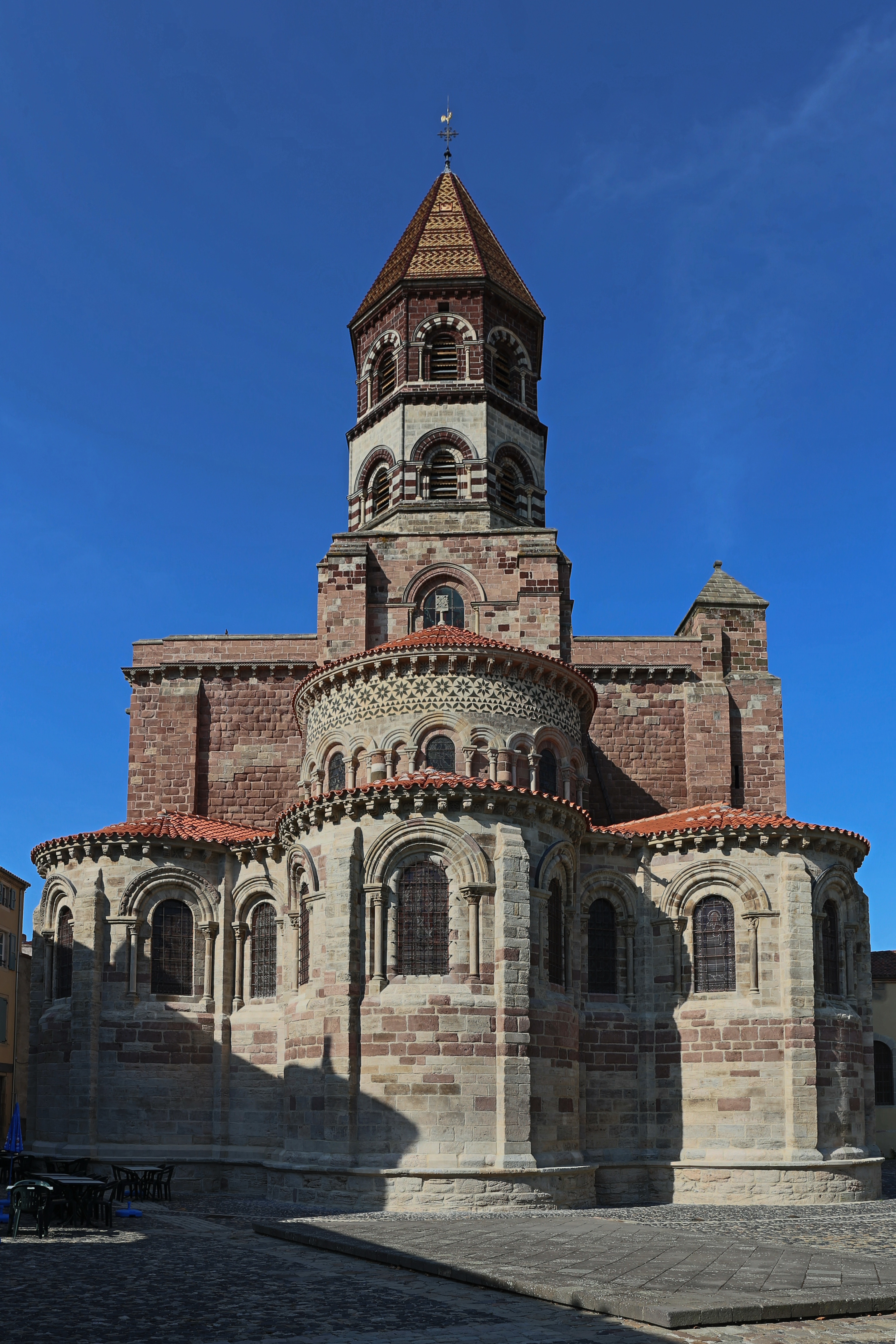
Basilica of Saint-Julian, Brioude
Walk into the nave of Saint-Julian's and look down before you look up. The floor is wrong -- or rather, wonderfully right, a 16th-century mosaic stretching the full length and breadth of the nave in patterns of colored stone that no other church in France can match. Step forward into the transept and the mosaic changes, the stones growing smaller, the pattern older: a Carolingian-era floor dating from a church that stood here before this one, before the Romanesque arches overhead were even imagined. Beneath all of it, in a crypt below the altar, lie the relics of Saint Julian, a Roman soldier martyred on this exact spot in the late 3rd century. The Basilica of Saint-Julian in Brioude is built on layers -- of stone, of faith, of time -- and reading those layers is the reward for making the journey to this small town in the Haute-Loire.
A Martyr's Tomb and a Spanish Lady's Gratitude
Julian was a Roman soldier who converted to Christianity and was beheaded near Brioude, probably around 304 AD. The first sanctuary over his tomb appeared in the late 4th century, built by a Spanish noblewoman in gratitude for the fulfillment of a vow -- one of the earliest examples of pilgrimage-driven construction in Gaul. Gregory of Tours, writing in the 6th century, recorded that the saint's fame was already spreading, drawing pilgrims from across the region. The Visigothic Duke Victorius, governor of Auvergne, adorned the early church with marble columns scavenged from ancient Roman monuments. Fluted column fragments found in today's crypt may be remnants of that original decoration -- stone carried from pagan temples to a Christian shrine, repurposed without apology, as medieval builders so often did.
Crossroads of the Crusade Routes
The Romanesque church that stands today was begun in the first quarter of the 12th century, fueled by Brioude's position on the pilgrimage routes to Santiago de Compostela, Rome, and Jerusalem. A college of canons replaced the earlier monastery, and the chapter grew powerful enough to attract papal attention. Pope Urban II, who came to Clermont in 1095 to preach the First Crusade, placed Saint-Julian directly under his authority, freeing it from the control of the Counts of Auvergne. His successor Paschal II confirmed the chapter's right to appoint its own leaders, while King Louis VII asserted his own claim over the institution. For centuries, the chapter controlled Brioude's civic life -- collecting taxes, administering justice, maintaining the basilica that was both its spiritual center and its source of political power.
Stone and Color
Outside, the apse is the masterpiece: five radiating chapels decorated with polychrome stonework in the distinctive Auvergne Romanesque style, the colored volcanic stone of the region lending the building a warmth that northern Gothic churches cannot achieve. Carved capitals and corbels crowd the exterior surfaces with figures both sacred and grotesque. Inside, beyond the extraordinary mosaic floors, the basilica holds one of the best-preserved ensembles of 13th-century Byzantine-style frescoes in France, hidden in Saint Michael's chapel at the western end of the southern aisle, visible from the gallery below. The frescoes' eastern influence is unmistakable -- evidence of the cultural currents that the Crusades sent flowing back from Constantinople to the heart of rural France.
The Leper's Christ and the Revolution's Axe
Among the basilica's most arresting objects is a large medieval crucifix known as Christ the Leper, originally housed in the leper colony at la Bageasse south of Brioude. The carved figure's expression and pathos speak to a community that understood suffering intimately -- lepers who prayed before an image of divine agony that mirrored their own. Nearby stands a rare 15th-century polychrome statue of the Virgin Mary in labor, an iconographic subject so unusual that few other examples survive anywhere in Europe. The Revolution brought its own violence to Saint-Julian: one bell tower was demolished entirely, the other decapitated, and the chapter that had governed Brioude for seven centuries was dissolved in 1794. The church was reassigned for parish use and has served that purpose since, its Romanesque capitals and Byzantine frescoes surviving because parish churches are rarely important enough to destroy. Michelin awards it three stars -- the highest ranking, shared with only a handful of non-cathedral churches in France.
From the Air
Located at 45.294N, 3.384E in the town of Brioude, in the Haute-Loire department of the Auvergne region of south-central France. The basilica's Romanesque profile with its distinctive polychrome apse is visible from the air, though the town is small. The terrain is hilly -- the Massif Central surrounds Brioude on multiple sides. Best viewed below 3,000 feet AGL with caution for terrain. Nearest airports include Le Puy-en-Velay Loudes (LFHP) approximately 55 km to the southeast and Clermont-Ferrand Auvergne (LFLC) approximately 70 km to the north. The Allier River runs through Brioude and provides a visual navigation reference.