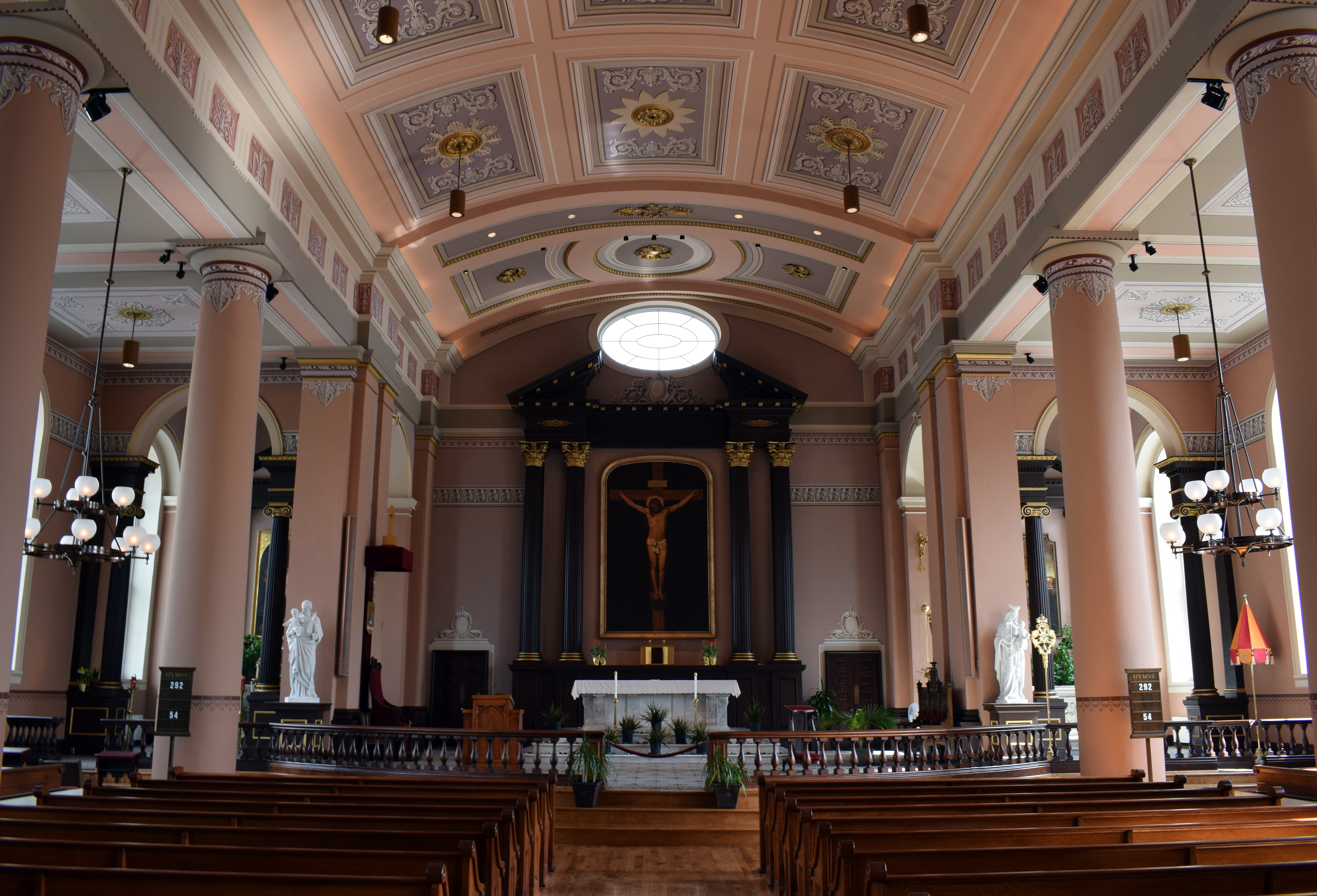
Basilica of Saint Louis, King of France
Every building in the neighborhood was leveled. Block after block of the St. Louis riverfront fell to the wrecking ball in the 1930s through the 1960s to clear the ground for Eero Saarinen's Gateway Arch and its surrounding park. Every building, that is, except one. The Basilica of Saint Louis, King of France -- the Old Cathedral, as locals call it -- stands in a small island of sanctified ground completely surrounded by Gateway Arch National Park, a survivor of both urban renewal and the passage of time. Built between 1831 and 1834, it was the first cathedral west of the Mississippi River, and it remains in continuous use nearly two centuries later, its congregation described as 'few in number but strong in loyalty.'
From Log Chapel to Stone Cathedral
The religious history of this site stretches back to 1770, when the Reverend Pierre Gibault, an itinerant priest, consecrated the first church structure in the village of St. Louis on June 24 of that year. A log chapel was added in 1776, but no priest permanently resided in the village until 1811. In 1818, Bishop Louis William Valentine Dubourg ordered the construction of a brick church, designed by Gabriel Paul, which was completed in 1821. During Dubourg's tenure, artifacts, paintings, and an organ were donated to the parish, and a cemetery was established nearby where many of the founders of St. Louis were interred. By 1826, population growth prompted the creation of the Diocese of St. Louis, and its first bishop, Joseph Rosati, laid the cornerstone of the current cathedral on August 1, 1831. The architectural firm of Laveille and Morton, among the first west of the Mississippi north of New Orleans, designed the Greek Revival structure that was consecrated on October 26, 1834.
The Cathedral the City Outgrew
St. Louis grew explosively through the 19th century, and by the early 1900s the old riverfront cathedral was far too small for the burgeoning Catholic population. In 1914, a magnificent new Cathedral Basilica of Saint Louis was consecrated in the city's Central West End neighborhood, becoming the seat of the archbishop. The old cathedral might have faded into obscurity, but its location along the Mississippi and its deep roots in the city's founding kept it relevant. On January 27, 1961, Pope John XXIII designated the church a basilica, officially recognizing its historical significance with the name Basilica of Saint Louis, King of France. Both of the city's basilicas honor the same patron: King Louis IX of France, the 13th-century Crusader-saint for whom the city itself is named. In 1963, the prominent St. Louis architectural firm Murphy and Mackey renovated the building, ensuring it could continue to serve as a working parish.
Sacred Text in Unexpected Letters
Above the main entrance, Hebrew letters are inscribed that are intended to spell out the Tetragrammaton -- the four-letter name of God. An urban legend of uncertain origin claims that a stonemason accidentally substituted the Hebrew letter Heth for He, rendering the inscription meaningless. Careful examination, however, suggests the letters are indeed He, and the inscription reads as intended. This small mystery captures something of the basilica's character: a building layered with stories, some verified and some apocryphal, where the sacred and the historical intermingle. In the church basement, artifacts trace the history of the Roman Catholic Archdiocese of Saint Louis, including a bell given to the church by the governor of the territory of Louisiana in the early 19th century. Bishop Joseph Rosati, who ordered the cathedral's construction, is interred in a vault beneath the sanctuary -- one of the founders of Catholic St. Louis resting literally beneath the church he built.
Standing in the Shadow of the Arch
The relationship between the Old Cathedral and the Gateway Arch is one of the most striking juxtapositions in American architecture. Saarinen's soaring stainless-steel catenary curve, completed in 1965, rises 630 feet behind the modest Greek Revival facade of a church built when Missouri was still a frontier. The park that surrounds the basilica commemorates westward expansion; the church commemorates the faith community that predated that expansion by decades. Today the basilica ranks 177th of 196 churches in the archdiocese by the number of Catholics it serves, but it ranks second in the number of marriage ceremonies performed -- couples drawn by the combination of historic intimacy and the photogenic backdrop of the Arch and the Mississippi River. The 2015 restoration repaired exterior limestone and sandstone, replaced windows with energy-efficient glass in the original Gothic design, and restored the wood floors that had been hidden under carpet. The Old Cathedral endures, small and resolute, exactly where it has stood since Andrew Jackson was president.
From the Air
Located at 38.624°N, 90.187°W on the St. Louis riverfront, immediately west of the Gateway Arch. The basilica's small Greek Revival structure is dwarfed by the 630-foot Arch but identifiable from the air as the sole historic building within the park grounds between the Arch and the Old Courthouse. Lambert-St. Louis International Airport (KSTL) is approximately 12 nm northwest. St. Louis Downtown Airport (KCPS) in Cahokia, Illinois, is about 3 nm east across the Mississippi. The church sits at approximately 450 feet MSL. Best viewed from approaches over the Mississippi River at 2,000-5,000 feet, where the contrast between the cathedral and the Arch is most dramatic.