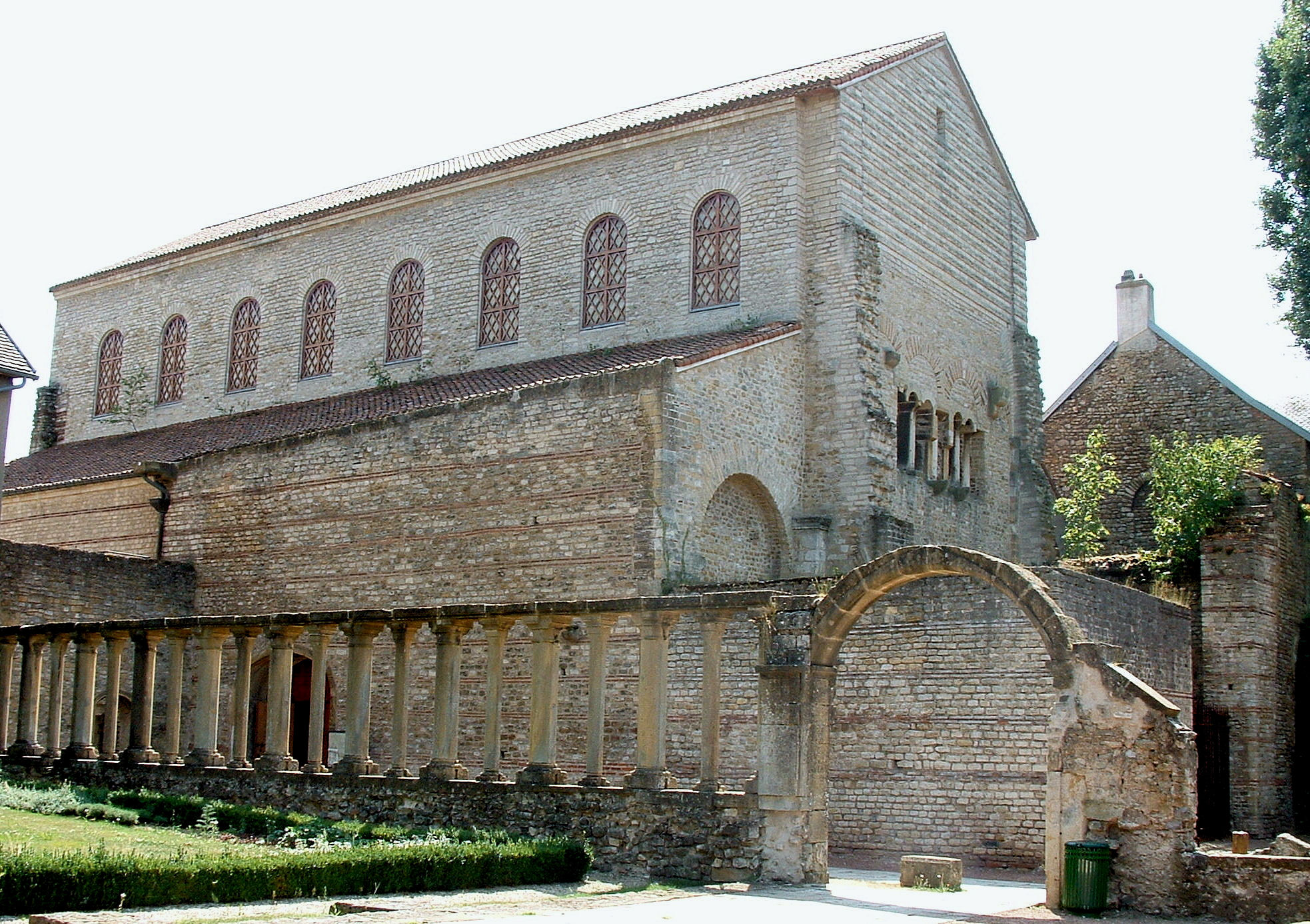
Basilica of Saint-Pierre-aux-Nonnains
Not many buildings can claim to have been a gymnasium, a church, and a warehouse across sixteen centuries of continuous use. The Basilica of Saint-Pierre-aux-Nonnains in Metz sits quietly in the city's cultural quarter, its unassuming exterior concealing what may be the oldest church walls in Europe. The Roman masonry is still visible if you know where to look -- bands of brick alternating with stone in the distinctive opus mixtum technique that Roman builders used when Metz was known as Divodurum Mediomatricorum, a prosperous Gallo-Roman city at the crossroads of imperial trade routes. What stands today is not a reconstruction or a replica. These are the actual walls, raised sometime around 380 AD, that have weathered Huns, sieges, revolutions, and the particular indignity of serving as a military storage depot for over three hundred years.
When Romans Bathed Here
In the 4th century, Metz was one of the most important cities in Roman Gaul, home to an imperial palace and several large thermae -- the public bath complexes that served as the social hubs of Roman life. Saint-Pierre-aux-Nonnains began as part of one of these complexes, likely a palaestra or gymnasium where bathers exercised before their rounds of hot and cold pools. The building's rectangular plan and thick walls reflect its Roman engineering, designed to support the heavy roof structures that such spaces required. When Attila's Huns swept through northeastern Gaul in 451, they devastated Metz, but this sturdy structure survived. The building outlasted the empire that created it, standing empty through the uncertain decades when Roman authority dissolved and Frankish power had not yet consolidated.
The Nuns' Chapel
Sometime in the 7th century, Benedictine nuns claimed the abandoned Roman building and converted it into a church. The name tells the story plainly: Saint-Pierre-aux-Nonnains means Saint Peter of the Nuns. Metz by then had become a cradle of Frankish civilization -- both the Merovingian and Carolingian dynasties traced their ancestry through the city. A stone chancel screen was installed to separate the choir from the nave, carved with interlacing patterns that blended late Roman and early medieval artistic traditions. Those carved panels survive today in the museums of Metz, among the finest examples of Merovingian decorative art in France. In the 11th century, the nuns rebuilt the nave, adding new walls atop the Roman foundations, but the essential footprint of the 4th-century building remained unchanged.
Siege, Storage, and Neglect
The 16th century brought upheaval. When Emperor Charles V besieged Metz in 1552, the city's military priorities overrode its religious ones. France eventually absorbed Metz as a garrison town, and the basilica lost its sacred purpose. The building became a warehouse -- one of the most historically significant structures in Europe reduced to storing military supplies. It remained a warehouse even after being declared a historical monument in 1909, a designation that apparently carried little urgency. For over three centuries, soldiers stacked crates against walls that predated their entire civilization. The building's very durability worked against it: because it refused to fall down, no one felt compelled to do anything with it.
Resurrection in Stone
Restoration finally came in the 1970s, when the city recognized what it had been using as a shed. The work was careful and revelatory, peeling back centuries of modifications to expose the Roman fabric beneath. Today the basilica serves as a venue for concerts and exhibitions, its austere interior and remarkable acoustics lending gravity to performances held within walls that have stood for more than sixteen hundred years. Visitors expecting Gothic grandeur will find something more humbling: a low, broad space where Roman engineering meets early medieval devotion, where the mortar between the bricks has held since an emperor none of us remember sat on the throne. Drogo of Champagne, a Carolingian noble, lies buried here -- a detail that grounds the building in the specific history of Frankish Lorraine. The basilica does not shout its significance. It simply endures, as it has since the century when Christianity itself was still new.
From the Air
Located at 49.115N, 6.169E in the heart of Metz, in France's Lorraine region. The basilica sits in the Cité Musicale complex near the Moselle River, adjacent to the Arsenal concert hall. From altitude, Metz's cathedral (Cathédrale Saint-Étienne) is the dominant landmark, with its distinctive yellow Jaumont limestone. The nearest major airport is Metz-Nancy-Lorraine (ETZ/LFJL), approximately 20 km south. Luxembourg Airport (LUX/ELLX) is about 60 km north. Best viewed at low altitude in clear conditions; the basilica's modest profile blends into the urban fabric. The Moselle River provides a useful navigation reference through the city center.