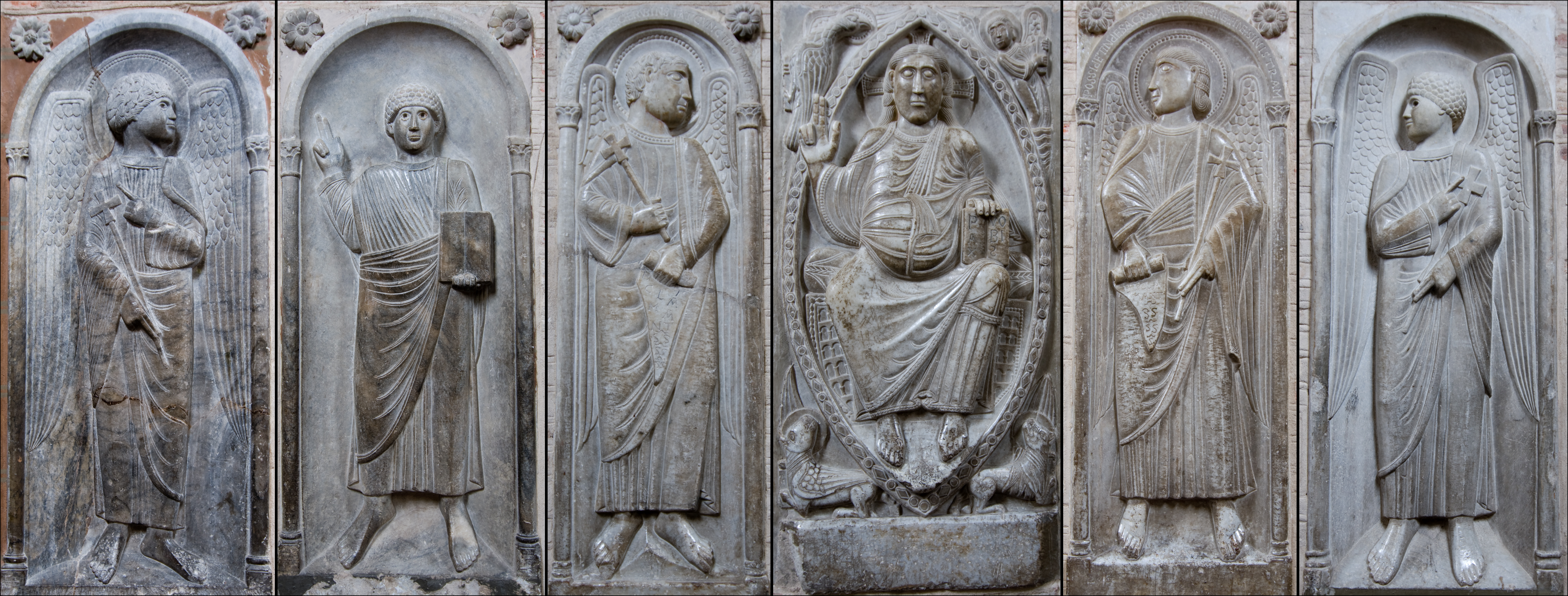
Basilica of Saint-Sernin, Toulouse
Four counts of Toulouse lie entombed beside a doorway that bears their name. The Porte des Comtes, carved with a depiction of Lazarus and Dives, opens into a church that has welcomed the faithful and the footsore for nearly a thousand years. The Basilica of Saint-Sernin stands in Toulouse's old quarter as the largest surviving Romanesque church in Europe, its five-tiered bell tower rising above the city's rooftops like a beacon for the pilgrims who once streamed south toward Spain. Built of the pink Roman brick that gives Toulouse its nickname, la ville rose, the basilica is a monument not merely to faith but to the centuries of ambition, engineering, and devotion it took to raise.
A Bishop's Bones
The story begins around 250 AD, when Saturnin -- or Sernin, in the local tongue -- became the first bishop of Toulouse and was martyred for refusing to sacrifice to pagan gods. A modest basilica sheltered his remains by the late fourth century, but it was Charlemagne who transformed the site's fortunes. By donating a trove of relics during his reign from 768 to 800, the emperor turned an obscure tomb into a destination. Pilgrims heading to Santiago de Compostela in Spain began stopping in Toulouse specifically to venerate these sacred objects, and the small church could no longer contain the crowds. What followed was one of the most ambitious building campaigns in medieval France.
Brick Upon Brick
Construction of the present church began no later than the 1070s, though scholars still debate the exact date. On May 24, 1096, Pope Urban II consecrated the marble altar beneath the crossing tower while the building remained largely incomplete around him. The walls tell their own chronology: the oldest sections near the apse are built of stone, but as construction crept westward over decades, brick increasingly dominated, reflecting both Toulouse's building traditions and the project's stretched finances. At least four distinct building campaigns left their signature in the masonry. Raymond Gayrard, canon and provost, reportedly brought the walls up to window height before his death in 1118, though a biographer writing three centuries later may have confused him with two other Raymonds involved in the work.
The Pilgrim's Architecture
Saint-Sernin follows what architectural historians call the pilgrimage plan -- a design shaped by the practical needs of medieval travelers. An ambulatory wraps around the nave and side aisles, allowing visitors to circulate past nine radiating chapels displaying relics without interrupting Mass. The crucifix-shaped building stretches 115 meters long and 64 meters wide, vast for any Romanesque structure. Barrel vaults soar 21 meters overhead in the central nave, while rib vaults cover the four flanking aisles. This plan proved so successful that the cathedral of Santiago de Compostela, begun in 1082, copied it so precisely that historians believe it must have been designed by Saint-Sernin's own architect or his closest student.
Stone Stories at the Door
The exterior sculpture ranks among the finest in Romanesque art. At the Porte Miegeville, an ascending Christ surrounded by angels fills one of the oldest and most celebrated tympanums in the style, carved around the turn of the twelfth century. Capitals flanking the doorway depict everything from the Annunciation to Adam and Eve's expulsion from Eden. Figures of Saint Peter and Saint James the Great stand as if guiding travelers onward. In 1860, the renowned architect Eugene Viollet-le-Duc undertook a restoration, but his additions eventually fell out of favor. A recent campaign has been removing his changes, peeling back the nineteenth century to reveal what the medieval builders intended.
Still Breathing
Beneath the crossing, where Pope Urban's consecrated altar still stands, the crypt shelters relics of numerous saints, including, by tradition, the apostles Simon and Jude. Above, the building remains very much alive. Its 1888 Cavaille-Coll organ, one of the three most important pipe organs in France alongside those at Saint-Sulpice in Paris and Saint-Ouen in Rouen, was inaugurated by Alexandre Guilmant in April 1889 and meticulously restored between 1992 and 1996. In 1998, UNESCO inscribed the basilica as part of the World Heritage Sites of the Routes of Santiago de Compostela in France, recognizing what pilgrims have known for a millennium: that this pink-brick church on the road to Spain is a destination worth the journey.
From the Air
Located at 43.608N, 1.442E in the heart of Toulouse. The five-tiered bell tower is visible from altitude against the surrounding pink-brick cityscape. Toulouse-Blagnac Airport (LFBO) lies 7 km northwest. Best viewed from 2,000-3,000 ft AGL for architectural detail.