Basilica of Saint Servatius: An Armenian Bishop's Grave in the Low Countries
Saint Servatius, the story goes, came from Armenia. By the late fourth century he was bishop of Tongeren, the Roman town twenty kilometres west of here, and when he died in 384 they buried him in Maastricht. A small chapel went up over his grave. Around 570 the bishop Monulph replaced it with a stone church. The seventh century brought a larger pilgrim church. Sometime in the eleventh and twelfth centuries that one came down too, and the building you walk into today began going up - in stages, over more than a hundred years, designed for emperors. The dedication ceremony in 1039 was attended by Henry III, Holy Roman Emperor, and twelve bishops. Every later century then layered something of its own on top: Gothic chapels, Renaissance epitaphs, Baroque spires, nineteenth-century restoration. None of it was undone. All of it is still there.
The Imperial Church
The chapter of Saint Servatius kept very close ties to the Holy Roman Emperors, and the architecture shows it. The nave went up in the first half of the eleventh century, the transept in the second half, the choir and the westwork in the twelfth. The proportions and the massive west end follow the German imperial-church model. Most medieval provosts here were sons of Germany's highest noble families. Several rose to become chancellors of the German Empire. At least eight became archbishops. For a parish church in a small Mosan river town, this was an extraordinary level of political wiring back to Aachen and the imperial court, and it explains both the building's ambition and the rivalry that pulsed between Servatius' and the smaller chapter of Our Lady's three hundred metres south.
Carved Capitals and a Choir Screen
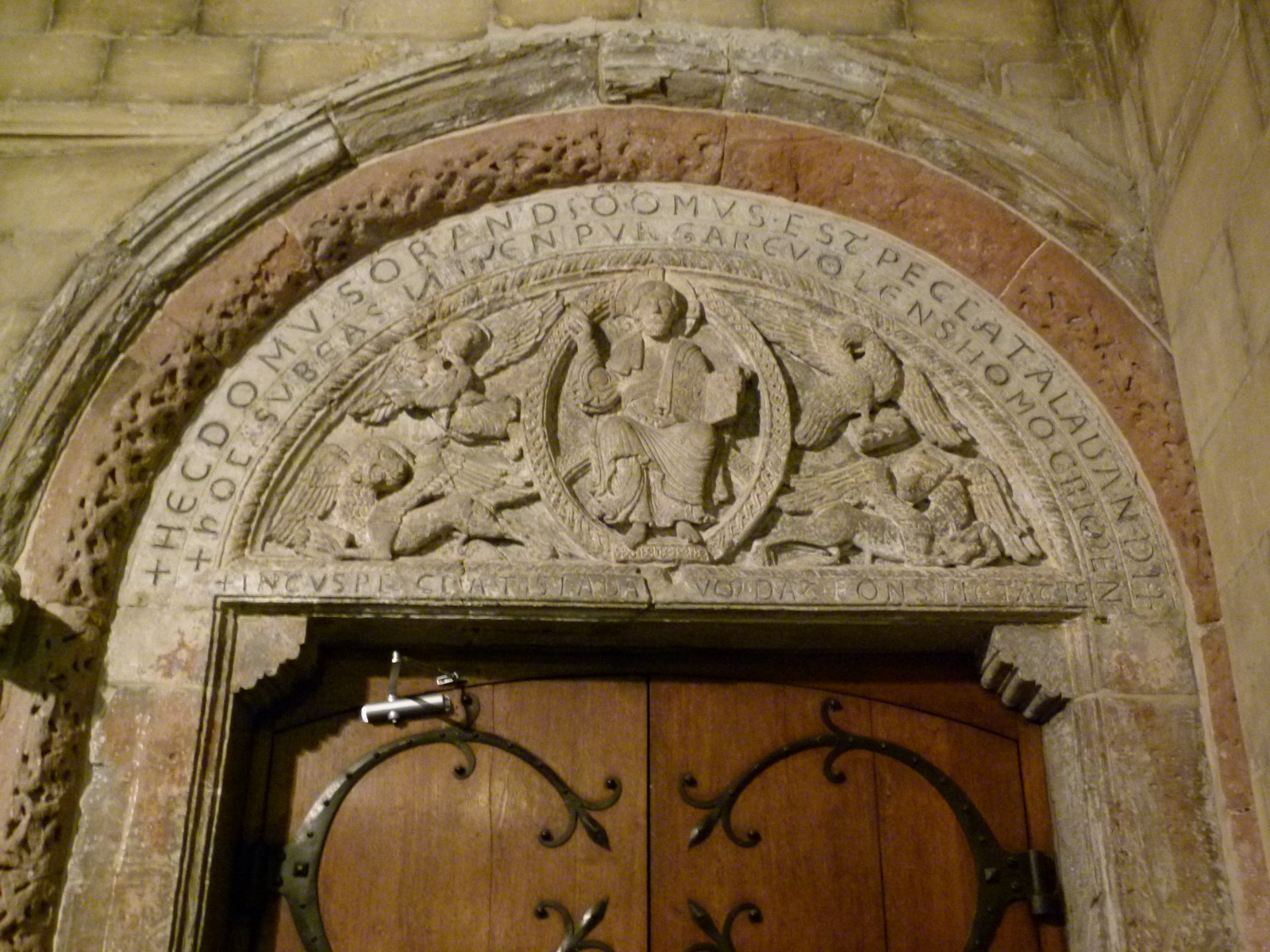
The Romanesque sculpture inside the westwork ranks with the most interesting in the Mosan region. Thirty-four elaborately carved capitals depict scenes from texts the canons were reading - Saint Augustine's City of God, medieval bestiaries - alongside botanical patterns, animals, humans entangled in plants, humans fighting with animals, humans engaged in daily work. The double relief in the westwork shows the Virgin and Child in a mandorla held by two angels, with Christ above handing the keys of heaven to Peter and to Servatius himself. The Bergportaal on the south side, begun around 1180, sits exactly on the seam where Romanesque sculpture starts becoming Gothic. Several scholars argue this portal influenced the early Gothic sculpture of France. The ceiling paintings in the choir, depicting the visions of Zechariah, may be the last surviving work of a Cologne-Maastricht school of painters whom Wolfram von Eschenbach praised in Parzival.
Stables, Fire, and Restoration
1797 was a hard year. The chapter was dissolved by the French revolutionaries; the church became a horse stable for the occupying troops. Furnishings were sold, stolen or destroyed. Most of the treasure disappeared. When the building returned to the parish in 1804 it was effectively a ruin. The damage continued even then: the eleventh-century Chapel of Saint Maternus and the fifteenth-century Koningskapel built by the French kings Charles VII and Louis XI were judged irreparable and demolished. The original eleventh-century crypt under the choir was torn out to lower the floor for liturgical reasons. In 1846 four panels from the great reliquary chest of Saint Servatius - the Noodkist - were sold to an antiques dealer and ended up in Brussels. Pierre Cuypers led the major restoration from 1866 to 1900. Then in 1955, fire took Cuypers' Gothic Revival spire through the roof of the church, forcing another deep restoration between 1982 and 1991. The excavations from that last campaign filled in much of what we now know about the building's earliest predecessors.
The Treasury
Despite all the losses, the treasury at Saint Servatius is one of the great medieval collections in the Low Countries. The Noodkist - the twelfth-century reliquary chest of the saint himself - sits at its centre. Around it are the key, the cup, the crozier and the pectoral cross attributed to Servatius, a large patriarchal cross, a fourteenth-century portrait bust, an eleventh-century ivory chest, and a fragment of silk cloth from the seventh or eighth century. The story of the collection reaches back to roughly 830, when Einhard - the Frankish scholar and biographer of Charlemagne - donated a silver reliquary in the shape of a Roman triumphal arch. The room itself is small, dim, climate-controlled. The ivories and silks come out of darkness one at a time as you move along the cases.
The Pilgrimage That Came Back
Beginning in the thirteenth century - a 1249 papal bull is the oldest surviving document referencing the pilgrimage - Saint Servatius coordinated a seven-yearly pilgrimage with Aachen Cathedral and Kornelimunster Abbey - the Heiligdomsvaart, the Pilgrimage of the Relics. Tens of thousands of people walked the route through the Meuse and Rhine valleys to see the great relic displays. The tradition was killed off in 1632 when Maastricht passed to the Dutch Republic and Protestant authorities suppressed it. It was revived in the nineteenth century and runs on its seven-year cycle to this day; the most recent celebration was held from 24 May to 3 June 2018. Pope John Paul II made the church a Basilica Minor when he visited in 1985. Today Saint Servatius remains the main church of the Deanery of Maastricht, the Roman Catholic centre of the city, and the busy town square called the Vrijthof spreads out from its western front - cafe tables, Christmas markets, a thousand-year stone wall behind them all.
From the Air
The Basilica of Saint Servatius sits at 50.849N, 5.687E, in the historic centre of Maastricht just west of the Maas (Meuse) river, opening onto the Vrijthof square. From the air, the church is identifiable as part of a distinctive pair of silhouettes on the west bank of the Maas - Saint Servatius and the adjacent Gothic Saint John Church (with its bright red spire) sit side by side, with the slightly smaller Basilica of Our Lady half a kilometre to the southeast. Nearest airport: Maastricht-Aachen (EHBK) 10km northeast; Liege (EBLG) 30km south; Cologne-Bonn (EDDK) 100km east.