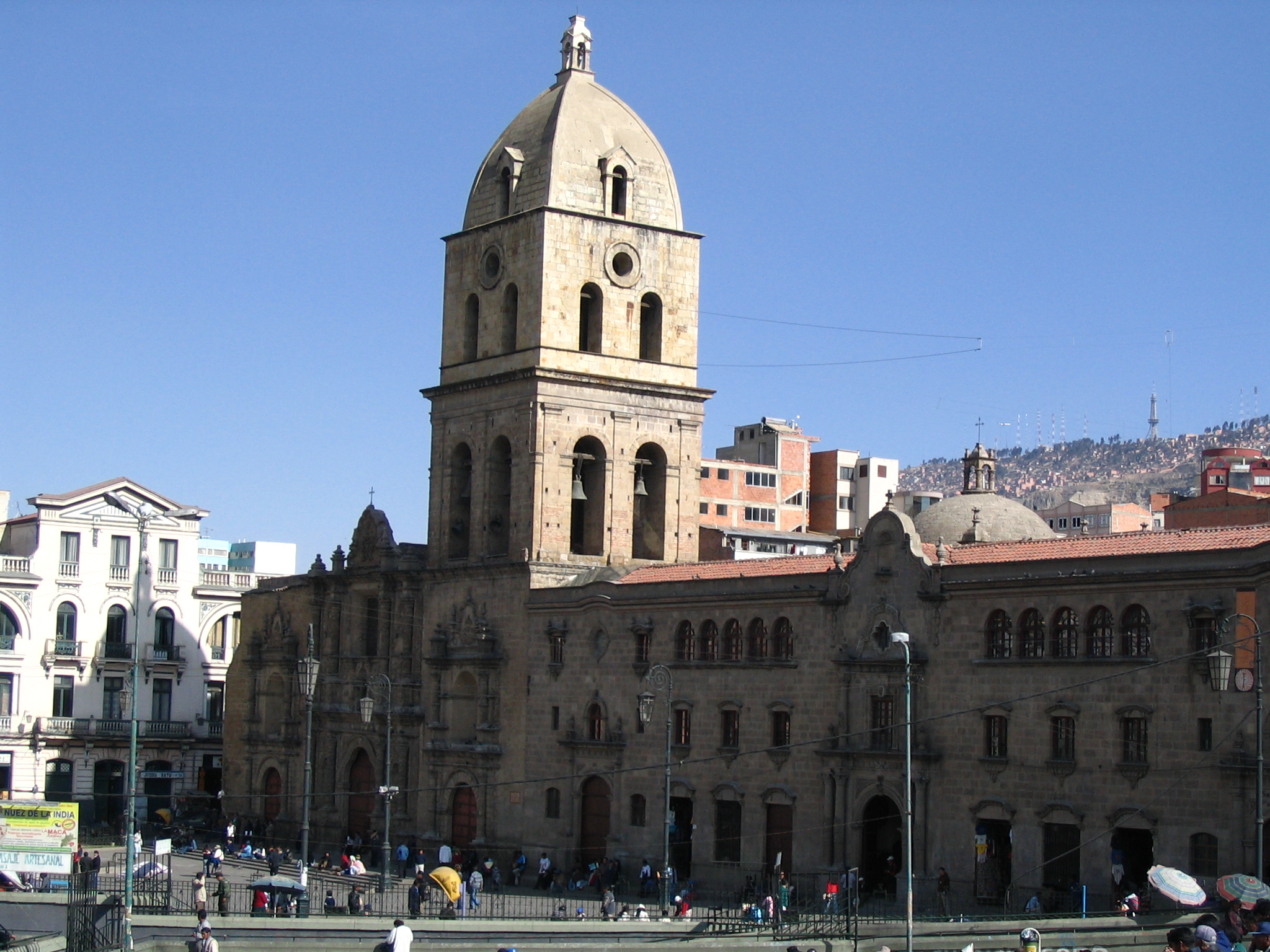
Basilica of San Francisco, La Paz
A church buried by snow. That is the unlikely origin story of one of Bolivia's most striking colonial buildings. The first Church of San Francisco in La Paz took over thirty years to construct, finished in 1581 along the banks of the Choqueyapu River. Less than three decades later, between 1608 and 1612, a snowfall of extraordinary proportions brought its roof crashing down. What rose in its place, beginning in 1743, was something altogether different -- a building that married European ecclesiastical ambition with the carved stone vocabulary of the Andes.
From Riverbank to Plaza
Fray Francisco de Morales founded the Convent of San Francisco in 1548, just thirteen years after La Paz itself was established. He chose a site along the Choqueyapu River, and construction of the first church began the following year. The location placed the Franciscan order at the heart of the new colonial city, a position the church has never relinquished. Today the Plaza San Francisco that surrounds the basilica serves as one of La Paz's principal gathering spaces, a transit hub and market square where the sounds of street vendors and bus horns echo off the carved stone facade. The river that once ran alongside the convent now flows beneath the city streets, channeled underground as La Paz grew around it.
Stone Lace at 3,600 Meters
Construction of the present church began between 1743 and 1744, and the dome was completed by 1753. The building was consecrated on April 23, 1758, but the elaborate carved facade was not finished until 1790 -- nearly half a century after construction started. That facade is the basilica's masterpiece. Executed in the Andean Baroque style, it weaves together Christian iconography with motifs drawn from indigenous Andean traditions: tropical birds, masked figures, and botanical forms that no European cathedral would recognize. The style emerged across the colonial Andes as indigenous stonemasons translated European architectural language through their own artistic sensibilities, creating something that belongs to neither tradition alone.
A Tower and a Title
For over a century, the church stood without a bell tower. Construction of its single tower did not begin until 1885, giving the building its present asymmetric profile against the La Paz skyline. In 1948, the Vatican elevated the church to the status of minor basilica, recognizing its historical and spiritual significance. Between 1950 and 1960, part of the original Franciscan convent was demolished, but the church itself survived intact. Since 1965, the remaining convent spaces have housed the Museo San Francisco, where visitors can explore the rooftop terraces and look out across La Paz's bowl-shaped valley, ringed by the snow-capped peaks of the Cordillera Real.
Above the Canyon City
La Paz sits in a deep canyon carved into the Altiplano at roughly 3,600 meters above sea level, making it one of the highest capital cities in the world. The basilica occupies a central position in this dramatic urban landscape, its stone facade catching the sharp, high-altitude light that gives the city its crystalline quality. From the air, the church and its plaza are clearly visible as a landmark in the dense urban core, surrounded by the steep hillsides that define La Paz's unusual topography -- a city that flows downhill from the rim of its canyon to the riverbed below.
From the Air
Located at 16.50S, 68.14W at approximately 3,640 meters (11,942 feet) elevation in central La Paz, Bolivia. The basilica sits in the city's main canyon, visible from above as a landmark in the dense urban center. El Alto International Airport (SLLP) sits on the Altiplano rim above the city at 4,061 meters. The surrounding terrain rises steeply on all sides, with the Cordillera Real visible to the east.