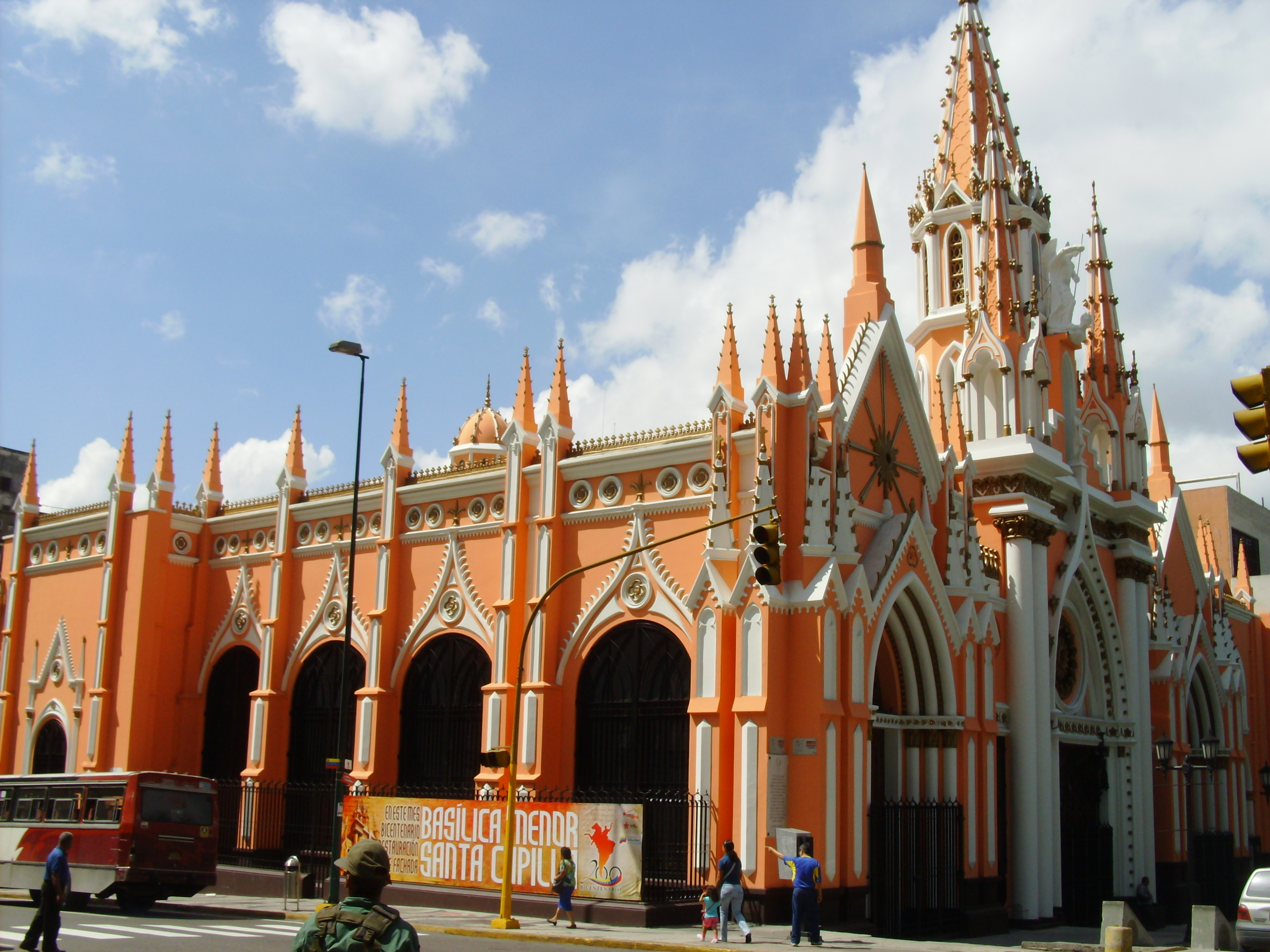
Basilica of Santa Capilla
Three churches have stood on this corner of Avenida Urdaneta in the historic center of Caracas. The first was a humble hermitage dedicated to San Sebastian, erected in 1568 during Venezuela's early colonial period. It was rededicated to Saint Maurice in 1640, then destroyed by an earthquake in 1667. Rebuilt with simple materials -- wood and bricks -- it stood for nearly a century and a half before another earthquake in 1812 almost completely leveled it again. The site, it seemed, was cursed by the geology beneath it. Yet each time, someone chose to build again.
A President's Parisian Ambition
The church that stands today owes its existence to President Antonio Guzman Blanco, one of the most influential and controversial figures in nineteenth-century Venezuela. Guzman Blanco was a modernizer with a deep admiration for French culture -- he spent years living in Paris and reshaped Caracas in the image of a European capital. In 1883, he commissioned architect Juan Hurtado Manrique to design a new church for the earthquake-scarred site, and the reference was unmistakable: the Sainte-Chapelle in Paris, the thirteenth-century Gothic jewel built by King Louis IX to house relics of the Passion. Hurtado Manrique's design translated that French Gothic aspiration into the tropics, creating a neo-Gothic structure on Avenida Urdaneta that stands as one of Caracas's most distinctive religious buildings.
From Parish Church to Minor Basilica
The Basilica of Santa Capilla grew in stature over the decades that followed its construction. In 1921, the church was expanded with the addition of two aisles, giving it more of the spatial grandeur its Gothic-inspired architecture demanded. Then, on August 5, 1926, Pope Pius XI elevated it to the rank of Minor Basilica -- a designation the Vatican reserves for churches of special historical, artistic, or devotional significance. The papal honor placed Santa Capilla among an elite group of churches outside Rome recognized for their importance to the Catholic faithful. On February 16, 1979, Venezuela added its own recognition, declaring the basilica a National Historic Landmark. Inside the church, notable figures from Venezuelan history are buried, making it both a place of active worship and a repository of national memory.
Standing Witness in a Changing City
The Basilica of Santa Capilla occupies a block in the Cathedral Parish of Libertador Municipality, surrounded by the noise and commerce of modern Caracas. Avenida Urdaneta is one of the city's major thoroughfares, and the basilica's neo-Gothic spires rise amid office buildings and bus stops rather than the quiet European squares its architect may have imagined. That tension between the building's aspirations and its context is part of what makes it memorable. The site has endured nearly five centuries of use -- from a sixteenth-century hermitage through multiple earthquakes to a presidential vanity project to a Vatican-recognized basilica. Each iteration has reflected the ambitions and values of its era, while the ground beneath has remained the same, as geologically restless as the country's own history.
From the Air
The Basilica of Santa Capilla is located at 10.506N, 66.914W in the historic center of Caracas, along Avenida Urdaneta in the Cathedral Parish of Libertador Municipality. From the air, look for the neo-Gothic spires near the heart of the colonial grid, close to Plaza Bolivar and other historic landmarks. The basilica sits within the dense urban core of western Caracas. Nearest airport: Simon Bolivar International Airport (SVMI/CCS) approximately 20km north across the Avila mountain range. Recommended viewing altitude: 2,000-4,000 feet for the best perspective on the historic center's layout.