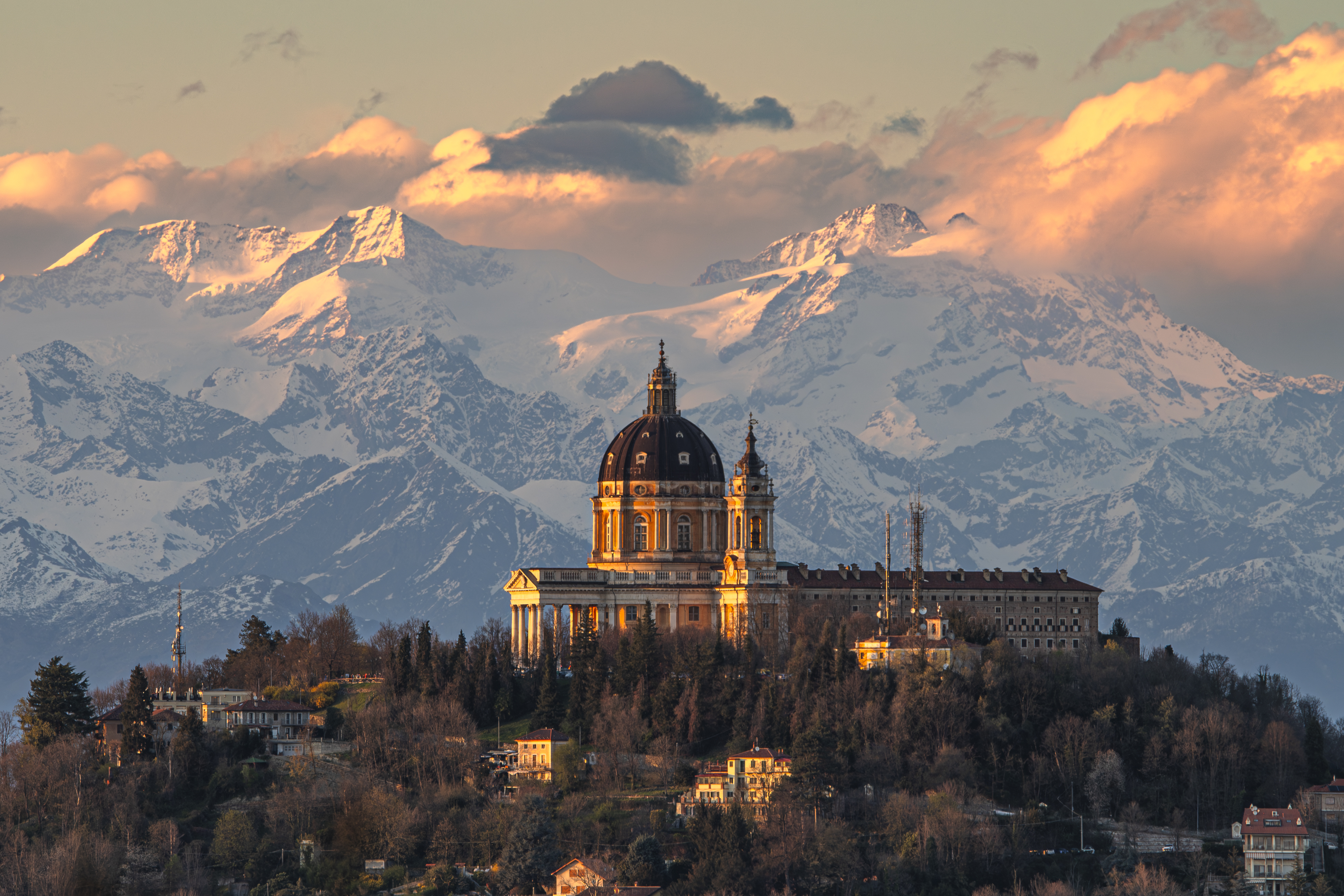
Basilica of Superga
On September 2, 1706, Duke Victor Amadeus II of Savoy and Prince Eugene of Savoy climbed the hill of Superga to survey the Franco-Spanish armies besieging Turin below. Victor Amadeus knelt and swore an oath: if God granted victory, he would build a monument to the Virgin Mary on this very spot. Five days later, from dawn to early afternoon, Piedmontese and allied forces clashed with the French across the fields of Lucento and Madonna di Campagna. By nightfall, the siege was broken. The duke kept his promise.
Juvarra's Crown on the Hill
Victor Amadeus entrusted his vow to Filippo Juvarra, a Sicilian-born architect who had spent a decade studying in Rome. Juvarra drew freely on what he had absorbed there. The dome, completed in 1726, echoes Michelangelo's work at St. Peter's Basilica -- no coincidence for an architect steeped in Roman grandeur. The temple front, protruding from the dome structure, cites the Pantheon. But Juvarra made it deliberately oversized, knowing the basilica would be seen from the city far below and needed to read powerfully against the sky. Construction lasted from 1717 to 1731, producing a church that art historians classify as late Baroque-Classicism: a building that alludes to earlier styles while adding a theatrical flourish that is unmistakably Baroque.
A Dynasty's Resting Place
Beneath the basilica's polished floors lies the Royal Crypt of Superga, the traditional burial place of the House of Savoy. Here rest the dukes, kings of Sardinia, and eventually kings of a unified Italy -- generation after generation of the dynasty that shaped Piedmont and, ultimately, the Italian nation. Charles Albert of Sardinia is interred here, among many others. Two kings of Italy, Victor Emmanuel II and Umberto I, were grand enough to merit the Pantheon in Rome. The last king, Umberto II, returned to the family's ancestral site at Hautecombe Abbey in Savoy. But Superga remains the dynasty's spiritual center, the place where the Savoys gathered their dead around the vow that made their ambitions possible.
The Triangle of Power
Victor Amadeus did not choose this hilltop by accident. The Basilica of Superga was intended as more than a devotional monument -- it was a statement of dynastic authority, visible from anywhere in Turin. The duke positioned it to maintain a direct line of sight to the Castle of Rivoli, the family's country residence to the west. Later, the Palazzina di Caccia of Stupinigi completed a triangle of Savoy residences that inscribed royal power across the landscape of Piedmont. From above, the geometry is unmistakable: three royal sites anchoring the territory like survey markers. The basilica, perched at 672 meters on the crest of the Superga hill with the Monte Rosa massif rising behind it, commanded the apex.
Shadow on the Hill
On May 4, 1949, the rear retaining wall of the Basilica became the site of Italy's most devastating sporting tragedy. A Fiat G.212 airliner carrying the entire Torino football team -- the legendary Grande Torino, five-time consecutive Serie A champions and the backbone of Italy's national squad -- crashed into the embankment in heavy fog. All 31 people aboard died, including 18 players, the Hungarian manager Erno Egri Erbstein, English head coach Leslie Lievesley, club officials, journalists, and the flight crew. The crash is commemorated annually, and a memorial plaque marks the point of impact. The basilica that was born from one battle's triumph now also carries the weight of a peacetime catastrophe that still reverberates through Italian football.
From the Air
Located at 45.08N, 7.77E atop the Superga hill (672m elevation) east of Turin. The white dome is clearly visible from the air against the green hillside, especially approaching from the west over the Po valley. The retaining wall where the 1949 Superga air disaster occurred is at the rear (east side) of the basilica. Nearest major airport is Turin-Caselle (LIMF), approximately 20 km northwest. The Castle of Rivoli and Palazzina di Stupinigi form a visible triangle with the basilica across the Turin plain. Best viewed at 3,000-5,000 feet.