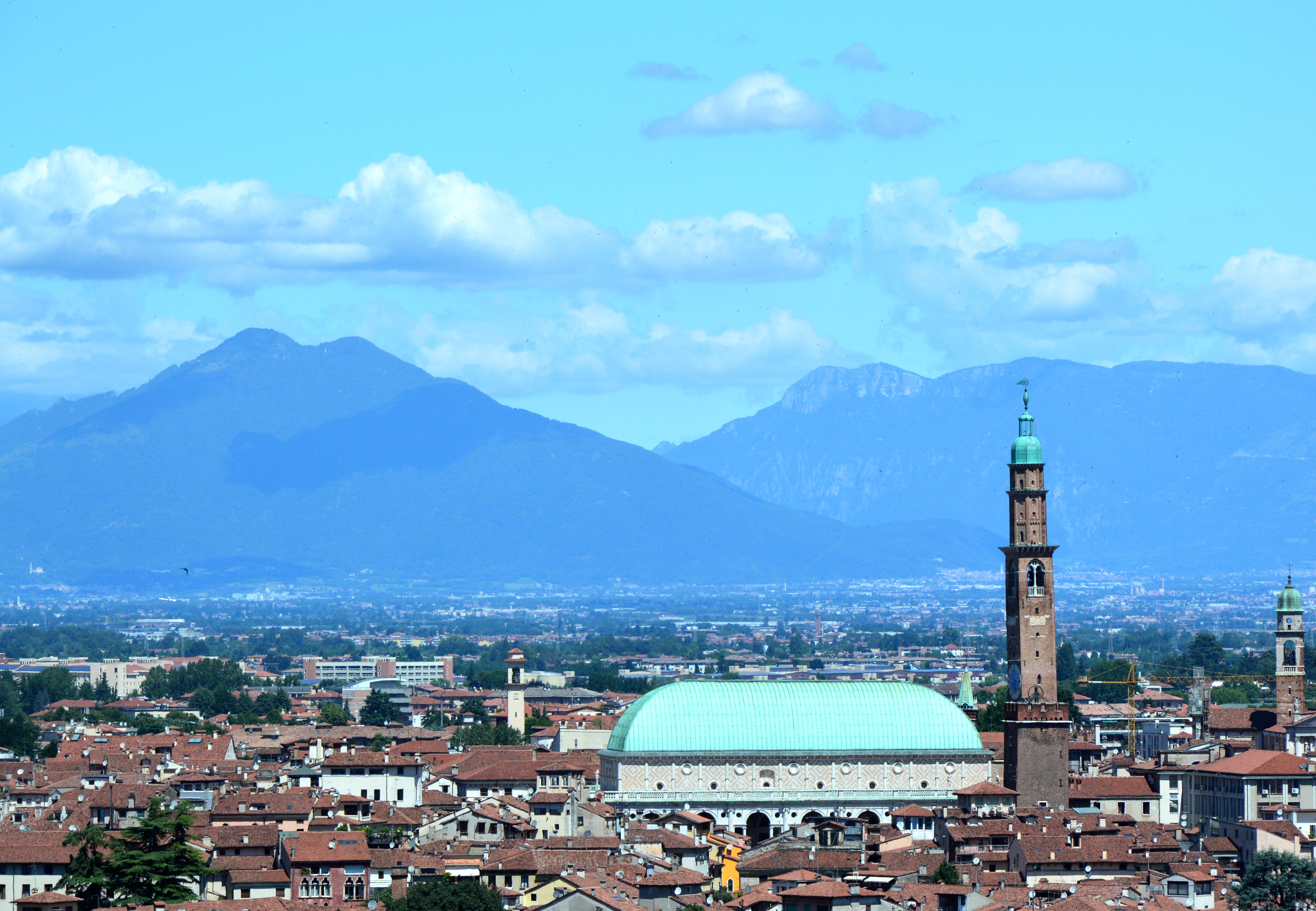
Basilica Palladiana
In 1546, a 38-year-old stonemason's son named Andrea Palladio won the commission that would change Western architecture. The job was not glamorous: rescue a collapsing Gothic palace in the central piazza of Vicenza, a provincial city in the Veneto that was nobody's idea of a cultural capital. The south-western corner of Tommaso Formenton's double-order colonnade had caved in just two years after its completion, and for decades the city council had been calling in famous architects -- Sansovino, Serlio, Sanmicheli, Giulio Romano -- none of whose proposals satisfied. Palladio's did. What he built over the next six decades would earn him the right to rename the structure: he called it a basilica, after the civic halls of ancient Rome.
A Shell Around a Shell
Palladio's genius at the Basilica was structural diplomacy. The original Gothic palace -- the Palazzo della Ragione, designed by Domenico da Venezia in the 15th century -- was not demolished. It remained, with its red and gialletto Verona marble facade still visible behind Palladio's addition. What Palladio did was wrap the existing building in a new outer shell of classical marble forms: a loggia and portico that transformed the building's public face without destroying what came before. The key innovation was the serliana, a repeating motif of round arches flanked by rectangular openings. Because the internal bays of the old palace varied in width, Palladio made the rectangular flanking openings different sizes to absorb the irregularity -- a problem-solving trick disguised as pure elegance. The lower loggia uses the Doric order, its frieze alternating metopes decorated with dishes and ox skulls with triglyphs. The upper floor shifts to the Ionic order with a continuous frieze. This progression from sturdy to refined, from ground to sky, gives the facade its visual lift.
Five Ducats a Month
The Basilica was not built quickly. Palladio received an income of five ducats per month for most of his working life for this single project, and the building was not completed until 1614 -- thirty years after his death. The total cost reached some 60,000 ducats, an enormous sum for a city of Vicenza's size. But the investment created something that transcended its municipal origins. The arched windows Palladio used here -- the serliana motif, later known simply as the Palladian window -- became one of the most copied architectural elements in history. From English country houses to American civic buildings, from St. Petersburg to Kolkata, the pattern that Palladio refined on this provincial piazza spread across the world. Vicenza, for its part, became an architectural destination. The Basilica Palladiana, along with Palladio's other buildings in and around the city, was designated a UNESCO World Heritage Site in 1994.
The Tower That Came First
Rising 82 meters above the piazza, the Torre Bissara predates the Basilica by centuries. Records mention it as early as 1172, though its height was increased and its pinnacle finished in 1444. The tower holds five bells tuned to the chord of E major, and their sound has marked the hours in the Piazza dei Signori for over five hundred years. Standing next to Palladio's Renaissance loggia, the medieval tower creates the kind of visual conversation between eras that makes Italian cities endlessly layered. The piazza below served as both seat of government and commercial center -- the ground floor of the original palazzo housed shops. That mix of civic grandeur and daily commerce continues today, with the Basilica's great hall hosting exhibitions while the piazza around it hums with the ordinary life of a working city.
Restoration and Recognition
By the 21st century, the Basilica Palladiana needed attention. A major restoration project began in 2007, carefully addressing centuries of wear on the marble loggias and the copper roof that caps the building. In 2014, the work won the European Union Prize for Cultural Heritage and the Europa Nostra Award, recognizing the quality of the conservation effort. From Monte Berico, the hill to the south of Vicenza, the Basilica's distinctive silhouette dominates the city's skyline -- the long horizontal sweep of the loggia crowned by the green copper roof, with the Torre Bissara punctuating the composition like an exclamation mark. It is the building that put Vicenza on the architectural map, and the building that put Palladio on it too. He was a local nobody when the Council of One Hundred chose him. By the time the last facade was finished, three decades after his death, he had reshaped the vocabulary of Western building.
From the Air
Located at 45.55N, 11.55E in central Vicenza, Veneto, Italy. The Basilica Palladiana is identifiable from the air by its distinctive copper roof and the adjacent 82-meter Torre Bissara in the Piazza dei Signori. Nearby airports include Vicenza (LIPT) and Verona Villafranca (LIPX). The city sits in the flat Veneto plain with the Berici Hills rising to the south, providing excellent visibility in clear conditions.