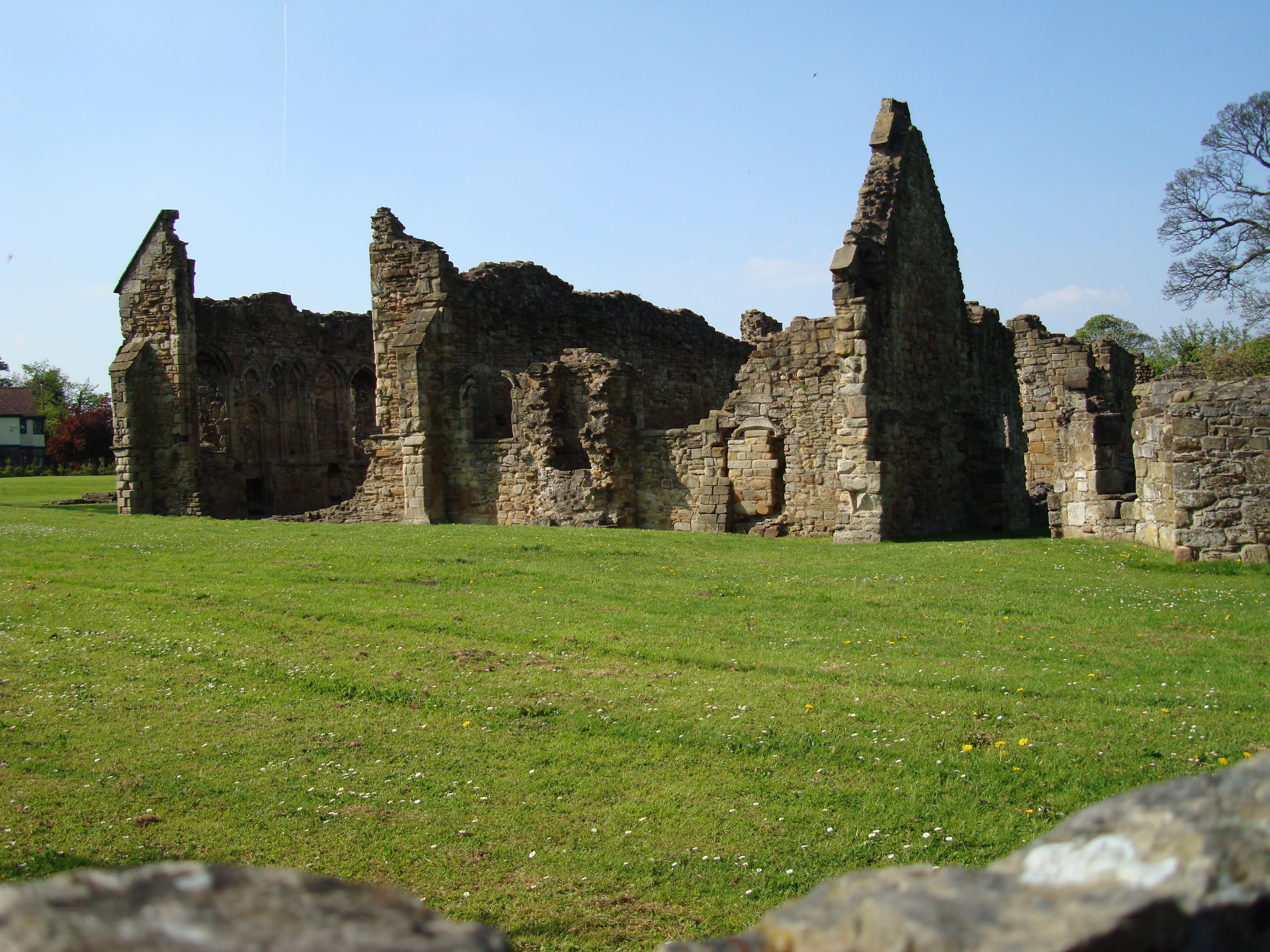
Basingwerk Abbey
The last abbot of Basingwerk was Nicholas Pennant, and he was the son of his predecessor Thomas. By the time Henry VIII's commissioners arrived in 1535 to assess the abbey's worth, the Cistercian ideal of austere devotion had long since given way to something more comfortable. The monks had rebuilt their domestic quarters for greater ease, patronized Welsh bards like Tudor Aled, and leased vast tracts of Derbyshire land to the Talbot family. Basingwerk was valued at a hundred and fifty pounds, enough to place it among the smaller houses earmarked for dissolution. The number of monks had probably dwindled to two or three. A monastery that had once shaped the politics of the Welsh borderlands ended not with a siege but with an accounting exercise.
From Normandy to the Dee Estuary
Basingwerk was founded in 1132 by Ranulf de Gernon, the 4th Earl of Chester, who brought Benedictine monks from Savigny Abbey in southern Normandy to this corner of Flintshire near Holywell. The abbey's first location may have been at nearby Hen Blas rather than the present site at Greenfields. In 1147, when the Savignac Order merged with the Cistercians, Basingwerk became a daughter house of Combermere Abbey in Cheshire, though it was soon transferred to Buildwas Abbey in Shropshire. Twenty years later, the monks challenged their subjection to Buildwas, but Savigny ruled against them. These institutional quarrels mattered because they determined who controlled the abbey's growing wealth and who directed the labor of its monks.
Princes, Kings, and Choosing Sides
Basingwerk occupied territory that both Welsh princes and English kings coveted. Owain Gwynedd stopped at the abbey before the Battle of Ewloe because it blocked the route Henry II needed to reach Rhuddlan, a position of strategic importance that made the monks politically useful to whoever held power. By the thirteenth century, the abbey had come under the patronage of Llywelyn the Great, Prince of Gwynedd, and his son Dafydd ap Llywelyn gave St Winefride's Well to the monks. But when Edward I launched his conquest of Wales in the late thirteenth century, the monks sided with the English. Their reward was permission to hold a market and fair at Holywell, commerce following allegiance as it always did.
An Empire in Derbyshire
The abbey's reach extended far beyond the Welsh borderlands. Henry II granted the monks a manor near Glossop in the Peak District of Derbyshire, and for centuries they administered these distant possessions through a network of roads and agents. The Monks' Road and the Abbot's Chair near Glossop still recall the effort required to manage property separated from the abbey by mountains and a national border. In 1290, the abbey gained a market charter for Glossop. Another charter for nearby Charlesworth followed in 1328. By 1433, the monks had leased all of Glossopdale to the Talbot family, the future Earls of Shrewsbury, effectively outsourcing the management of lands they could no longer efficiently control.
Stone That Speaks
What survives at Basingwerk today tells the story of a community that valued beauty alongside prayer. The refectory, aligned north-south in the traditional Cistercian manner, was a high-quality chamber. Elaborate lancet windows with Early English shafting survive in the west wall, alongside the reader's pulpit where a monk would have read scripture aloud during meals, and the hatch connecting to the kitchen. Part of the dormitory walls still stand, their lancet windows framing views of the Holywell stream that the monks harnessed to power a corn mill and process wool from their flocks. The monks had been practical people as much as spiritual ones, and the ruins at Basingwerk, now managed by Cadw, preserve both dimensions of their lives: the arched windows that lifted the eye toward heaven and the millrace that kept the enterprise running.
From the Air
Located at 53.288N, 3.207W near Holywell in Flintshire, northeast Wales, close to the Dee Estuary. The abbey ruins are on low ground near the coast. St Winefride's Well, one of the 'Seven Wonders of Wales,' is nearby. Nearest airport is Hawarden (EGNR, 12nm southeast). The North Wales coast and the Dee Estuary provide good visual landmarks for orientation.