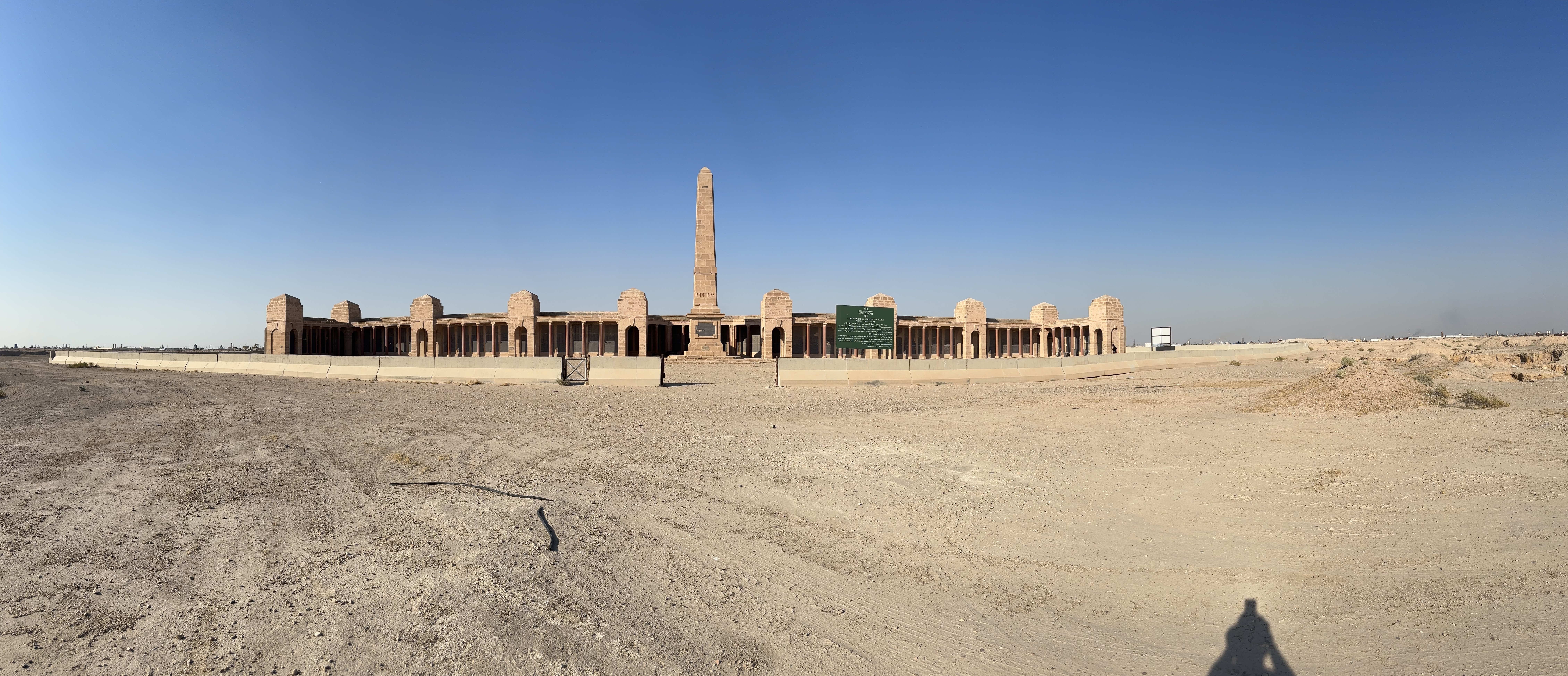
Basra Memorial
"And 258 other Indian soldiers." That is how the Basra Memorial records some of its dead -- not by name, but by number, regiment, and an afterthought of arithmetic. Of the 40,682 Commonwealth soldiers commemorated here for dying without known graves during the Mesopotamian Campaign of 1914-1921, only 7,385 British personnel and Indian officers are identified individually. The remaining 33,256 Indian non-commissioned officers and soldiers are reduced to tallies etched beside unit designations. The Commonwealth War Graves Commission has acknowledged it knows their names. It has not yet inscribed them.
Built to Remember, Moved to Forget
Architect Edward Prioleau Warren designed the memorial, and it was unveiled on 27 March 1929 by Gilbert Clayton at a site eight kilometers north of Basra, near the Shatt al-Arab River. For decades it stood where Mesopotamia's waters carried the weight of empire and the campaigns fought to secure it. Then in 1997, the entire memorial was relocated southwest to a Gulf War battleground near Zubayr. The reasons for the move have never been fully transparent. What is clear is that the memorial now sits surrounded by gravel and sand extraction pits, ringed by piles of debris, with a concrete barrier the only thing preventing mining spoil from spilling onto the site. The Commonwealth War Graves Commission abandoned active maintenance in the early 2000s and has no current plans to renovate this or any other war memorial in Iraq.
Sixty-Eight Panels in the Desert
The memorial consists of 68 stone panels bearing the names of the dead -- or at least the names of some of them. As of recent inspections, approximately 62 panels remain present and readable, though 8 have delaminated from the walls. The Cross of Remembrance has been stolen. Bronze plaques from the Wall of Remembrance have been stripped. The Telegraph reported the vandalism in 2013, and the state of disrepair has only deepened since. Yet the panels themselves endure with a stubbornness that outlasts their custodians' attention. A private individual has photographed all 68 for posterity, making them available online -- an act of personal preservation filling a gap left by institutional neglect.
The Names That Are and Aren't There
Five Victoria Cross recipients are listed on the memorial's panels. Lieutenant Commander Charles Henry Cowley and Lieutenant Humphrey Osbaldston Brooke Firman, both killed on the night of 24-25 April 1916 during desperate actions on the River Tigris near Kut al-Amara, share Panel 1. James Henry Fynn, who earned his Victoria Cross at Sanna-i-Yat in Mesopotamia at the age of 22, is recorded on Panel 17. He died the following year, still only 23. George Stuart Henderson, decorated with the Victoria Cross, the Distinguished Service Order and Bar, and the Military Cross, is on Panel 31. He survived the Great War only to die in Iraq in July 1920, during the postwar insurgency. These men are remembered by name, rank, and deed. But for every named soldier on the memorial, roughly four others are present only as anonymous additions to a regimental count. Naik Lal Khan of the 67th Punjabis, who died on 28 April 1916, is one of the rare Indian non-commissioned soldiers individually commemorated. Tens of thousands of his comrades were not.
An Unfinished Reckoning
In 2016, the BBC reported that CWGC publicity director Colin Kerr acknowledged the disparity: 30,000 Indian soldiers remain unnamed on the Basra Memorial despite the commission possessing records of their identities. Kerr said the commission had launched a project to find ways to publicize their names in India and Britain. As of 2025, nothing has been done. No deadlines have been set. No ongoing effort is underway. The memorial stands in the Iraqi desert as a monument to two kinds of forgetting -- the fog of war that swallowed these soldiers' graves, and the institutional choices that erased their names from the stone meant to preserve them. The 68 panels weather slowly in the heat. The concrete barrier holds back the gravel pits. The names that are there remain legible. The names that should be there remain absent.
From the Air
Located at 30.41°N, 47.55°E, near Zubayr in southern Iraq, southwest of modern Basra. The site sits in flat, arid terrain amid gravel extraction operations. Nearest major airport is Basra International Airport (ORMM), approximately 25 km to the northeast. The memorial is a ground-level structure not easily distinguished from altitude; best viewed below 2,000 ft. The Shatt al-Arab waterway lies to the northeast, and the Kuwait border is roughly 50 km to the south.