Basrah Museum
In 1991, looters ransacked it. In 2003, the British Army occupied its grounds. In 2008, American and Iraqi soldiers launched combat operations from its courtyards. And in 2019, the Basrah Museum opened its doors to the public, displaying artifacts that span eight millennia of human civilization. The building on the banks of the Shatt al-Arab, three kilometers southeast of Basra's historic center, was once a palace of Saddam Hussein. Now it belongs to the people whose history it houses.
From Palace to Stronghold to Museum
The Basrah Museum's journey mirrors Iraq's own turbulent modern history. The original museum collection was scattered in 1991, when mobs opposed to Saddam Hussein looted nine museums across the country during the uprisings that followed the first Gulf War. Artifacts that had survived millennia vanished in days. The palace that would become the museum's new home sat on the Shatt al-Arab waterway, an imposing structure that changed hands with each shift in power. After the 2003 invasion, British forces claimed the grounds as a military base. By 2008, the Iraqi Army, Federal Police, and United States Army were using the compound to launch combat operations against the Mahdi Army. Sandbags and armored vehicles occupied spaces where curators would eventually arrange display cases. The transformation from military base to cultural institution began in 2010, when the British Museum in London partnered with Iraqi authorities to support the project. Qahtan Al Abeed, Director of Basrah Antiquities and Heritage, managed the long effort from the start, navigating the bureaucracies of the State Board of Antiquities and Heritage and the Ministry of Culture.
Eight Thousand Years Under One Roof
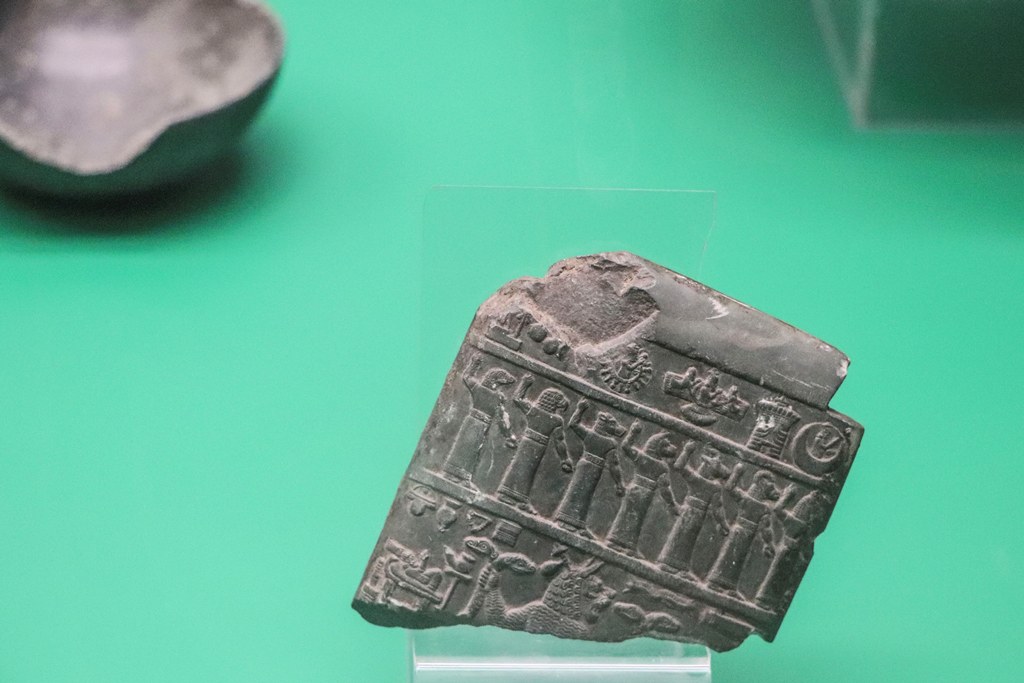
The museum's four galleries walk visitors through the deep layers of southern Mesopotamia. The Sumer Gallery reaches furthest back, displaying material from the Halaf culture around 5500 BCE through the Third Dynasty of Ur, roughly 2000 BCE -- pottery strainers, figurines, and tools from the civilizations that invented writing and built the first cities. The Babylon Gallery focuses on the Kassite period, from about 1600 to 1100 BCE, a dynasty that ruled Babylonia for nearly five centuries. The Assyrian Gallery holds objects from the Neo-Assyrian Empire of the 9th and 8th centuries BCE, including stone Lamashtu plaques meant to ward off demons. The Basrah Gallery brings the story closer to home, exhibiting pottery, glass vessels, terracotta figurines, and Hellenistic coins -- artifacts spanning from the Hellenistic period through the Parthian, Sasanian, and Islamic eras that trace the city's own deep roots as a trading crossroads.
Shanasheels and Reed Houses
The 2,500-square-meter museum building draws on Ottoman architectural traditions, incorporating Basrian shanasheels -- the ornate wooden balconies with latticed screens that once defined the city's skyline. A domed foyer opens into four ground-floor halls that house the galleries, with four smaller halls on the upper floor. But the collection extends beyond the walls. In the outdoor compound, two reed guesthouses called mudhifs stand alongside traditional boats of the kind used for centuries in the Mesopotamian Marshes to the north. These structures are not replicas behind glass. They are functional, inhabitable architecture -- a living connection to the marsh Arab culture that Saddam Hussein tried to destroy by draining the wetlands in the 1990s.
A Homecoming of Stolen Treasures
The museum's first gallery opened in September 2016, funded through the UK Friends of Basrah Museum, which raised money through corporate and individual donations. A Cultural Protection Fund grant from the British Council, managed in partnership with the Department of Digital, Culture, Media and Sport, followed in December 2016 to support the completion of the remaining galleries. When the museum fully opened in March 2019, three new galleries -- Babylon, Sumer, and Assyrian -- went on display. Thousands of artifacts dating as far back as 6000 BCE were visible to the public in southern Iraq for the first time in decades. Among them were objects looted in 1991, painstakingly recovered and returned to their rightful home in the Basrah Gallery. The Iraq Museum in Baghdad assisted with the effort, helping to ensure that Basra's story would be told in Basra itself -- not only in the capital or in foreign collections thousands of kilometers away. For a city that has known more war than peace in living memory, the museum offers something rare: a place to look backward without grief.
From the Air
Located at 30.497N, 47.861E on the west bank of the Shatt al-Arab waterway in Basra, Iraq. The museum building is visible along the riverbank approximately 3 km southeast of the old city center. Nearest airport is Basra International Airport (ORMM), about 15 km to the west-northwest. The Shatt al-Arab, formed by the confluence of the Tigris and Euphrates rivers, is the dominant waterway landmark. Best viewed at 2,000-5,000 feet for riverside detail.