Bastar State
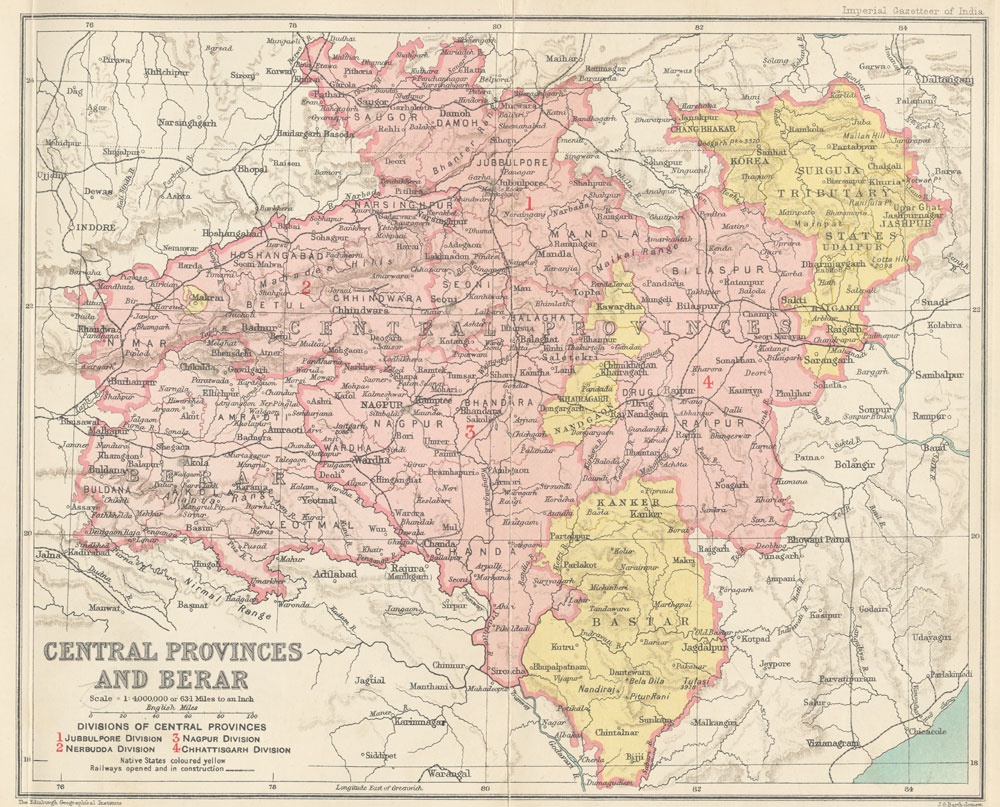
The forests of Bastar have swallowed kingdoms before. Covering more than 13,000 square miles of what is now southern Chhattisgarh, this landscape of sal woodlands and river gorges was already ancient when, around 1324 CE, a prince fleeing the collapse of the Kakatiya dynasty arrived from Warangal. His name was Annamadeva, and the goddess who guided him was Danteshwari. He built a kingdom here that would endure -- through Maratha invasions, British suzerainty, and Indian independence -- for more than six centuries, making the Bastar royal line one of the longest-reigning dynasties in the subcontinent.
Dandakaranya's Long Memory
Long before the Kakatiyas came, this land carried other names. Hindu epic tradition identifies the region as Dandakaranya, the great forest through which Rama wandered during his exile in the Ramayana. The Mahabharata places it within the Kosala Kingdom. By around 450 CE, a Nala king named Bhavadatta Varman ruled the area and launched raids into the neighboring Vakataka kingdom. These early powers left little architecture but deep cultural imprints. The tribal communities of Bastar -- the Gonds, the Halbas, the Marias -- maintained their own traditions through every change of ruler, and those traditions remain visible today in the region's festivals, art, and forest-dependent way of life. The Halba tribe, in particular, traces its descent to the military classes of these early kingdoms.
A Goddess and a Fugitive Prince
The founding story of Bastar is one of exile and reinvention. When the Kakatiya capital of Warangal fell in the early 14th century, Annamadeva -- recorded as a brother or relative of the last Kakatiya ruler, Prataparudra II -- traveled north into the tribal highlands and established a new kingdom under the patronage of the goddess Danteshwari. Historians note that the genealogy linking the Bastar rulers to the Kakatiyas may reflect later embellishment; a 1703 family chronicle records only eight generations spanning nearly four centuries, a suspiciously thin lineage. Such claims of prestigious ancestry were common among Indian princely states, lending legitimacy and warrior status. Whatever the precise truth of the dynasty's origins, Danteshwari became the tutelary deity of Bastar, and her temple still stands at Dantewada, a pilgrimage site that binds the region's identity to its founding myth.
Palace Intrigues on the Deccan Plateau
Bastar's history reads like a chronicle of survival against internal fracture and external pressure. When the main dynastic line went extinct around 1709, a collateral branch took over under Rajapala Deva, who had two wives from different Rajput clans. After his death in 1721, the elder queen placed her own brother on the throne, forcing the legitimate heir Dalapati Deva to flee to the neighboring Kingdom of Jeypore. A decade of exile followed before Dalapati reclaimed his seat in 1731. Meanwhile, the Marathas were tightening their grip on central India, eroding the independence that Bastar had enjoyed for centuries. By 1861, the state had been formally absorbed into British India's Central Provinces and Berar, its capital relocated from the old town of Bastar to the more accessible Jagdalpur, where the royal palace became the seat of an increasingly constrained monarchy.
The Last Maharaja
The final chapter of Bastar's royal story is its most tragic. Maharaja Pravir Chandra Bhanj Deo ascended the throne in 1936 at the age of seven. When India gained independence, Bastar acceded to the Indian Union on January 1, 1948, and eventually became part of Chhattisgarh state in 2000. But Pravir Chandra remained immensely popular among the tribal communities, championing their rights against land encroachment by outsiders and government officials. On March 25, 1966, while leading a tribal protest at the gates of his own palace in Jagdalpur, Pravir Chandra was shot dead by police. Scores of tribal supporters and courtiers died alongside him. The event remains one of the most controversial episodes in post-independence Indian history, still debated in Chhattisgarh and beyond.
A Kingdom in the Canopy
Today, Bastar is a division of Chhattisgarh state, and the ceremonial title of Maharaja rests with Kamal Chandra Bhanj Deo, who has held it since 1996. The Danteshwari Temple at Dantewada continues to draw pilgrims, and the annual Dussehra festival in Jagdalpur -- a 75-day celebration that predates most of India's better-known Dussehra observances -- remains the region's defining cultural event. The forests that sheltered Annamadeva seven centuries ago still cover much of the landscape, harboring a biodiversity that ranges from wild buffalo to Indian giant squirrels. From above, the Indravati and Godavari rivers carve silver threads through an unbroken green canopy, marking the boundaries of a kingdom that existed longer than most and left its deepest marks not in stone but in the living traditions of the people who still call this forest home.
From the Air
Located at 20.083N, 83.200E in the heavily forested Bastar division of southern Chhattisgarh. The nearest airport is Maa Danteswari Airport at Jagdalpur (VEJR). From cruising altitude, the region appears as dense forest canopy bisected by the Indravati and Godavari rivers. The Jagdalpur royal palace and Danteshwari Temple at Dantewada are not individually visible from high altitude, but the town of Jagdalpur stands out as the largest settlement in the region. Best viewed at 5,000-8,000 feet AGL to appreciate the river valleys and forest coverage.