Bat Masterson
On October 25, 1921, a 67-year-old sportswriter at the New York Morning Telegraph suffered a massive heart attack at his desk. His final column, found beside him, included this observation: "I suppose these ginks who argue that because the rich man gets ice in the summer and the poor man gets it in the winter, things are breaking even for both. Maybe so, but I'll swear I can't see it that way." The dead man was Bat Masterson, and the distance between that Manhattan newsroom and the dusty streets of Dodge City, Kansas, where he had once served as county sheriff, measured the full improbable arc of a life that crossed from the frontier to the front page.
Buffalo Hunter, Army Scout, Gunfighter
Bartholomew William Barclay Masterson was born on November 26, 1853, in Henryville, Quebec, the second of seven children in a working-class Irish family. By his late teens, he and his brothers Ed and Jim had left the family farm to hunt buffalo on the Great Plains. On June 27, 1874, Masterson found himself at Adobe Walls in the Texas Panhandle, one of only 28 hunters defending a collection of ramshackle buildings against several hundred Comanche, Kiowa, and Cheyenne warriors led by Quanah Parker during a five-day siege. The defenders lost four men, one by accidental self-inflicted gunshot. Masterson survived and promptly signed on as a U.S. Army scout with Colonel Nelson Miles, helping recover four sisters, aged 9 to 15, who had been captured by Cheyenne Dog Soldiers after their parents and three siblings were killed and scalped near Ellis, Kansas.
The Law in Dodge City
On November 6, 1877, Masterson won election as county sheriff of Ford County, Kansas, by three votes. His brother Ed simultaneously held the post of city marshal, giving the Masterson brothers control of both the city and county police forces. Bat captured the notorious outlaws Dave Rudabaugh and Ed West for an attempted train robbery. Then, on April 9, 1878, 25-year-old Ed Masterson was shot and killed in the line of duty by a cowboy named Jack Wagner. Bat responded from across the street, firing on Wagner and his boss, Alf Walker. Wagner died the next day. More violence followed in October when a variety actress named Dora Hand was murdered by James Kenedy, son of wealthy Texas cattleman Mifflin Kenedy. Masterson's posse, which included Wyatt Earp and Bill Tilghman, captured Kenedy after Masterson shot him in the arm and other posse members killed his horse.
From Faro Tables to the Front Page
After losing his re-election bid, Masterson drifted through Colorado as a gambler, a city marshal in Trinidad, a faro dealer in Denver, and a fixture at every major prizefight in the country. He knew the heavyweight champions of the era personally, from John L. Sullivan to Jack Dempsey. In 1902, he and his wife Emma moved to New York City, where his friend Alfred Henry Lewis got him a job as a columnist for the Morning Telegraph. His thrice-weekly column, "Masterson's Views on Timely Topics," covered boxing and other sports but ranged freely into crime, war, and politics. He wrote biographical sketches of Ben Thompson, Wyatt Earp, Luke Short, Doc Holliday, and Bill Tilghman for Human Life magazine. Lewis also introduced Masterson to President Theodore Roosevelt, and the two formed a friendship that led to Masterson's appointment as a deputy U.S. Marshal for the Southern District of New York.
The White House Gunfighter
Roosevelt, who had a well-documented fascination with the frontier, appointed Masterson alongside other Western lawmen Pat Garrett and Ben Daniels, a group informally known as the "White House Gunfighters." Roosevelt wrote Masterson a letter cautioning him to be careful not to gamble while holding public office, adding, "I wish you to show this letter to Alfred Henry Lewis and go over the matter with him." Masterson served as deputy marshal from 1905 to 1909, earning $2,000 per year. When William Howard Taft succeeded Roosevelt and ordered an investigation of Masterson's employment, Masterson was terminated. He returned to sportswriting full-time for the remaining twelve years of his life.
Buried in the Bronx
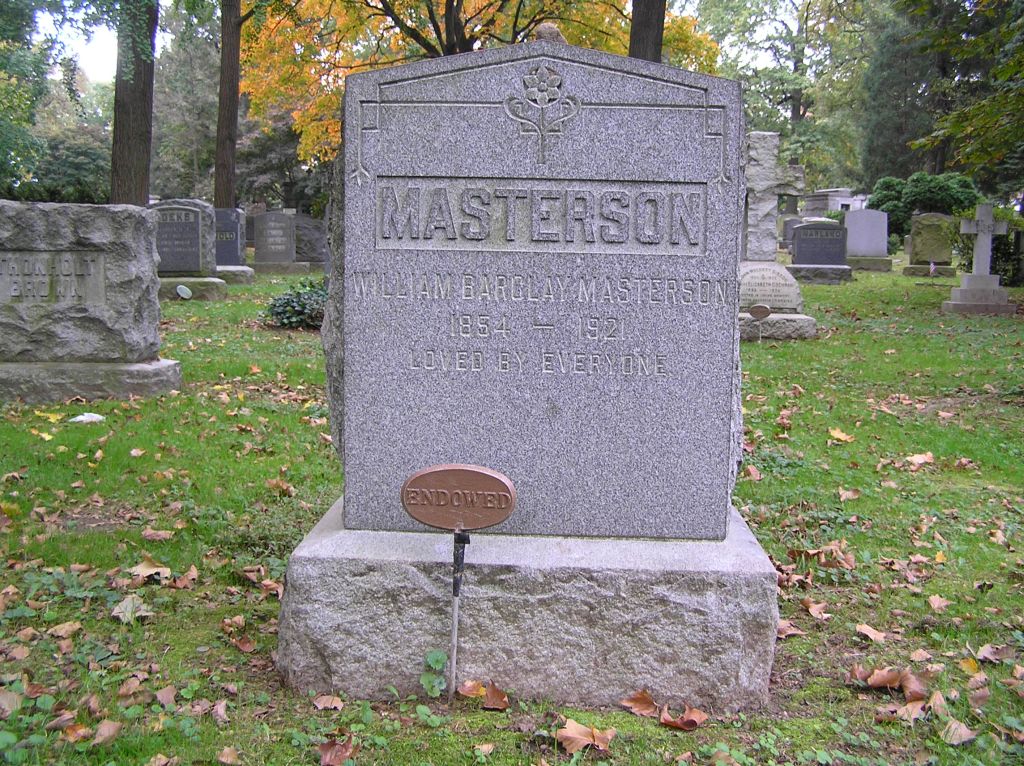
About 500 people attended Masterson's funeral at Frank E. Campbell's Funeral Church on Broadway and 66th Street. His honorary pallbearers included Damon Runyon and Tex Rickard. Runyon, a close friend, eulogized him as "a 100 percent, 22-karat real man" who was "always stretching out his hand to some down-and-outer." Runyon's short story collection Guys and Dolls, published eleven years later, featured a high-rolling gambler from Colorado named Sky Masterson, a character barely disguised. Masterson was buried at Woodlawn Cemetery in the Bronx under a granite marker inscribed "William Barclay Masterson" and the epitaph "Loved by Everyone." His first name, Bartholomew, does not appear on the stone. Even in death, Bat Masterson kept a little of the frontier's preference for the name you chose over the one you were given.
From the Air
Bat Masterson is buried at Woodlawn Cemetery, located at 40.888N, 73.872W in the northern Bronx, at the intersection of Webster Avenue and East 233rd Street. The sprawling 400-acre cemetery, with its distinctive Victorian monuments, is clearly visible from above. Best viewed at 2,000-3,000 feet AGL. Nearest airports: KTEB (Teterboro, 10nm west), KLGA (LaGuardia, 10nm south). Van Cortlandt Park borders the cemetery to the west.