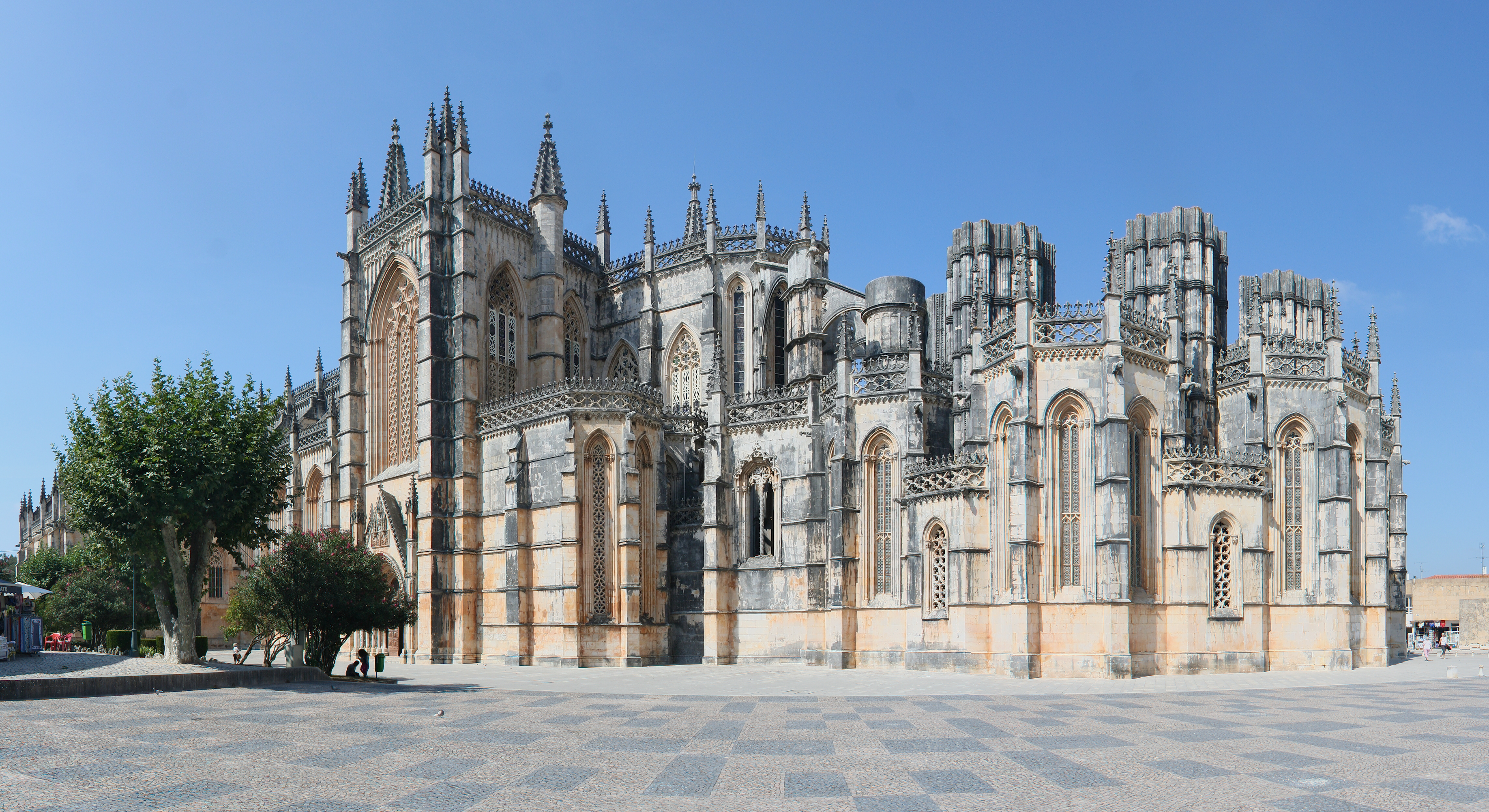
Batalha Monastery
The architect Huguet was so confident in his unsupported vault that he slept beneath it the night the scaffolding was removed. The Chapterhouse of Batalha Monastery spans 19 meters without a single central pillar -- so daring a feat that condemned prisoners were forced to do the construction work, and it failed twice before it held. Today, two Portuguese soldiers from World War I lie beneath that same vault, guarded by a permanent military honor watch. A building born from one battle now memorializes another, five centuries later.
A Promise on the Battlefield
On August 14, 1385, King John I of Portugal stood on the plain of Aljubarrota facing a Castilian army that outnumbered his own. He swore to the Virgin Mary that if he won, he would build a monastery in her honor. The Portuguese won decisively, ending the 1383-1385 succession crisis and securing the Aviz dynasty's hold on the throne. John kept his word. Construction began in 1386 under Portuguese architect Afonso Domingues, whose Rayonnant Gothic design drew influence from English Perpendicular architecture -- similarities with York Minster and Canterbury Cathedral are still visible in the facade. The project would consume 131 years, span seven reigns, and employ fifteen master architects, though seven held the title only as an honor.
Where Portugal and England Clasp Hands
The Founder's Chapel, completed between 1426 and 1434, is where the monastery becomes personal. Under a star-vaulted octagon lie King John I and his wife Philippa of Lancaster, their stone effigies resting in full regalia with hands clasped -- a gesture symbolizing the alliance between Portugal and England. The coats of arms of both the House of Aviz and the House of Lancaster crown their baldachins, alongside the insignia of the Order of the Garter. Along the south wall, four recessed arches shelter the tombs of their sons: Ferdinand the Holy Prince, who died a prisoner in Fez in 1443; John of Reguengos; Henry the Navigator, whose voyages would reshape the world; and Peter of Coimbra, killed at the Battle of Alfarrobeira in 1449. The chapel's inscribed mottos repeat across the stonework: the king's Por bem -- 'for the better' -- and the queen's Yl me plet -- 'I am pleased.'
The Chapels That Never Got Their Roof
The Capelas Imperfeitas -- the Unfinished Chapels -- are Batalha's most evocative feature precisely because of what they lack. Commissioned in 1437 by King Edward as a second royal mausoleum, the octagonal structure was begun by Huguet but passed through successive architects who each reimagined the design. Mateus Fernandes transformed the portal into a 15-meter masterpiece of Manueline decoration, completed in 1509: armillary spheres, winged angels, ropes, tree stumps, and clover-shaped arches carved in a lacework of stone. King Manuel I's motto -- Leaute faray tam yaserei, 'I will always be loyal' -- appears more than two hundred times across the arches and pillars. But the vault was never completed. When John III redirected resources to the Jeronimos Monastery in Lisbon, work stopped for good. The chapels remain open to the sky, accessible only from outside the church.
Scars of War and the Patience of Restoration
The 1755 earthquake damaged Batalha, but Napoleon's Marshal Massena inflicted far worse. His troops sacked and burned the complex in 1810 and 1811. One tomb of King John II stands empty because Massena's soldiers threw the bones away. When the Dominicans were expelled in 1834, the monastery was abandoned and left to decay. Rescue came from King Ferdinand II, who began a restoration program in 1840 that would continue into the early 20th century. Master stonemason Jose Patrocinio de Sousa oversaw much of the rebuilding. The monastery was declared a National Monument in 1907, became a museum in 1980, and received UNESCO World Heritage status in 1983.
Light Through Colored Glass
Batalha likely housed Portugal's first stained-glass workshop, an art introduced by German craftsmen from Franconia and Nuremberg. The oldest windows date to the late 1430s, while the Manueline ogival windows in the choir were produced in the 1520s and 1530s by Portuguese masters including Francisco Henriques. They depict the Visitation, the Epiphany, the Flight into Egypt, and the Resurrection. Standing inside the nave -- 22 meters wide but soaring 32.4 meters high -- the proportions designed by Huguet compress the space horizontally while pulling the eye upward. The interior is deliberately austere, the ribbed vaults resting on compound piers without ornament. Light does the decorating here, filtered through tracery windows and tinted glass, shifting across bare stone as the hours pass.
From the Air
Located at 39.66N, 8.83W in central Portugal, roughly 120 km north of Lisbon. The monastery is a distinctive Gothic complex visible from moderate altitude, standing apart from the town of Batalha. Nearest airports include LPMT (Monte Real, ~30 km northwest) and LPPT (Lisbon Portela, ~120 km south). The equestrian statue of Nuno Alvares Pereira in the square provides a visual anchor. The battlefield of Aljubarrota lies approximately 10 km to the south.