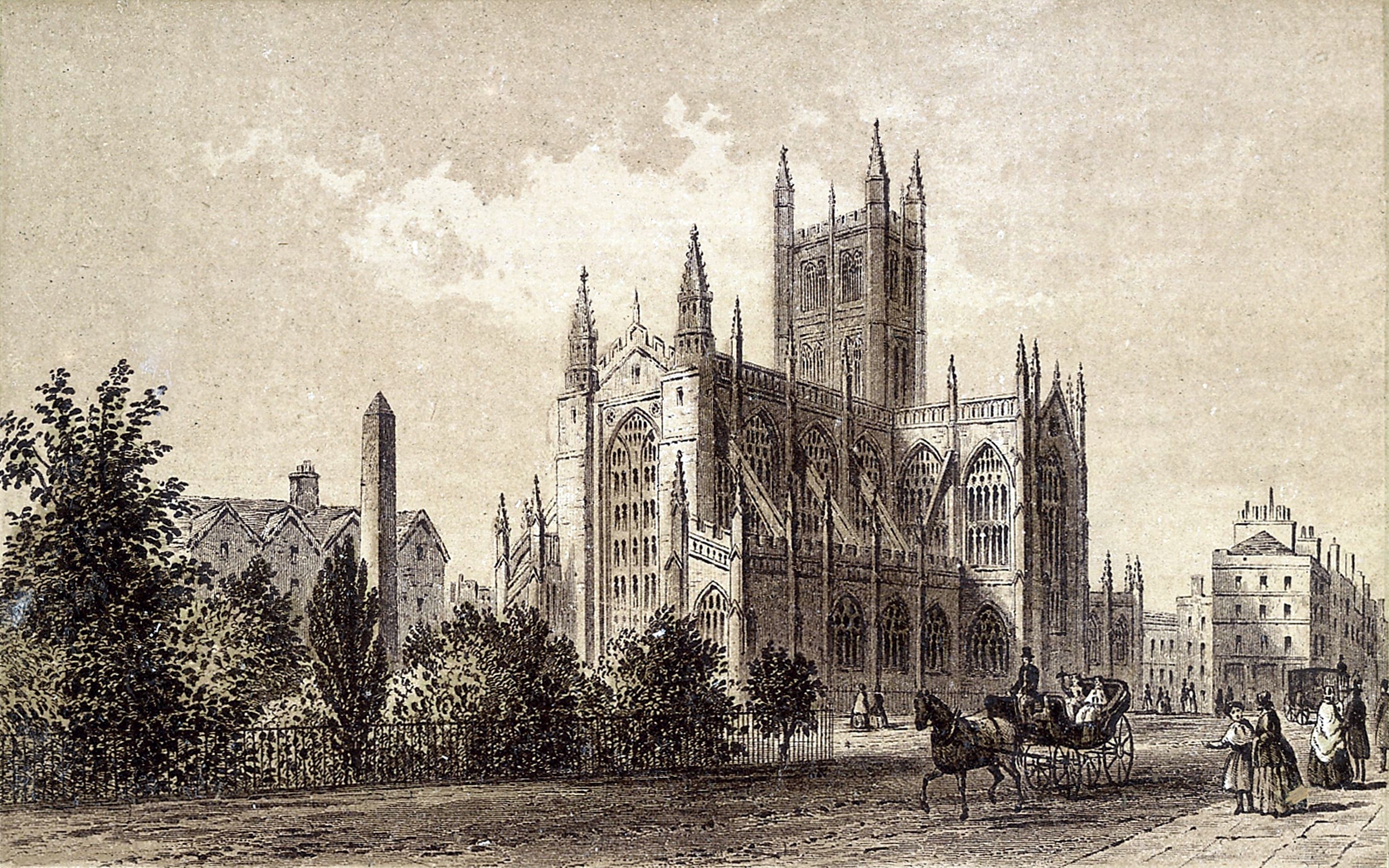
Bath Abbey
Angels climb ladders on the west front of Bath Abbey. Carved in stone, they ascend and descend between heaven and earth, an image from Bishop Oliver King's dream in 1499 that inspired the rebuilding of the church. It is a fitting symbol for a building that has itself risen and fallen more than once. Founded in the seventh century, burned, rebuilt, dissolved, left roofless, and finally restored, Bath Abbey stands today as one of the finest examples of Perpendicular Gothic architecture in western England, its vast windows flooding the interior with more light than most medieval churches dared admit.
From Saxon Coronation to Norman Ambition
A monastery was established on this site in 757, part of the wave of Saxon religious foundations that spread across the kingdom of Wessex. In 973, Edgar was crowned King of all England here, a ceremony whose liturgy formed the basis of every subsequent English coronation. The Benedictine community that oversaw this moment would endure for centuries, though the building they knew would not. After the Norman Conquest, the see of a bishop was transferred from Wells to Bath, and a vast Norman cathedral was begun. At 100 metres long, it dwarfed the present church. But ambitions shifted, and the seat of the diocese eventually settled at Wells Cathedral after prolonged contention between the two cities.
The Bishop's Dream
By the late fifteenth century, the old Norman cathedral was crumbling. Bishop Oliver King, visiting Bath in 1499, reportedly dreamed of angels ascending and descending a ladder beside an olive tree, with a voice commanding him to restore the church. Whether divine vision or political calculation, King commissioned a new building in the Perpendicular Gothic style, smaller than its Norman predecessor but astonishingly luminous. The architects, Robert and William Vertue, masters of fan vaulting who had worked on Henry VII's Chapel at Westminster, designed a structure that is essentially more window than wall. The nave's fan vault, completed centuries later during Victorian restoration, remains one of the finest in England. Construction was still underway when Henry VIII dissolved the monasteries in 1539, and the unfinished church was stripped of its lead, glass, and iron.
Ruin and Resurrection
For decades the abbey stood roofless, exposed to the elements while the citizens of Bath worshipped in the nave amid the decay. Elizabeth I, visiting in 1574, was so moved by the state of the building that she launched a national appeal for its restoration. Work proceeded fitfully over the following centuries. The most transformative intervention came in the 1860s, when Sir George Gilbert Scott undertook a comprehensive restoration, completing the fan vaulting that the Vertue brothers had designed but never finished. Scott's work gave the abbey the soaring interior it has today, where stone ribs spread across the ceiling like frozen fountains.
A Church of Memorials
Walk through Bath Abbey and you walk through a gallery of English history. The floor and walls hold more than 600 memorial tablets and over 30 wall monuments, a concentration rivalled by few churches outside Westminster Abbey. Senators, soldiers, colonial administrators, Georgian socialites who came to Bath for the waters and never left -- their names cover every surface. Beau Nash, the self-appointed Master of Ceremonies who transformed Bath into the most fashionable city in eighteenth-century England, is commemorated here. So are scores of people whose names mean nothing now but whose epitaphs, earnest or witty or heartbroken, form a collective portrait of English life across three centuries.
Living Stone
Bath Abbey remains an active parish church, its services drawing both residents and the millions of visitors who pass through Bath each year. The honey-coloured Bath stone of its exterior glows in afternoon light, and the 52 windows -- including the great east window depicting 56 scenes from the life of Christ -- fill the interior with a warmth unusual in English Gothic churches. Below the abbey, the Roman Baths that gave the city its name draw their own crowds, and the juxtaposition is striking: pagan springs and Christian spires sharing the same ancient ground, separated by centuries but united by the human impulse to find meaning in place.
From the Air
Located at 51.381N, 2.359W in the centre of Bath, Somerset. The abbey's cruciform footprint and pale stone are clearly visible among the Georgian terraces. Nearest airports: Bristol (EGGD) approximately 15nm northwest, Bath has no commercial airport. Best viewed from 2,000-3,000ft for context with the surrounding crescents and the River Avon.