Baton Rouge: The Red Stick Capital on the Mississippi
On March 17, 1699, French explorer Pierre Le Moyne, Sieur d'Iberville, led an expedition up the Mississippi River. At a bluff on the east bank, he found a cypress pole stained red with animal blood - a boundary marker between the Houma and Bayougoula tribes. Iberville named the place 'le bâton rouge,' the red stick. The name stuck. The small settlement became Louisiana's capital in 1817, lost the title during Civil War occupation, reclaimed it in 1882. Huey Long built the state's Art Deco capitol tower here in the 1930s - at 450 feet, still the tallest state capitol in America. Long was assassinated in its corridors in 1935. Louisiana State University sprawls south of downtown, its Tiger Stadium one of college football's most fearsome environments, 100,000 fans making the ground shake on Saturday nights.
Huey Long's Capitol
The Louisiana State Capitol rises 450 feet above Baton Rouge - 34 stories of Art Deco limestone completed in 1932, still the tallest state capitol building in America. Governor Huey Long built it in 14 months, pushing the project through with characteristic force. The Kingfish, as they called him, transformed Louisiana through populist programs and ruthless politics, building roads, hospitals, and schools while crushing opposition. On September 8, 1935, Dr. Carl Weiss shot Long in the capitol's first-floor corridor. Long's bodyguards killed Weiss immediately; Long died two days later. The bullet holes have been patched, but guides show visitors where they once were. Long is buried on the capitol grounds, his statue facing the building he built.
Death Valley
LSU's Tiger Stadium earned its nickname through simple physics: when 100,000 fans start jumping and screaming, the concrete bowl amplifies the sound until opposing quarterbacks can't hear their own signals. Visiting teams have measured crowd noise exceeding 130 decibels - louder than a jet engine. The stadium opened in 1924 and has expanded repeatedly; night games under the lights are legendary, the crowd dressed in purple and gold, the band playing 'Hold That Tiger' until the air vibrates. Death Valley has hosted some of college football's most famous moments: the 1959 Billy Cannon punt return, the 1988 earthquake game against Auburn (crowd noise registered on LSU's geology department seismographs). Saturday nights in Baton Rouge are Louisiana's secular religion.
River City
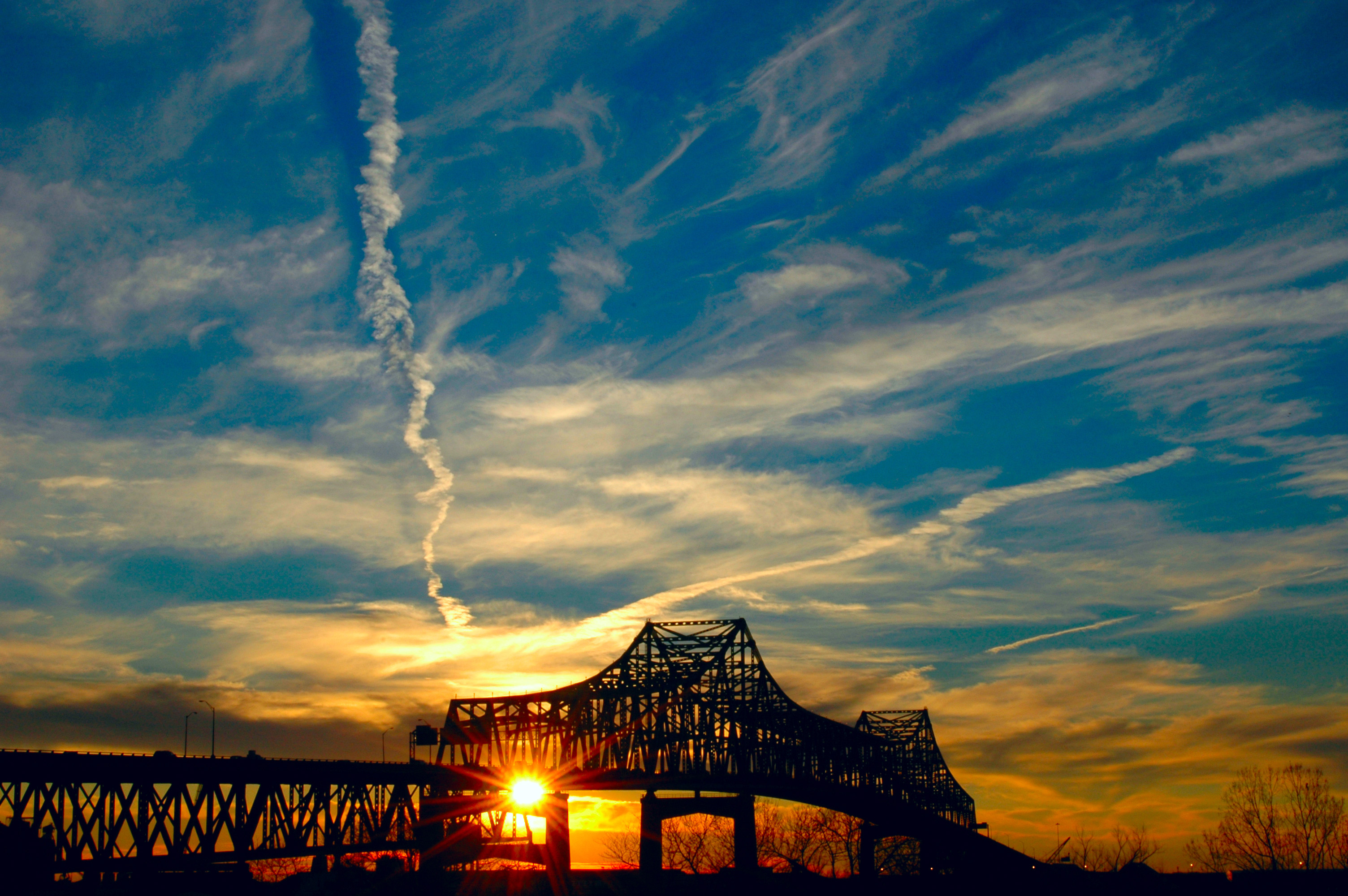
The Mississippi River defines Baton Rouge as it defines Louisiana. The city sits at the last point where the river bottom can support bridge foundations before the Gulf - the Huey P. Long Bridge (1935) and the Horace Wilkinson Bridge (I-10) cross here, connecting traffic between Texas and Florida. The Port of Baton Rouge ranks among America's largest, handling petroleum, grain, and chemicals. Refineries and chemical plants line the river north and south of downtown, Louisiana's petrochemical corridor visible as tank farms and flare stacks. The river brought the French, the Americans, the industry. Old downtown sits on the bluff where Iberville saw the red stick.
Capital City Culture
The Old State Capitol, a Gothic Revival castle on the river bluff, served from 1852 until Long's tower replaced it. Mark Twain called it 'an architectural falsehood' - too medieval for his taste. It now houses the Louisiana Political Museum, where exhibits cover the state's colorful political history. The Shaw Center for the Arts anchors downtown's cultural district, housing the LSU Museum of Art and Manship Theatre. The USS Kidd, a Fletcher-class destroyer, is permanently moored on the riverfront - one of the only surviving ships to have served at the Battle of Okinawa. Baton Rouge's restaurant scene mixes Cajun, Creole, and Southern influences; seafood boils and crawfish étouffée are local religion alongside football.
Bayou State Capital
Baton Rouge Metropolitan Airport (BTR) serves the city with connections to major hubs; New Orleans (MSY), 80 miles southeast, offers more options. I-10 connects Baton Rouge to New Orleans in 90 minutes when traffic cooperates, to Houston in four hours. From altitude, Baton Rouge appears as development concentrated on the Mississippi's east bank - the Art Deco capitol tower visible as the city's tallest structure, the LSU campus spreading south of downtown, the massive oval of Tiger Stadium clear against the suburban grid. Industrial facilities line both riverbanks. What appears from the air as Louisiana's second city began with a red stick on a bluff, marking boundaries in a place where cultures have collided ever since.
From the Air
Located at 30.45°N, 91.15°W on the east bank of the Mississippi River, 80 miles northwest of New Orleans. From altitude, Baton Rouge appears as urban development concentrated along the river - the 450-foot Art Deco state capitol visible as the tallest structure, the oval of LSU's Tiger Stadium clear to the south, industrial facilities lining both riverbanks. What appears from the air as Louisiana's second city is the Red Stick capital, where French explorers named a bluff and Huey Long built America's tallest statehouse.