Battle for Lake Tanganyika
The Admiralty wanted to name them something sensible. Lieutenant-Commander Geoffrey Spicer-Simson had suggested Cat and Dog. The Admiralty said no, and HMS Mimi and HMS Toutou -- two forty-foot motor boats armed with three-pounder guns -- received names that sounded, to the officers who would crew them, like a music-hall joke. The mission was no joke. German warships controlled Lake Tanganyika, the vast inland sea dividing the Belgian Congo from German East Africa, and neither the British nor the Belgians could advance without neutralizing them. Spicer-Simson's plan was to transport the boats from England to South Africa, then by rail, river, ox-team, and steam tractor through three thousand miles of African interior to the lake. That the man chosen for this improbable assignment had previously nearly sunk a submarine, run a ship aground testing Portsmouth Harbour's defences, and killed a man in a collision says something about the desperation of the enterprise -- or perhaps about the Royal Navy's faith that eccentrics sometimes deliver.
Ten Thousand Miles to a Lake
Mimi and Toutou left England on 15 June 1915, loaded on special trailers alongside the expedition's equipment. After seventeen days at sea, they reached Cape Town. From there, the boats travelled by rail through Bulawayo to Elisabethville, arriving on 26 July. At the railhead at Fungurume, they were detrained and dragged 146 miles through the bush by teams of oxen and steam tractors to reach the railway at Sankisia. From Sankisia to Bukama by rail, then down the Lualaba River -- running aground repeatedly -- through Lake Kisale to Kabalo. A final short rail journey brought them to the Belgian port of Lukuga on the shore of Lake Tanganyika by late October. The journey had covered roughly ten thousand miles. The boats had been hauled over an 1,800-metre mountain range. And the Germans had no idea they were coming.
Christmas Morning Ambush
The Germans held three vessels on the lake. The smallest, Kingani, was commanded by Sub-Lieutenant Junge after her previous commander, Lieutenant Job Rosenthal, had been captured while personally swimming ashore to scout the British positions at Lukuga. On 26 December 1915, Kingani approached Kalemie. Spicer-Simson was conducting morning prayers when she was spotted offshore. Mimi and Toutou raced out of the harbour. Kingani's six-pounder could only fire forward, and the faster British boats closed from behind. The engagement lasted eleven minutes. A shell passed through Kingani's gunshield, killing Junge and two petty officers. Her chief engineer hauled down the colours. The British patched a hole in her hull and recommissioned her as HMS Fifi -- named, Spicer-Simson explained, because fifi meant "tweet-tweet" in French, a suggestion from a Belgian officer's wife who kept a caged bird. King George V sent a personal message praising "the wonderful work carried out by his most remote expedition."
Fifi's Last Two Shells
Six weeks passed before the Germans sent Hedwig von Wissmann to investigate Kingani's disappearance. On 9 February 1916, the Anglo-Belgian flotilla -- Mimi, Fifi, the Belgian barge Dix-Tonne, and a whaleboat -- sortied to intercept her. Commander Odebrecht initially mistook the approaching vessels for Belgian craft, but the white ensigns told him otherwise. He turned to flee. Fifi, now mounting a captured twelve-pounder, opened fire, but the recoil stopped the boat dead in the water. Odebrecht pulled away. As Fifi fell behind, Mimi sped past, her three-pounder shots missing but forcing Odebrecht to come about and expose his vessel to Fifi's bow gun. With her second-to-last shell, Fifi struck Hedwig's hull, causing flooding. Her final shell hit the engine room, bursting the boiler and killing five African sailors and two Germans. Odebrecht ordered his crew to abandon ship and set explosive charges. Among the prizes the British recovered was a large German naval ensign -- the first captured in the war.
The Ship That Refused to Die
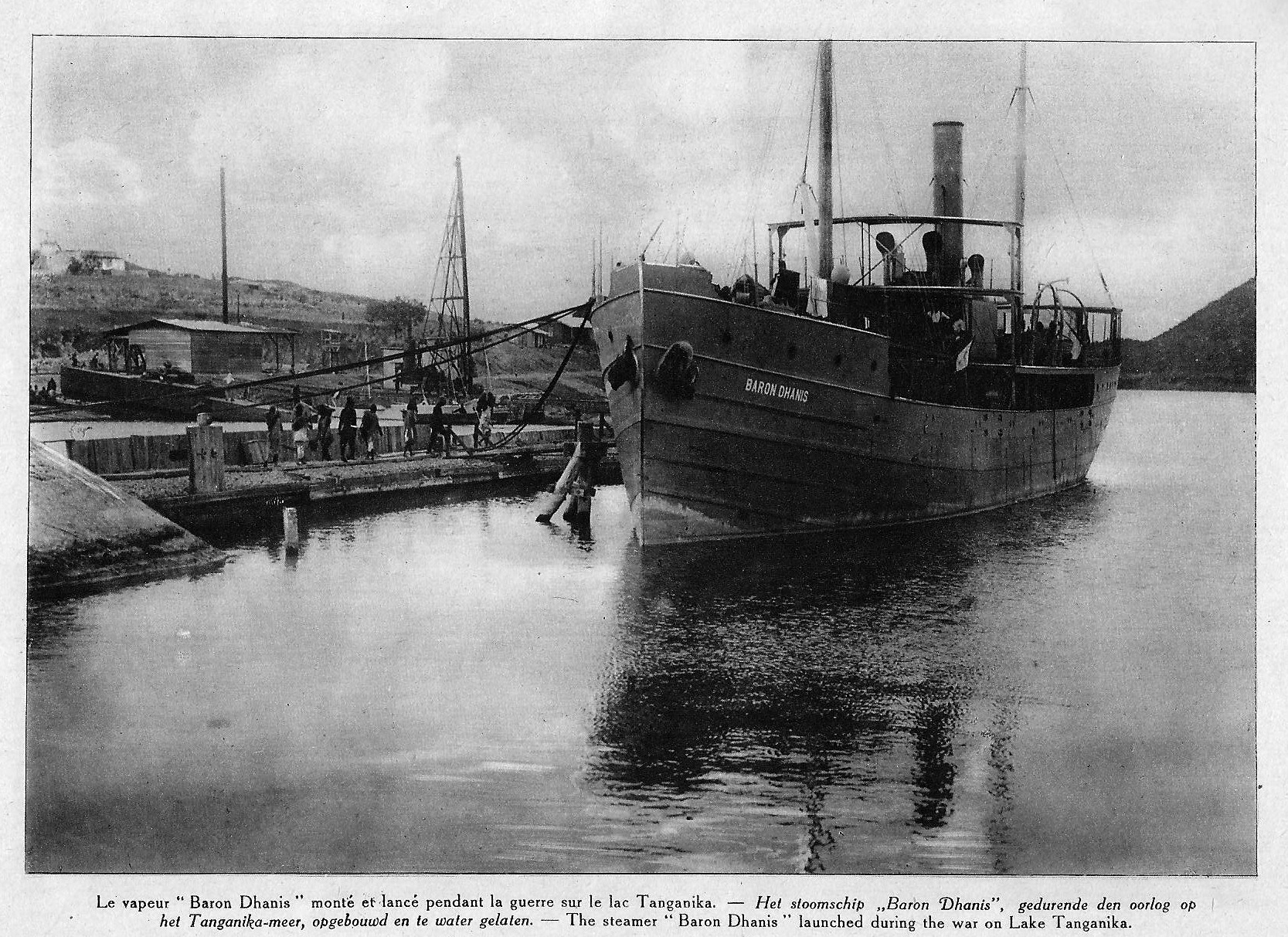
The largest German vessel, Graf von Gotzen, was a formidable opponent. Constructed at the Meyer shipyard in Papenburg, she had been disassembled, packed into five thousand crates, shipped to Dar es Salaam, railed to Kigoma, and assembled in secret. She mounted a 105mm quick-firing gun salvaged from the cruiser Konigsberg. When Gotzen appeared offshore the day after Hedwig's sinking, steaming slowly past in search of the missing vessel, Spicer-Simson forbade an attack. The Belgians captured Kigoma on 28 July 1916 during the Tabora Offensive, but Gotzen was already gone. Her crew had greased her engines thoroughly, filled her with sand, and scuttled her in twenty metres of water. She was raised by the Belgians, sank again in a storm, and was raised once more by the British in 1921. The greasing had preserved her so well that she needed little repair. On 16 May 1927, she returned to service under the name Liemba. She still sails Lake Tanganyika today -- the oldest operating passenger ferry on the lake, and a direct physical link to the most improbable naval campaign of the First World War.
An Eccentric's Legacy
Spicer-Simson received the Distinguished Service Order and a Belgian Croix de Guerre, but he was also reprimanded for antagonizing his allies and never given another command. His reluctance to engage Gotzen and his failure to prevent the German garrison at Bismarckburg from escaping in a fleet of dhows -- past a fort whose guns turned out to be wooden dummies -- tested the patience of the army commanders who depended on him. The battle's real legacy, though, is the improbability it proved possible. Two motor boats, dragged across a continent by oxen and steam tractors, defeated a German flotilla on an inland sea the size of Belgium. Anglo-Belgian control of Lake Tanganyika was secured by mid-1916, removing a threat that had paralyzed the central African campaign. The story inspired C.S. Forester's novel The African Queen and, through it, the 1951 film. But the facts needed no embellishment. As the Admiralty's Sir Henry Jackson had put it when approving the operation: "It is both the duty and the tradition of the Royal Navy to engage the enemy wherever there is water to float a ship."
From the Air
Located at approximately 6.5S, 29.83E on Lake Tanganyika, the world's longest freshwater lake stretching roughly 650 km between the DRC and Tanzania. From altitude, the lake's narrow shape is distinctive -- about 72 km wide. Key locations in the battle: Kigoma (German base) at the northeast shore, Kalemie/Lukuga (Belgian port) on the western shore, and Bismarckburg (now Kasanga) at the southern end. The MV Liemba (the former Graf von Gotzen) may be visible plying the lake's waters. Nearest airports include Kigoma Airport (HTKA) in Tanzania and Kalemie Airport (FZRF) in the DRC.