Battle of 73 Easting
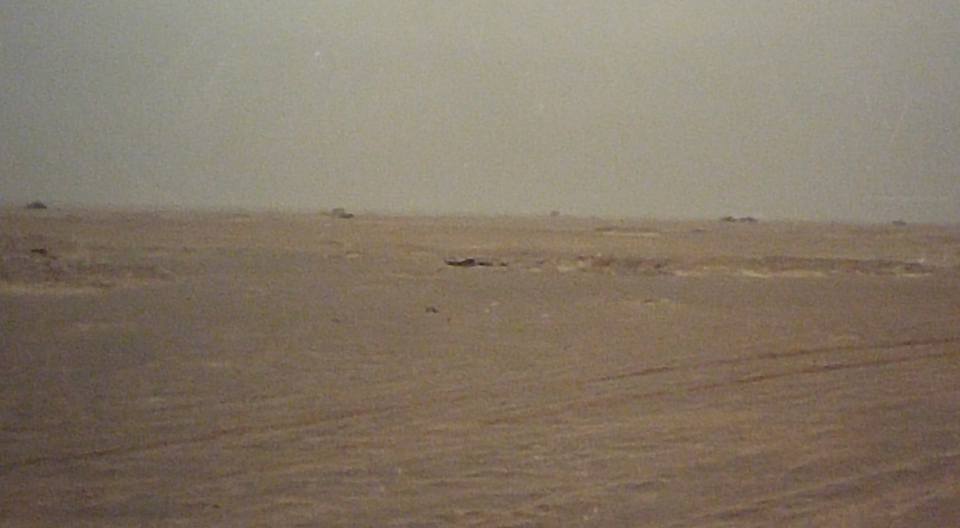
The battle is named for a line on a map that nobody on the ground could see. In the featureless desert of southern Iraq, Coalition forces measured their advance by UTM grid lines -- invisible north-south coordinates readable only on GPS receivers. On February 26, 1991, the 2nd Armored Cavalry Regiment was pushing east through blinding sandstorms when it crossed the 73rd such line and ran headlong into the dug-in defenses of Iraq's Republican Guard. What followed was twenty-three minutes of concentrated violence that destroyed an Iraqi tank company and set off a running battle lasting into the night. Lt. John Mecca, who fought there, would later call it "the last great tank battle of the 20th century."
A Hail Mary Through the Sand
General Norman Schwarzkopf's ground assault plan hinged on a sweeping left hook he called a "Hail Mary." On the night of February 23, VII Corps raced east from Saudi Arabia into Iraq, aiming to cut off the Iraqi retreat from Kuwait and destroy five elite Republican Guard divisions near the border. The 2nd Armored Cavalry Regiment, a 4,500-soldier reconnaissance force, led the advance as the corps' eyes and ears. Its job was to strip away enemy security forces, locate the Republican Guard's main defensive positions, and clear the way for the heavy divisions following behind. Initial resistance was scattered. For two days the regiment pushed through minor engagements, cavalry scouts in lightly armored M3 Bradleys scanning the horizon with advanced thermal sights while M1A1 Abrams tanks covered them from behind. Then on the morning of the 26th, moving undetected through the Republican Guard's security zone, they found what they were looking for.
Twenty-Three Minutes at the 70 Easting
Captain H.R. McMaster's Eagle Troop was in the lead. At around 4:20 PM, his nine M1A1 Abrams tanks crested a low rise and surprised an Iraqi tank company dug into a reverse slope defense along the 70 Easting. McMaster engaged the first T-72 himself. His two tank platoons finished the rest. Visibility had been cut to as little as 400 meters by sandstorms that rolled through all day, but the American thermal sights could see through the murk. In twenty-three minutes, Eagle Troop's nine tanks destroyed 28 Iraqi tanks, 16 personnel carriers, and 30 trucks without a single American loss. McMaster did not stop at the ordered limit of advance. He pushed three kilometers further east to the 74 Easting, where he found and destroyed another eighteen T-72s. The Iraqis here stood their ground and tried to maneuver against him -- the first determined defense the regiment had encountered in three days.
Ghost Troop's Six-Hour Fight
Three kilometers to the north, Captain Joe Sartiano's Ghost Troop occupied a ridge overlooking a wadi running parallel to the 73 Easting. The position became a magnet for trouble. By 6:30 PM, waves of Iraqi T-72 and T-55 tanks began advancing into the wadi. Wave after wave of armor and infantry charged the troop's position. Combat grew so intense that only massed artillery, attack helicopters, and Air Force close air support kept the Iraqis from overrunning Ghost Troop. At one point, a military intelligence platoon had to abandon its signals work and return fire against Iraqi soldiers who climbed out of a burning BMP and kept attacking on foot. Ghost Troop's fire support team called in 720 howitzer and MLRS rounds while the troop's own mortars worked at close range. By 9 PM, the unit had burned through nearly half its TOW missiles and was running short on cannon ammunition. They had destroyed at least two companies of Iraqi armor. Hundreds of Iraqi infantrymen and their vehicles lay scattered across the wadi floor.
The Passage of Lines
By 10:30 PM, the fighting at 73 Easting was dying down. The 2nd ACR had accomplished its mission -- fixing the southern forces of the Republican Guard and mapping their defenses. Colonel Don Holder, the regimental commander, advised VII Corps to send the 1st Infantry Division through the regiment's southern sector, steering the main attack around the now-known Republican Guard positions. Beginning around 2 AM on the 27th, two brigades of the 1st Infantry Division passed through in total darkness. Where three cavalry squadrons had fought, six heavy battalions of tanks and infantry fighting vehicles now pressed the attack, backed by six battalions of 155mm artillery. The passage of lines was not clean. A disoriented Bradley platoon crossed in front of Iraqi positions, silhouetted by burning vehicles. The Iraqis opened fire from three directions, killing three American soldiers. By dawn the 1st Infantry Division had seized Objective Norfolk, and the 2nd Cavalry Regiment became part of VII Corps' reserve.
A Battle Measured in Grid Lines
The final accounting tells the scale of what happened in this patch of empty desert. The 2nd Cavalry Regiment destroyed 159 enemy tanks and 260 other vehicles, and captured 2,000 prisoners. The regiment's own losses were six soldiers killed and nineteen wounded. The 2nd Squadron alone accounted for 55 tanks, 45 armored vehicles, and 865 prisoners. The battle became the most intensively studied engagement of the Gulf War, later reconstructed as one of the first military simulations using real battlefield data. The name itself -- 73 Easting -- captures something essential about modern armored warfare: a fight so fast and violent that the only way to fix it in space was by an abstract coordinate on a GPS screen, a line drawn across sand that bore no landmarks, no towns, no rivers. Just flat desert, and the machines that fought across it.
From the Air
Located at approximately 29.54N, 46.63E in the desert of southern Iraq, roughly 150 km west of Basra. The battlefield is featureless desert terrain with no prominent landmarks visible from altitude. The nearest major airport is Basra International (ORMM). From cruising altitude, the area appears as flat, tan desert with no distinguishing features -- fitting for a battle named after an invisible coordinate line. The Kuwait-Iraq border lies approximately 50 km to the southeast.