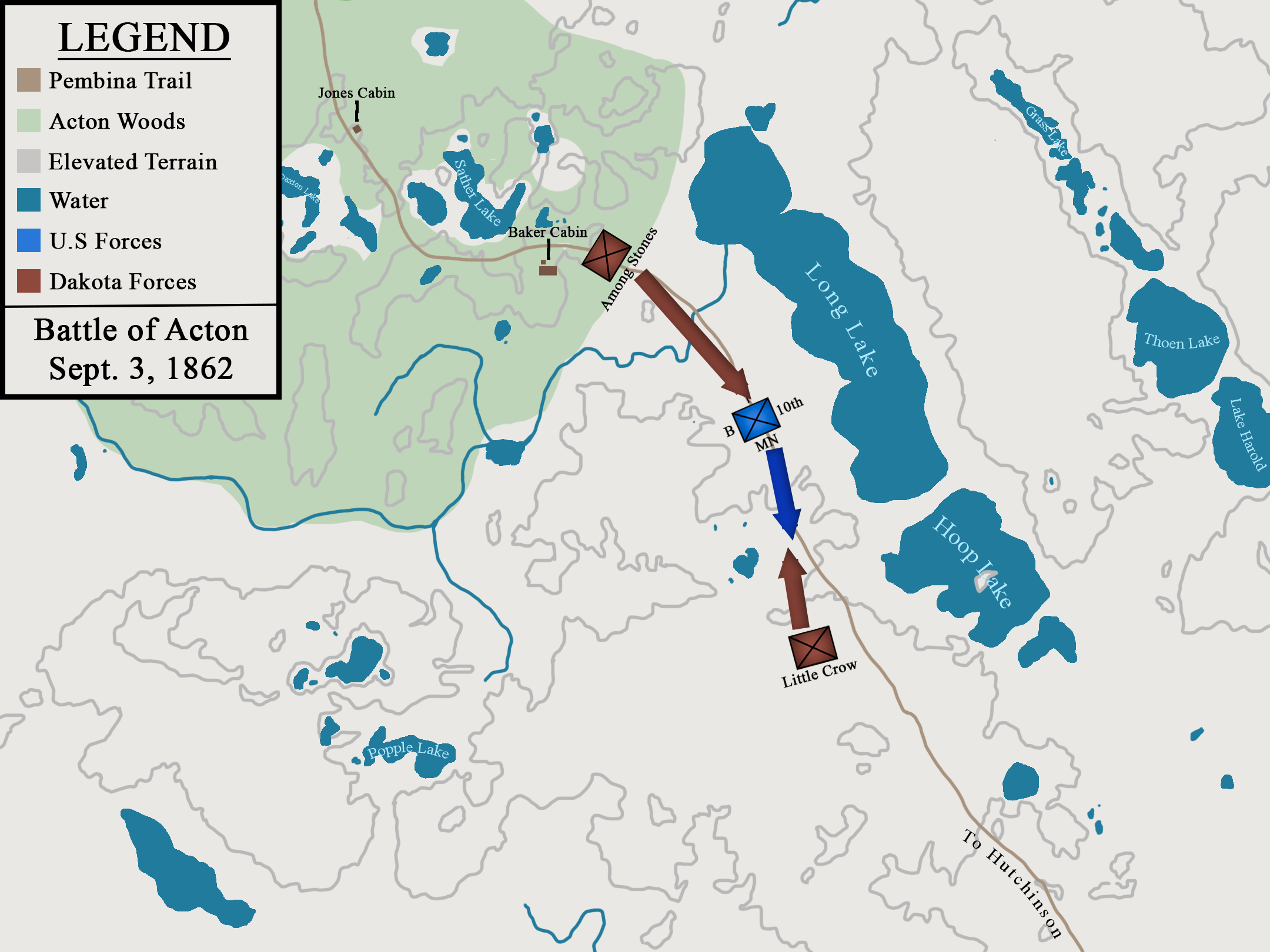
Battle of Acton
The soldiers had the wrong bullets. Issued .62 caliber balls for their .58 caliber muskets, the men of Company B spent their first hours of deployment whittling each round down by hand, shaving lead so the ammunition would actually fit their weapons. It was an inauspicious start for Captain Richard Strout's raw recruits, rushed west from the Twin Cities not to fight Confederates but to confront a crisis closer to home. On September 3, 1862, near the tiny settlement of Acton in Meeker County, Minnesota, these untested soldiers stumbled into a gauntlet that would stretch across eight miles of open prairie and last six brutal hours.
A War Chief Turns North
The Dakota War of 1862 had erupted two weeks earlier along the Minnesota River Valley. After failing to take Fort Ridgely and being repulsed at New Ulm, Dakota leaders debated strategy. Chief Little Crow wanted to strike north into the Big Woods, where he believed settlements were lightly defended and flour supplies abundant. A successful campaign there could also threaten Colonel Henry Hastings Sibley's supply lines at Fort Ridgely from the north. But Little Crow's coalition fractured. Mankato, Gray Bird, and Big Eagle chose to continue fighting along the Minnesota River. Worse for Little Crow, his own second-in-command, Walker Among Stones, split away with 75 warriors, preferring to plunder the countryside independently. Little Crow marched north into the Big Woods with just 35 men. Walker Among Stones and his larger band were somewhere nearby, operating on their own agenda.
Glinting Barrels in the Wheat
On September 2, Strout's company of 55 to 65 men camped near Acton. Scouts arrived between midnight and three in the morning with alarming news: roughly 100 Dakota warriors were encamped in two groups nearby. At dawn, Strout marched his column southeast along the west side of Long Lake. As they moved, soldiers spotted a glint of gun barrels in the distance. Strout assumed it was a relief column. It was not. Little Crow's 35 warriors had positioned themselves in the wheatfields near Kelly's Bluff. Scouts on the bluff drew the first gunfire and war cries. On the lower ground, two soldiers fell dead and several were wounded, including scout Jesse Braham, who took a bullet through his lungs. Then Walker Among Stones's larger force hit the column from behind. Sergeant Michael Kenna grabbed twenty men and charged uphill with fixed bayonets, buying precious minutes for the rest of the company to reach the higher ground of the bluff.
The Running Fight to Hutchinson
From Kelly's Bluff, Strout faced a stark choice: hold the high ground outnumbered or retreat to the stockaded town of Hutchinson, eight miles away. Frontiersman Albert H. DeLong had already ridden for Hutchinson to bring reinforcements. Strout arranged his men on both flanks of the wagon train and began moving. A third soldier was killed descending the bluff. At Cedar Mills, the Dakota attacked again from every direction, fighting on foot and horseback. Terrified teamsters dumped food and supplies from the wagons to gain speed, nearly abandoning the wounded in their panic. The hungry Dakota warriors fell upon the discarded provisions, which may have saved the column. Two straggling wagons were lost, but Strout rallied his green troops and broke through the encirclement. Little Crow reportedly watched the breakthrough from a fence line, bullets snapping past him. The rear of the column endured continuous harassment for the remaining miles until DeLong's militia finally appeared along the road to Hutchinson.
What the Prairie Remembers
Strout counted three dead and fifteen wounded on arrival in Hutchinson, though some estimates placed casualties as high as eighteen or twenty-three wounded. At least three more men died of their injuries afterward in the Hutchinson Hotel, pressed into service as a field hospital. Dakota casualties remain unknown. The next day, Little Crow's warriors attacked both Hutchinson and Forest City, burning outlying buildings but failing to breach either town's defenses. The chief withdrew southwest. Captain Strout's men, originally designated as Company B of the Tenth Minnesota Infantry, would later be reorganized as Company B of the Ninth Minnesota Infantry Regiment. Fifty years later, on November 20, 1912, ten aging veterans gathered at the Nicollet House in Minneapolis for a banquet honoring the battle. Today, a historical marker stands at the intersection of County Highway 23 and 550th Avenue, roughly where the fighting began west of Hope Lake. The rolling prairie is farmland now. The Pembina-Henderson trail that Strout's column followed along Long Lake has vanished entirely, erased by plows and time.
From the Air
Located at 45.084N, 94.661W in the rolling agricultural prairie of Meeker County, central Minnesota. The battlefield area is approximately 3.5 miles south of the Acton State Monument. The terrain is flat to gently rolling farmland with scattered lakes, including Long Lake and Hope Lake, which serve as visual references. The nearest airport is Litchfield Municipal Airport (KLJF), approximately 15 nm southeast. St. Cloud Regional Airport (KSTC) lies roughly 40 nm to the northeast. Best viewed from 3,000-5,000 feet AGL to appreciate the rolling prairie landscape and lake-dotted terrain that shaped the running battle. The eight-mile fighting retreat from Kelly's Bluff to Hutchinson traces a path southeast through open farmland that is still clearly visible as agricultural grid roads.