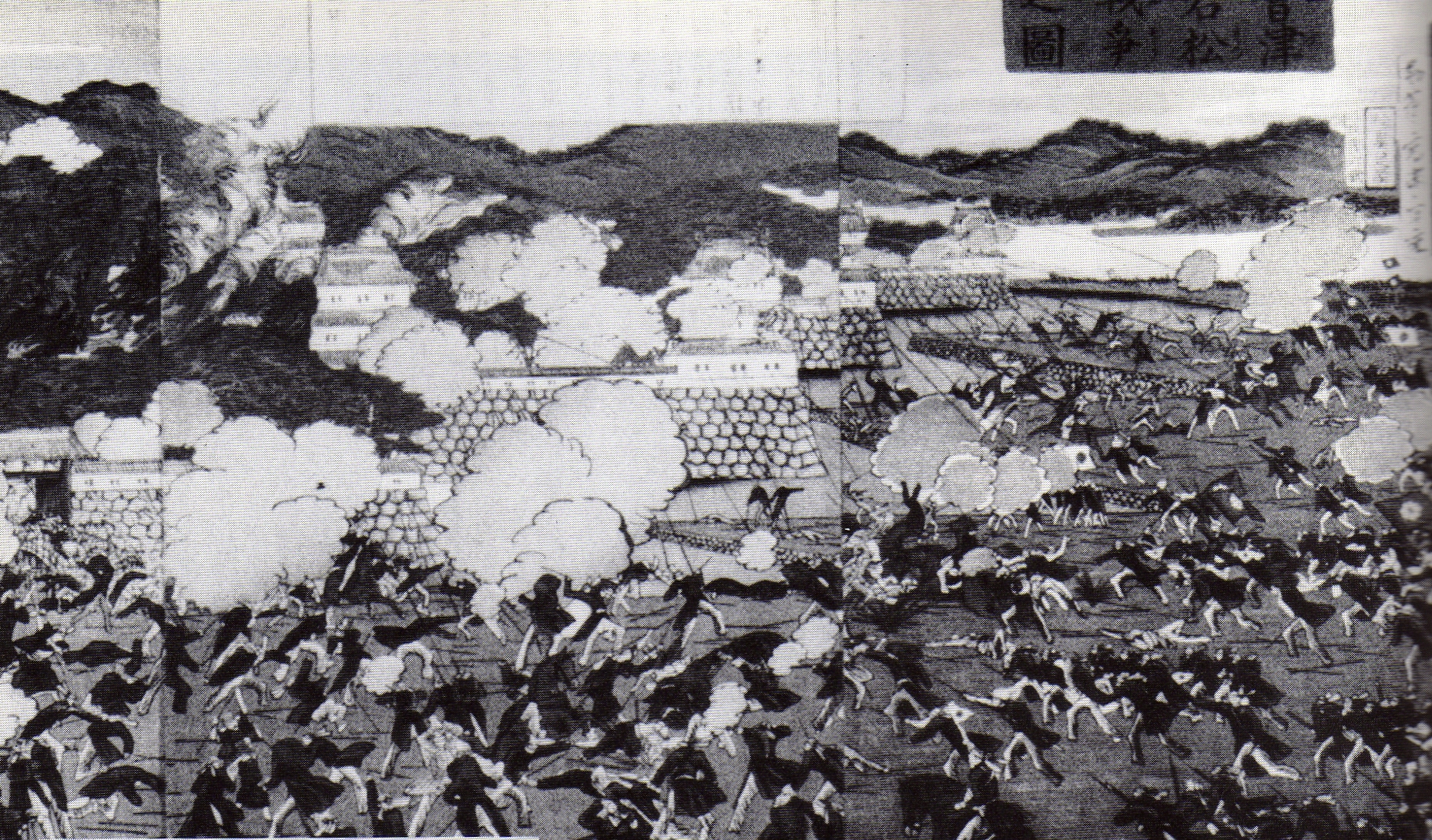
Battle of Aizu
Twenty boys climbed Mount Iimori on an October morning in 1868, bleeding from a battle they had barely survived. From the summit, they looked down at Tsuruga Castle, the fortress they had pledged their lives to defend. Smoke choked the valley. The castle town was burning. Through the haze, the boys could not see whether the castle itself still stood. They decided it had fallen. Nineteen of them drew their swords and committed seppuku on the spot. They were wrong. Tsuruga Castle would hold for another month. The story of the Byakkotai -- the White Tiger Company -- has defined the Battle of Aizu ever since, but the siege itself was the final reckoning for one of Japan's most formidable warrior domains, a place that had spent centuries guarding the nation's borders only to be declared its enemy.
Warriors at the Edge of the World
The Aizu domain, centered in what is now western Fukushima Prefecture, had built its identity around martial discipline. Its standing army of over 5,000 troops was routinely deployed to the most distant and dangerous postings in Japan -- as far north as southern Sakhalin, and as close to foreign threat as the defenses of Edo Bay during Commodore Perry's arrival in the 1850s. This was not a backwater fief playing at soldiery. Aizu was the shogunate's sword arm, trusted with missions that required both skill and absolute loyalty. When the political upheavals of the 1860s demanded someone to keep order in the imperial capital, the shogun chose Matsudaira Katamori, lord of Aizu, as Kyoto Shugoshoku -- military governor of Kyoto. It was a posting that would earn Katamori powerful enemies.
The Price of Loyalty
In Kyoto, Katamori supervised the Shinsengumi, the feared special police force that hunted down enemies of the shogunate in the capital's narrow streets. He earned the undying hatred of the Choshu domain and alienated his sometime ally, Satsuma. When the political winds shifted decisively toward the imperial restoration movement, Katamori retreated alongside Shogun Tokugawa Yoshinobu in 1868. The new imperial government, dominated by the Satsuma-Choshu alliance, branded Aizu an 'enemy of the court.' Katamori tried desperately to demonstrate submission, but the designation stuck. Aizu joined the Ouetsu Reppan Domei -- a northern alliance of domains resisting imperial forces -- and prepared for war. After the disastrous defeat at the Battle of Bonari Pass, the Bakufu forces under Otori Keisuke abandoned their Aizu allies. The domain would fight alone.
Thirty-One Days Under the Guns
On October 6, 1868, imperial forces encircled Tsuruga Castle and began a siege that would last a full month. The castle town burned, but the fortress held. Inside, Aizu's defenders included remnants of the Shinsengumi under the command of Saito Hajime, survivors from the Shogitai who had fled the fall of Edo, and units organized by age -- the youngest being the Byakkotai, boys mostly in their teens who had been pressed into service as the domain's manpower dwindled. Outside the walls, the imperial forces employed a regiment of Shinto priests called the Shin'itai as spiritual advisors, lending a religious dimension to what was already a deeply ideological conflict. Among the attacking commanders was Itagaki Taisuke, who would later become one of the founders of Japanese democracy.
The Boys on the Mountain
The Byakkotai detachment that climbed Mount Iimori had been separated from the main force during fighting outside the castle. Exhausted and wounded, the twenty young samurai reached the summit and looked down into the smoke-filled valley. The castle town was ablaze. They could not see Tsuruga Castle clearly through the fire and haze, and concluded the fortress had been overrun. Rather than face capture, nineteen of them committed seppuku. One survived: Iinuma Sadakichi, whose attempt failed and who was found and saved by a local peasant woman. He lived to old age, the sole witness to a tragedy born from a misunderstanding. The castle they believed lost would not surrender until November 6, when Katamori, his son Nobunori, and the senior retainers offered their unconditional capitulation through the mediation of the neighboring Yonezawa Domain.
The Domain That Ceased to Exist
The aftermath was absolute. The samurai population of Aizu was marched to prisoner-of-war camps on the remote Tsugaru Peninsula, at the northern tip of Honshu. The domain itself, which had existed since the mid-seventeenth century, was dissolved. Aizu's punishment was meant as an example -- a warning to any who might resist the new Meiji order. Today, Tsuruga Castle has been reconstructed and stands as a museum. On Mount Iimori, statues of the Byakkotai mark the spot where the boys fell. Each autumn, the city of Aizu-Wakamatsu holds reenactments of the battle, with citizens dressed as cannoneers and young warriors marching through streets that once burned. The Byakkotai story remains one of Japan's most deeply felt historical tragedies -- a tale of loyalty carried past the point of reason, and of a misreading of smoke that turned courage into catastrophe.
From the Air
Located at 37.30N, 139.56E in the Aizu basin of western Fukushima Prefecture. Tsuruga Castle (Aizu-Wakamatsu Castle) is visible from altitude as a white structure amid the city grid. Mount Iimori rises to the east of the castle, marked by memorial structures at its summit. The Aizu basin is ringed by mountains on all sides, creating a distinctive bowl-shaped geography. Nearest airport: Fukushima Airport (RJSF), approximately 50nm to the east. The terrain is mountainous with limited flat approaches -- expect turbulence in the surrounding valleys.