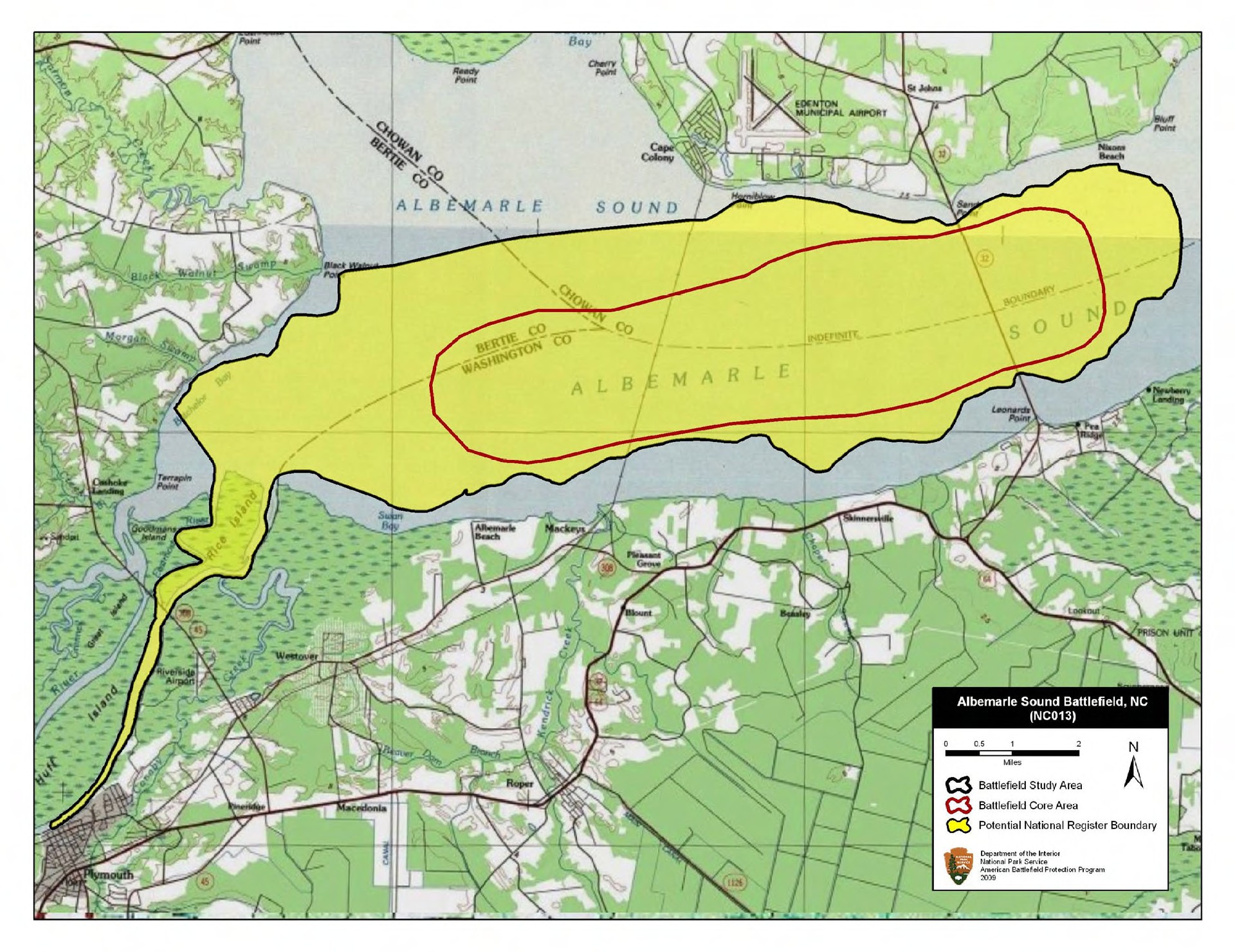
Battle of Albemarle Sound
The USS Sassacus hit the CSS Albemarle at full speed. The double-ender gunboat drove straight into the ironclad's side, shattering her own timber bow and twisting off her bronze ram on impact. The two ships jammed together. Then, with the hulls nearly touching, the Albemarle's crew leveled a Brooke rifle through a gun port and fired two shells point-blank into the Sassacus, puncturing her boilers. Scalding steam filled the Union vessel as she drifted helplessly downriver. It was May 5, 1864, and the most audacious moment of the Battle of Albemarle Sound had just ended in a draw -- a pattern that would define the entire engagement on these shallow North Carolina waters.
Flush with Victory
The CSS Albemarle was riding high. Just weeks earlier, the ironclad ram had helped Confederate forces under Robert F. Hoke retake Plymouth, North Carolina, sinking the USS Southfield, killing the Union naval commander Charles W. Flusser, and driving Federal gunboats from the Roanoke River. Encouraged by that decisive victory, Hoke planned to recapture New Bern, which had been in Union hands since early 1862. Once again, he turned to Commander James W. Cooke and the Albemarle for naval support. In early May 1864, Cooke steamed out of Plymouth with two escort vessels -- the captured steamer CSS Bombshell and the transport CSS Cotton Plant, loaded with troops for the New Bern operation -- and headed south down the Roanoke River toward Albemarle Sound.
The Ambush at the Sound's Mouth
Albemarle Sound stretches roughly 50 miles east to west along the North Carolina coast, shielded from the Atlantic by the Outer Banks. Nowhere deeper than 25 feet, these waters forced the ironclad and the Union fleet alike into close quarters. Captain Melancton Smith commanded eight Federal gunboats waiting at the mouth of the sound: the double-enders USS Mattabesett, USS Sassacus, USS Wyalusing, and USS Miami, along with the converted ferryboat USS Commodore Hull, and the gunboats USS Ceres, USS Whitehead, and USS Isaac N. Seymour. When Cooke's small flotilla appeared, four Union warships immediately formed a line of battle, with the remaining three in support. The Albemarle opened fire first, wounding six men at one of Mattabesett's 100-pounder Parrott rifles. Mattabesett, Whitehead, and Wyalusing answered almost simultaneously.
Iron Against Wood
The Albemarle attempted to ram the Mattabesett, but the sidewheeler managed to round the ironclad's armored bow. The Sassacus followed close behind and fired a broadside of solid shot and 100-pound rounds -- every one bounced off the Albemarle's casemate armor. The Bombshell, lacking any such protection, was hulled by each heavy shot from the Sassacus broadside and quickly surrendered. The Cotton Plant retreated back up the Roanoke. The Albemarle was now alone against eight Union warships. That was when Lieutenant Commander Francis Asbury Roe of the Sassacus made his decision: at about 400 yards, he ordered full speed and rammed the ironclad broadside. The collision shattered the Sassacus's bow and jammed the two vessels together. The Albemarle's crew responded with devastating point-blank fire that ruptured the Sassacus's boilers, leaving her disabled and drifting.
Saved by Sunset
With the Sassacus out of action, the Mattabesett and Wyalusing continued to circle and fire on the Albemarle for three more hours. Over the course of the entire engagement, the Union fleet hurled more than 500 shells at the ironclad. Her smokestack was riddled, her hull showed visible scars, but her armor held. As darkness settled over the sound, the firing stopped. The Albemarle, battered but unbroken, steamed back up the Roanoke to Plymouth. The battle was inconclusive -- the Union fleet still controlled the sound, and the Albemarle still controlled the river. The planned attack on New Bern was abandoned. The ironclad would remain a threat until Lieutenant William B. Cushing sank her with a spar torpedo at her Plymouth berth on the night of October 27, 1864, finally ending the Albemarle's reign over these coastal waters.
From the Air
The Battle of Albemarle Sound took place near 35.98°N, 76.54°W at the mouth of the Roanoke River where it enters Albemarle Sound. The sound stretches roughly 50 miles east-west and 5-14 miles north-south, clearly visible from altitude. KPMZ (Plymouth Municipal Airport) is approximately 10 nm west-northwest. KEDE (Northeastern Regional Airport, Edenton) lies roughly 15 nm north along the sound's northern shore. KECG (Elizabeth City Regional Airport) is about 56 nm north-northeast. Best viewed at 3,000-5,000 ft AGL where the full extent of the sound, the Roanoke River's entry point, and the Outer Banks barrier are all visible. The shallow, protected waters make the geography of the naval engagement immediately clear from the air.