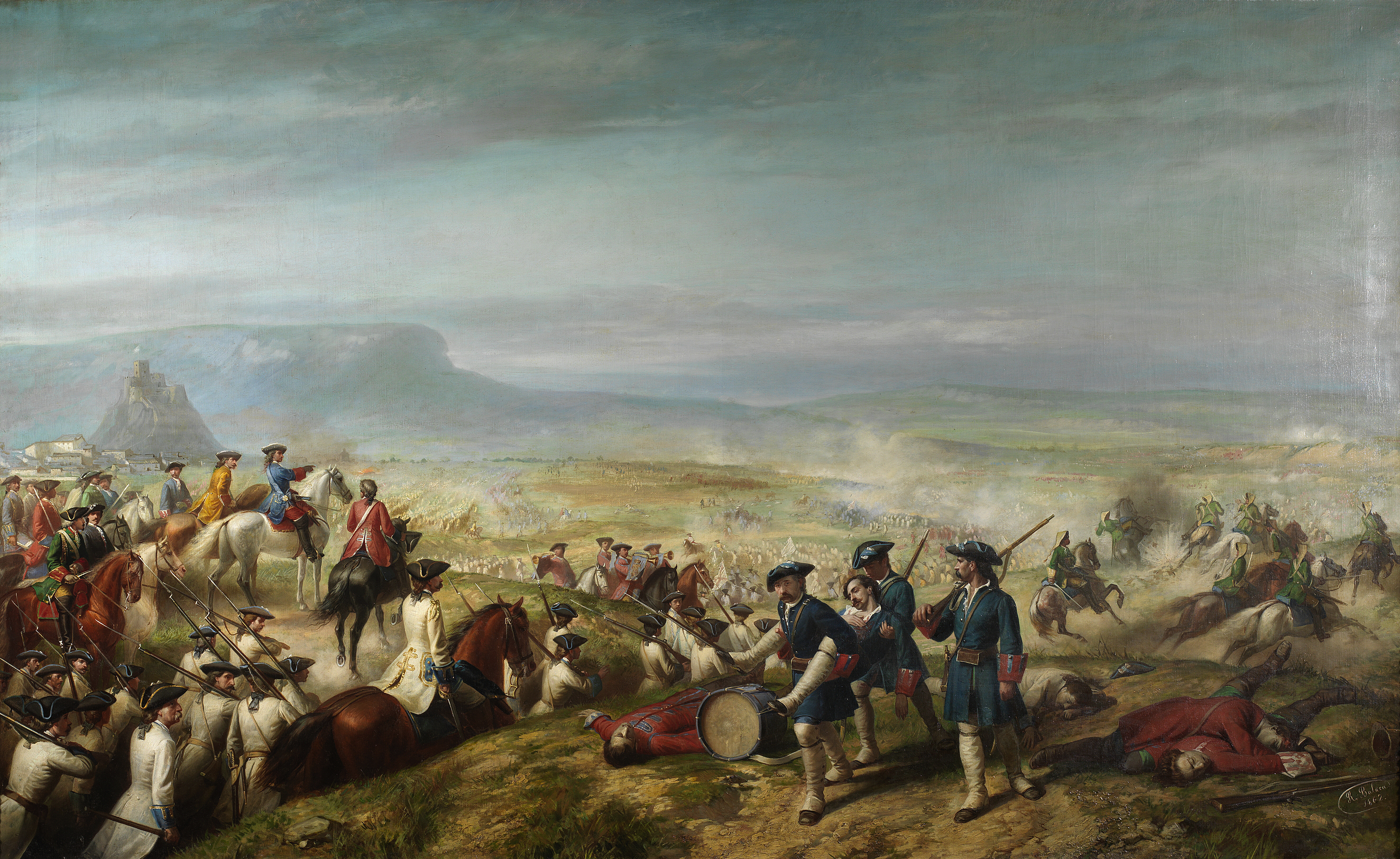
Battle of Almansa
It may be the most absurd command arrangement in military history. On April 25, 1707, outside the town of Almansa in eastern Spain, the French and Spanish army was commanded by the Duke of Berwick -- an Englishman, the illegitimate son of King James II of England. Facing him, the Allied forces of England, Holland, and Portugal were led by Henri de Massue, Earl of Galway -- a Frenchman, an exiled Huguenot fighting against his homeland. The result was, as Frederick the Great later observed, the most impressive battle of the century, and a Valencian proverb born that day still carries its sting: Quan el mal ve d'Almansa, a tots alcança -- Bad news from Almansa reaches everybody.
A War of Succession, A War of Logistics
The War of the Spanish Succession was, at its heart, a family quarrel fought across a continent. When Charles II of Spain died without an heir in 1700, the Bourbon Philip V and the Habsburg Archduke Charles of Austria both claimed the throne. The resulting war drew in every major European power. In Spain itself, the conflict was shaped less by grand strategy than by the brutal reality of logistics. The arid interior made it nearly impossible to supply large armies far from the coast, and until the advent of railways in the 19th century, goods moved primarily by water. The Allies secured a base in Lisbon when Portugal changed sides in 1703 and opened a second front in Catalonia through the 1705 Pact of Genoa. But controlling coastal cities proved easier than holding interior territory, and by November 1706, Philip V controlled Castile, Murcia, and parts of Valencia.
Berwick's Trap
To counter an Allied offensive planned for 1707, France dispatched James FitzJames, Duke of Berwick, to command Bourbon forces in northeastern Spain -- a mixed force of 33,000 French and Spanish troops, along with exiled Irish regiments who had followed the Jacobite cause across Europe. Berwick detached 8,000 men to besiege Xàtiva, drawing the Allied commander in Spain, the Earl of Peterborough, to consolidate his forces in Catalonia rather than combine with the 16,500 troops under Galway and the Portuguese Marquess of Minas. This left Galway badly outnumbered. On April 22, Berwick halted outside Almansa, positioning his army to threaten Allied supply lines to Valencia. He drew up his forces in two lines with infantry in the center and cavalry on the wings, and waited.
The Gap in the Line
Despite being clearly outnumbered, Galway attacked on the afternoon of April 25 after a brief artillery exchange. His infantry initially drove back the Bourbon center, but a fatal gap opened between the advancing foot soldiers and the Portuguese cavalry on the right wing, commanded by the 63-year-old Marquess of Minas. The Franco-Spanish cavalry struck into this gap. Berwick's account records that the Portuguese fought bravely before collapsing; their retreat was covered by a few squadrons under Minas's personal command, including his mistress, who fought dressed as a man and was killed. With the Allied center now attacked from three sides, Galway managed to extract some troops with his remaining cavalry, but thirteen battalions lost contact with the army and surrendered the following morning. Casualties were severe: by most estimates, the Allies lost around 5,000 killed or wounded and as many as 10,000 captured.
The Portrait Hangs Upside Down
Almansa has been called the single most important battle fought in Spain during the war. Victory confirmed Philip's control of northeastern Spain and Valencia, and by the end of 1707, the Allies were restricted to Catalonia and the Balearic Islands. The Franco-Spanish army quickly overran Valencia and besieged Xàtiva, which surrendered in June. Much of the town was destroyed and renamed San Felipe. In the local museum, a portrait of Philip V still hangs upside down -- a quiet act of defiance maintained for more than three centuries. The consequences for Valencia and Catalonia were profound: the defeat led to the loss of regional autonomy under the Nueva Planta decrees, generating resentment that found expression in proverbs still repeated today. De ponent, ni vent ni gent -- From the west, neither wind nor people -- captures in eight words the bitterness that Almansa left in the Valencian collective memory.
From the Air
Located at 38.87°N, 1.09°W near the town of Almansa in the province of Albacete, Castilla-La Mancha. The town sits on a plain with its medieval castle visible on a rocky outcrop. The battlefield was on open ground just south of the town. Nearest airport: LEAL (Alicante-Elche Airport), approximately 90 km southeast. Best viewed at 5,000-8,000 ft AGL, where the relationship between the town, its castle, and the surrounding plains where the cavalry charges took place is clearly visible.