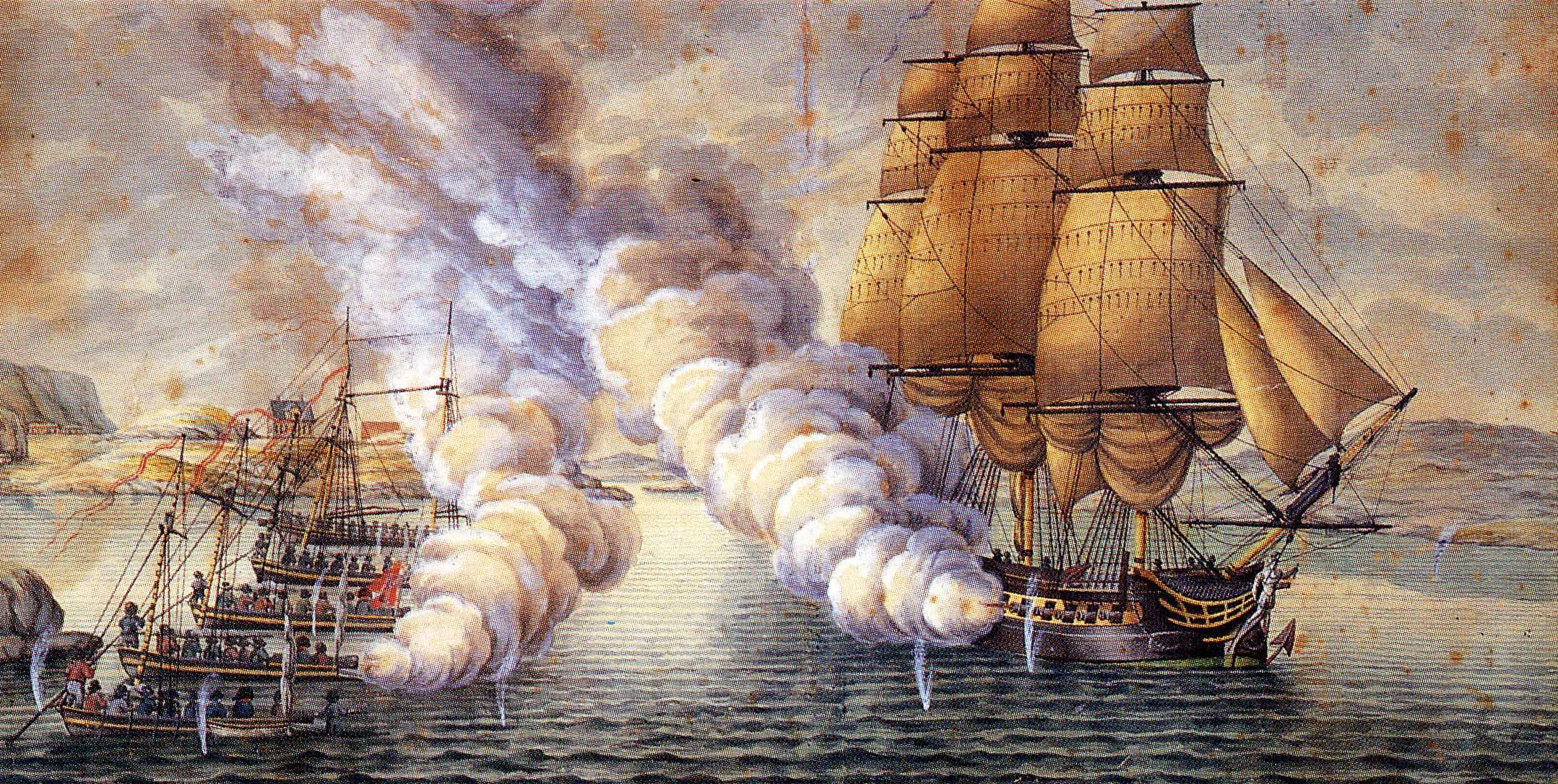
Battle of Alvoen
The fishermen rowed out to welcome what they thought was a friendly ship. On 15 May 1808, a frigate flying Dutch colors entered the narrow waters west of Bergen, and local pilots rushed to offer their services -- the first to reach a foreign vessel earned the job of guiding it through the fjords. But HMS Tartar was British, not Dutch, and the pilots who climbed aboard were taken prisoner and forced at gunpoint to navigate the warship toward Bergen harbor. The deception unraveled the next day when five Norwegian gunboats rowed out into the fog to fight a vessel that outgunned them many times over. In fifty-seven minutes of close-quarters battle, they killed the Tartar's captain and forced the frigate to withdraw.
A Blockade That Starved a Nation
The Battle of Alvoen grew from desperation. After the British seized the entire Danish-Norwegian fleet at Copenhagen in 1807, Denmark-Norway shifted from armed neutrality to open war against Britain. The Royal Navy blockaded the Skagerrak strait and prowled the Norwegian coast, capturing merchant vessels and disrupting the grain convoys that Norwegians depended on for survival. With no funds to rebuild a proper navy, the Danes and Norwegians resorted to gunboats -- small, oar-driven craft mounting one or two heavy cannons. Citizens were urged to donate money and valuables to finance their construction. Norwegian privateers, sailing under Danish letters of marque that let them keep ninety-nine percent of any prize's value, raided as far as Scotland, enraging British merchants and provoking the Royal Navy into sending still more warships north.
The Tartar's Deception
HMS Tartar had been dispatched from Leith, Scotland, on 10 May along with two other vessels, hunting the Dutch frigate Gelderland, which was known to be sheltering in Bergen for repairs. When Post Captain George Edmund Byron Bettesworth reached the waters off Stolmen on 15 May, local fishermen told him the Gelderland had already departed. Some accounts say Tartar was still flying Dutch colors, which is why Norwegian fishermen and pilots approached without suspicion. The pilots were seized and confined below decks, with one or two kept topside to guide the ship. Near the island of Sotra, the crew of an optical telegraph station -- part of Bergen's coastal warning chain -- also rowed out, believing the frigate was friendly. They too were captured, silencing a critical link in Bergen's defenses. By evening, Tartar had anchored off Bjoroyhamn, and reconnaissance boats slipped toward the harbor to probe Bergen's shipping.
Fifty-Seven Minutes in the Fog
On the morning of 16 May, Senior Lieutenant J. C. A. Bjelke led Bergen's entire naval force -- one kanonchallup and four smaller kanonjoller -- thirteen kilometers out to confront the frigate. The Tartar lay becalmed and fog-bound near the island of Bjoro, being towed by her own boats. Bjelke's gunboats positioned themselves between the frigate and Bergen and opened fire. His second shot struck one of the towing vessels, and observers on shore counted five holes in its hull. For nearly an hour, the tiny gunboats traded fire with a full-rigged frigate carrying dozens of cannons. A faint southerly breeze eventually allowed Tartar to gain headway and withdraw through Gjeltefjord. The Norwegian boats pursued, still firing, but their damage amounted mostly to shot-away oars. British losses were two men killed, including Captain Bettesworth himself. The Norwegians lost four men.
David's Fight in the Fjords
The Battle of Alvoen was a minor engagement by the standards of the Napoleonic Wars, but it looms large in Norwegian naval memory. Five rowboats challenged a warship that could have obliterated them, and they drove it off -- killing its commander in the process. The battle illustrated both the ingenuity and the vulnerability of the gunboat strategy: in the confined, fog-shrouded waters of western Norway's fjords, maneuverability and local knowledge could offset massive firepower, at least temporarily. Bettesworth, an experienced and decorated officer, became one of the war's notable casualties in an action the Admiralty barely noticed. Today the waters off Alvoen, a few kilometers southwest of central Bergen, are quiet and residential. A painting of the engagement hangs in the main building at Alvoen, showing the Tartar's cannonballs splashing behind the tiny gunboats as they press their attack under the Danish flag.
From the Air
Located at 60.35N, 5.17E, in the waters off Alvoen, approximately 13 km southwest of central Bergen, Norway. The battle took place in the narrow fjord approaches between the islands of Sotra and the mainland. Nearest airport: Bergen Flesland (ENBR), roughly 15 km to the south. Fly at 1,500-3,000 ft to appreciate the confined, island-studded waters where gunboats engaged a frigate. Marstein Lighthouse on Sotra marks the outer approach the Tartar used.