Battle of Angamos
Peru still marks the anniversary. Every October 8, the nation observes a public holiday for the Battle of Angamos, not to celebrate a victory but to honor the death of Rear Admiral Miguel Grau Seminario, who fell aboard his battered monitor Huascar off a headland 80 kilometers north of Antofagasta. For Chile, the same battle sealed command of the Pacific and opened the door to a land invasion that would eventually take Lima. For the broader history of naval warfare, it was a proving ground for armor-piercing ammunition that European and American observers studied closely. One engagement, remembered differently by each nation, decided the course of the War of the Pacific.
The Lone Wolf of the Pacific
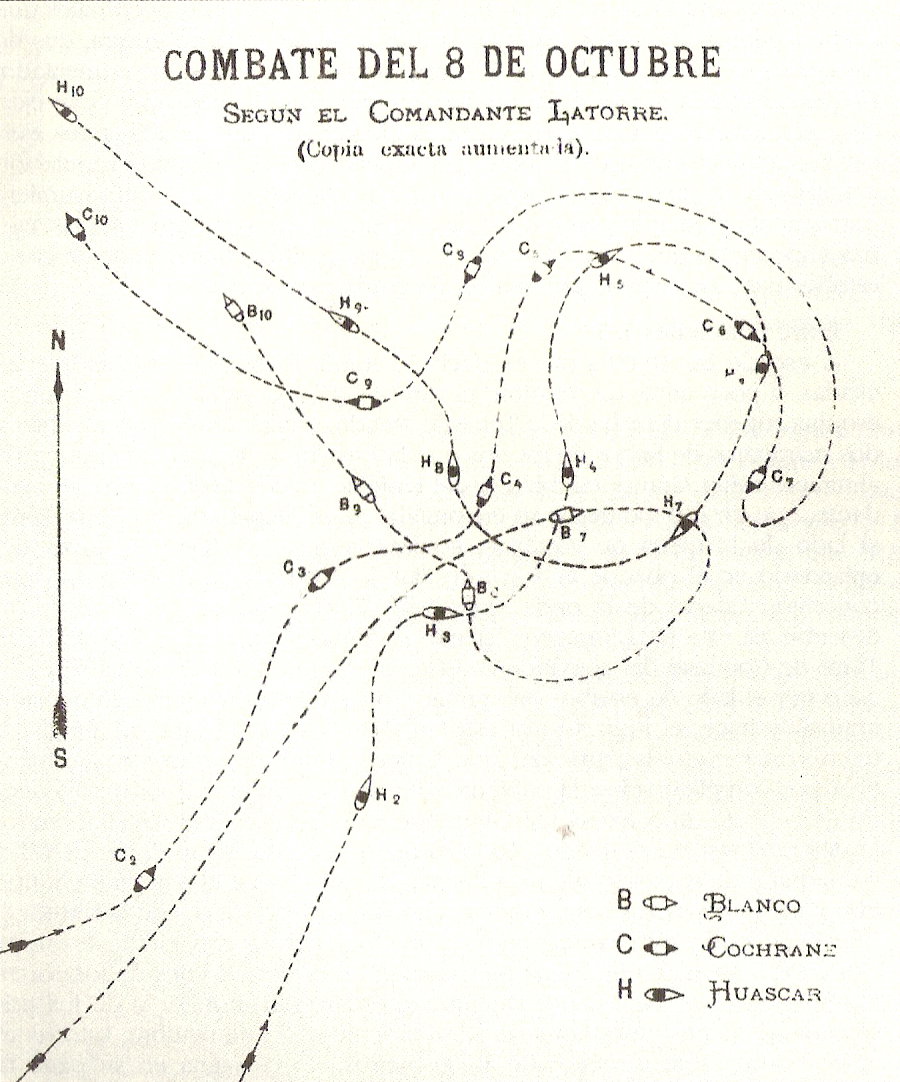
After Peru lost the armored frigate Independencia at the Battle of Punta Gruesa in May 1879, Grau found himself commanding the only serious Peruvian warship left afloat. Rather than risk a direct confrontation with Chile's numerically superior fleet, he turned the Huascar into a raider. Over the following months, the monitor sank or captured 14 Chilean transports, one of them carrying an entire cavalry regiment. The humiliation enraged Chilean public opinion and cost fleet commander Juan Williams Rebolledo his commission. His replacement, Commodore Galvarino Riveros Cardenas, inherited a fleet that needed nearly a month of repairs before it could sail again. When the government ordered Riveros to hunt down the Huascar at all costs, he devised a new approach. Rather than chasing Grau in a single formation, he split his ships into two divisions. The slower group, under his own command aboard Blanco Encalada, would hug the coast. The faster division, led by Captain Juan Jose Latorre aboard Almirante Cochrane, would patrol 35 kilometers offshore, forming a barrier.
The Trap Closes
On the night of October 7, Grau sailed southward along the Chilean coast with Huascar and the corvette Union. Spotting the lights of Antofagasta, he decided to probe the port for targets. Finding the bay empty, the two Peruvian ships resumed their northward course at 3:00 a.m. on October 8. At the same hour, lookouts on Blanco Encalada spotted two smoke columns on the horizon. Grau saw three. Both sides recognized each other, and the Peruvian ships turned south. Riveros deliberately slowed his division, tempting Grau to think he could swing back north and run for Peru. At 5:40 a.m., the Peruvian ships took the bait, turning northward. Riveros then increased speed to close the distance. When Grau's lookouts spotted fresh smoke columns ahead at 7:15 a.m., it was Latorre's division cutting off the escape route. The corvette Union, capable of 13 knots, broke away to the northeast and escaped. The slower Huascar had no such option.
Three Hours Under Fire
Grau opened fire on Almirante Cochrane at 9:25 a.m. off Punta Angamos. Latorre held his fire, closing to 2,200 meters before his three starboard Armstrong cannons unleashed armor-piercing Palliser rounds, the first combat use of such anti-armor projectiles. The effect was devastating. The very first shot pierced Huascar's turret and wounded all twelve crew members manning the 300-pound guns. Another round perforated the armor above the waterline, severing the rudder chain and leaving the monitor adrift. The crew rigged an emergency rudder within ten minutes. At 10:00 a.m., a shell struck the bridge cabin, killing Grau and his adjutant Diego Ferre. Command passed to Captain Elias Aguirre. Ten minutes later, intense gunfire shot Huascar's flag from its hoist. Latorre ordered a ceasefire, believing the ship had surrendered, but an unknown officer re-hoisted the colors and the fight resumed. When Blanco Encalada arrived at 10:22, fire from both Chilean ironclads killed nearly everyone inside the turret, including Aguirre. Lt. Pedro Garezon, now in command, ordered the ship scuttled. Before the seacocks could finish their work, Chilean boarding parties swarmed aboard at 11:08, plugging the leaks with 1.2 meters of water already in the engine room.
A Flag That Never Came Down
When Garezon surrendered the crippled Huascar to the Chilean officers who boarded her, he made a point of clarification. The Peruvian flag lay on the deck, its chain cut through by enemy fire. It had not been hauled down in surrender. The ship had not capitulated; it had simply been overwhelmed. A Chilean officer acknowledged the distinction, noting that a similar thing had happened to the Chilean ship Magallanes. It was a small gesture of mutual respect amid the carnage. Of the battle's broader consequences, there was no ambiguity. With Huascar captured and Independencia already lost, Peru's naval power was broken. Chile controlled the Pacific coast unchallenged, cutting off Peru and Bolivia from resupply by sea. The land invasion of Peru's Tarapaca department began weeks later, and Chilean forces marched into Lima in January 1881.
A Museum That Once Fought
Chile repaired the Huascar and pressed her into service under the Chilean flag. She served for decades before decommissioning, and today sits as a floating museum in the port of Talcahuano. Visitors can walk the decks where Grau commanded his raids and where Palliser rounds tore through iron plate. The turret, rebuilt after the battle, still bears the geometry of its original design. For Peruvians, the ship is both a shrine and a wound. Grau is regarded as Peru's greatest naval hero, and the holiday commemorating Angamos is one of the nation's most solemn. The battle demonstrated what European observers already suspected: that armor-piercing ammunition and rotating turrets with large-caliber guns were the future of naval design. Reports on the engagement appeared in military journals across Europe and America, influencing warship construction in the years before the dreadnought era reshaped everything again.
From the Air
Punta Angamos is at approximately 23.00°S, 71.00°W, about 80 km north of Antofagasta on the Chilean coast. The headland is visible from altitude as a prominent coastal feature. Cerro Moreno International Airport (SCFA) in Antofagasta is the nearest major airport. The coastline runs north-south with open Pacific to the west and the Atacama Desert rising sharply to the east. Conditions are typically clear and dry.